
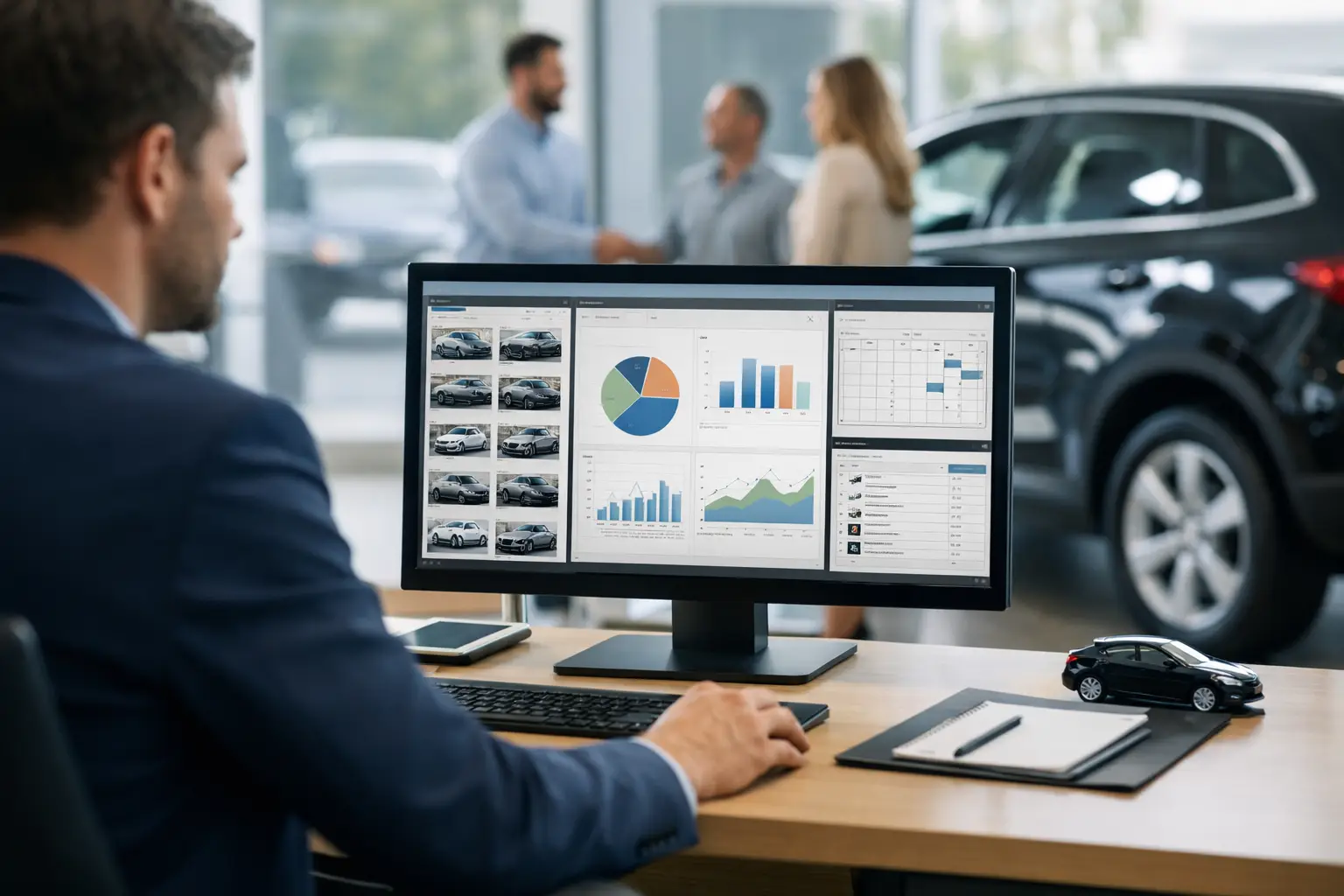
When a service adviser is chasing workshop status in one system, parts are checking stock in another, and finance is reconciling contracts from spreadsheets, the dealership is already paying for fragmentation. An integrated dealership management platform changes that by giving equipment, machinery, and capital-goods dealers one operational system across sales, service, parts, rental, and finance.
For dealerships with multiple revenue streams, disconnected software does more than create admin. It slows quoting, creates stock blind spots, weakens service planning, and makes it harder for managers to trust the numbers in front of them. The real issue is not whether each department has a tool. It is whether the whole business can operate from a single source of truth.
What an integrated dealership management platform actually does
An integrated dealership management platform is not just an accounting package with a few dealership add-ons. It is a dealership-specific operating system built around how equipment dealers run day to day. That means customer records, machine history, service jobs, parts inventory, rental availability, finance activity, and operational reporting all sit within the same environment.
This matters because dealership processes rarely stay within one department. A sales deal may involve a trade-in, workshop preparation, parts allocation, rental substitution, and finance approval. If those steps sit across separate tools, staff spend their time rekeying data, checking details twice, and fixing avoidable errors. If those functions sit inside one platform, the handover from one team to the next becomes far more controlled.
The value is not only efficiency. It is visibility. Leaders can see what is happening across the business without waiting for manual reports or chasing updates from each department.
Why fragmented systems hold dealerships back
Many dealerships did not choose fragmentation on purpose. It usually develops over time. A legacy DMS handles one set of functions, another platform is added for finance, the workshop uses a separate tool, rental is managed elsewhere, and reporting ends up in spreadsheets. Each system may do its individual job reasonably well, but the dealership as a whole becomes harder to manage.
The first problem is duplicated data. Customer details, machine records, and contract information are entered multiple times in multiple places. That creates inconsistencies, and inconsistencies lead to operational mistakes.
The second problem is slow decision-making. If parts demand, service capacity, rental utilisation, and sales pipeline all live in separate systems, managers cannot get a clean operational view without someone manually pulling the information together. By the time the report is ready, it may already be out of date.
The third problem is scale. What works for a single branch often starts to break under the pressure of multi-branch operations, growing rental fleets, larger service teams, and more complex financial controls. Fragmented systems rarely improve with complexity. They usually expose more gaps.
Where integration delivers the biggest operational gains
The strongest case for an integrated dealership management platform is in the handoffs between departments. That is where delays, mistakes, and margin leakage often sit.
Sales, service, and parts in one workflow
When sales and aftersales are connected, machine preparation is easier to manage, service history is visible during the sales process, and parts demand can be linked directly to workshop activity. Staff are not relying on calls, emails, or side notes to move a unit through the business.
That improves customer experience, but more importantly, it improves internal control. A dealership can track what has been promised, what has been booked, what parts are required, and what remains outstanding.
Rental and workshop coordination
Rental operations put pressure on availability, maintenance scheduling, damage tracking, and billing accuracy. If rental sits outside the core system, it becomes harder to manage fleet status alongside workshop workload and parts consumption.
In an integrated model, rental equipment can be managed with the same operational visibility as other dealership assets. That helps teams schedule servicing at the right time, reduce avoidable downtime, and keep billing aligned to actual equipment movements and contract terms.
Finance and operational data aligned
Finance teams need more than an export from operational systems at month end. They need confidence that transactions, contracts, costs, and revenue events are being captured accurately as the business runs.
A connected finance function reduces reconciliation effort and gives leaders better visibility into margins, outstanding work, asset position, and branch performance. It also supports stronger governance, which matters more as the dealership grows.
What to look for in an integrated dealership management platform
Not every integrated platform is equally suited to complex dealerships. Some products combine functions on paper but still feel like separate modules bolted together. Others are built for generic distribution or retail businesses and fall short once dealership-specific requirements come into play.
A strong platform should reflect the realities of equipment and machinery dealerships. That includes machine-centric records, workshop operations, parts control, rental workflows, and finance capability that supports the commercial structure of the business.
It should also support role-based visibility. A service manager, parts manager, rental coordinator, and finance administrator do not need the same screens or the same reporting priorities. Integration should simplify work, not bury teams in irrelevant data.
Reporting is another practical test. If managers still need offline spreadsheets to understand WIP, stock movement, rental utilisation, or branch performance, the platform may not be delivering the level of control it should.
The trade-offs dealers should consider
There is a reason some dealerships stay with disconnected systems longer than they should. Replacing core software is not a small decision. It affects process, people, reporting, and day-to-day discipline.
An integrated dealership management platform brings standardisation, but that can expose inconsistent practices across branches or departments. For some businesses, that is exactly the point. For others, it creates short-term friction because legacy workarounds can no longer hide inside separate tools.
Implementation also requires clear ownership. Integration does not fix weak process design by itself. If a dealership has unclear approval paths, poor data habits, or inconsistent inventory controls, the new system will surface those issues quickly. That is a positive outcome in the long run, but it does require commitment from leadership.
There is also the question of fit. A platform built for heavy equipment, machinery, and capital-goods dealerships will usually serve these environments better than generic business software. The trade-off is that specialist systems are chosen for operational depth, not broad consumer-market familiarity. For serious dealerships, that is generally the right compromise.
Why dealership-specific design matters
A dealership is not a standard wholesaling business with a workshop attached. It is a mix of asset sales, service labour, parts movement, rental activity, warranty processes, and finance administration, often spread across branches and teams with different priorities.
That complexity is exactly why generic ERP or accounting software often struggles. It may manage ledgers well enough, but it usually needs significant workarounds to support machine lifecycle visibility, workshop scheduling, rental status, or dealership-specific reporting.
A purpose-built platform is designed around those operational realities from the outset. That changes the quality of decision-making because the system mirrors the business more closely. Instead of forcing dealership operations into generic structures, it supports the way the dealership actually works.
For Australian dealers under pressure to improve efficiency, reduce duplication, and gain tighter operational control, that distinction matters. It affects adoption, reporting confidence, and the ability to scale without adding more administration.
A better standard for operational control
The strongest software decisions are rarely about adding more features. They are about reducing friction across the business. An integrated dealership management platform gives dealerships a cleaner operating model, where sales, service, parts, rental, and finance are connected rather than managed as separate islands.
That does not mean every process becomes simple overnight. Complex dealerships will always have moving parts. But when the system is built for dealership complexity, teams spend less time chasing information and more time acting on it. For businesses ready to replace legacy sprawl with tighter control, that is a far better place to run from.