
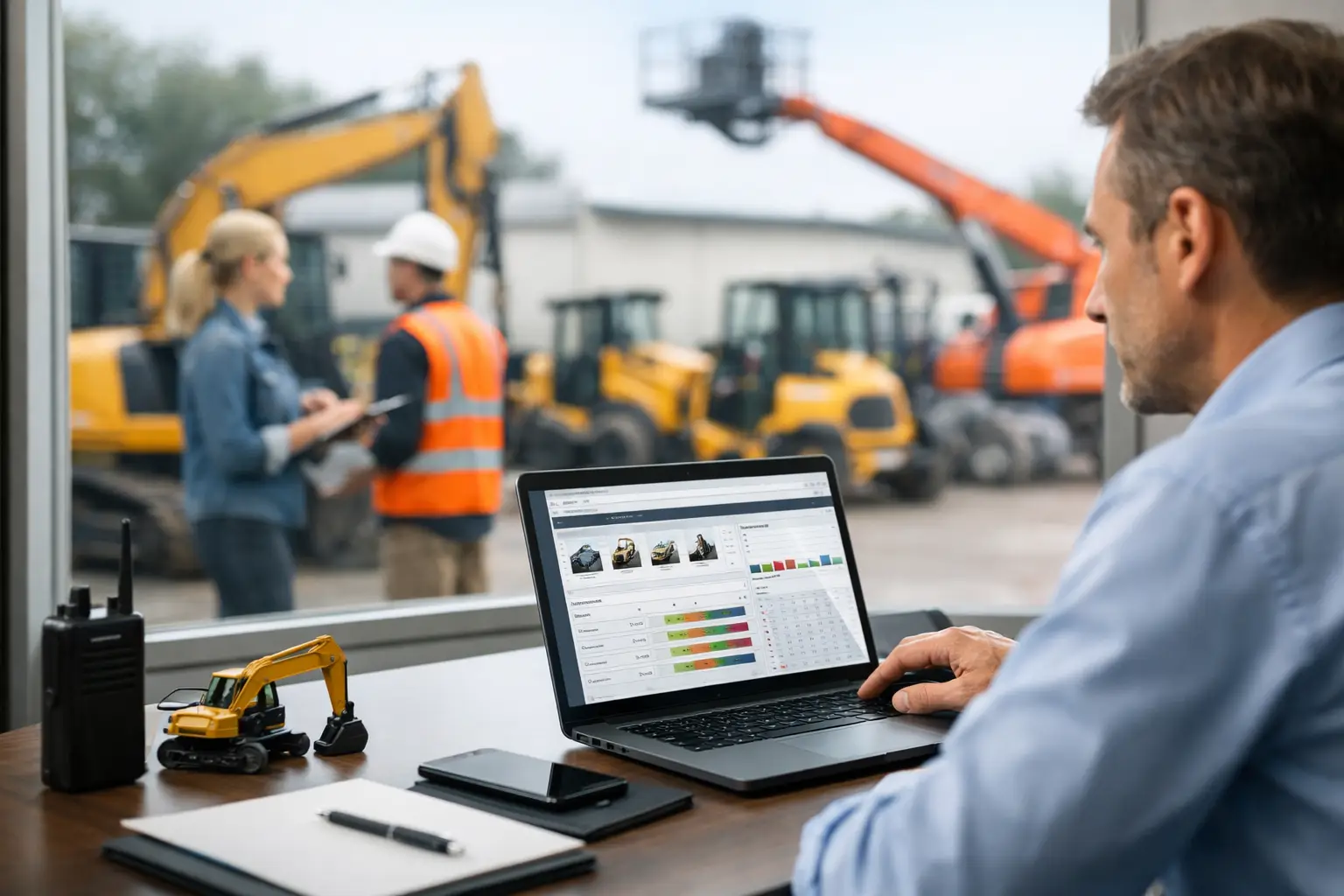
A machine comes back from hire needing inspection, a customer wants to extend the contract, finance needs the next invoice raised, and the service team has already booked the unit for maintenance. If those events sit in different systems, rental slows down fast. That is why rental management software for equipment dealers matters - not as a standalone tool, but as part of a working dealership operation.
For equipment and machinery dealers, rental is rarely a simple side activity. It sits between sales, service, parts and finance, and it depends on accurate asset visibility every hour of the day. When rental teams are managing contracts in one system, workshop activity in another, and invoicing in spreadsheets or accounting software, mistakes become normal. Double-booked assets, missed charges, late returns, unclear damage history and weak utilisation reporting all follow.
What rental software needs to do in a dealership
A dealer rental business is different from a general hire operation. The asset base is more complex, service requirements are tighter, and the commercial model often overlaps with sales, parts supply and workshop labour. That changes what good software looks like.
Rental management software for equipment dealers should start with asset control. Teams need to know what is available, what is out on rent, what is reserved, what is in transit and what is in the workshop. That sounds basic, but many dealerships still rely on whiteboards, spreadsheets or disconnected modules that do not reflect reality quickly enough.
Contract management is the next pressure point. Rental agreements need to be raised quickly, updated when terms change, and connected to the right customer, machine, rate structure and billing cycle. If off-rent dates, extensions, damage notes or transport charges live outside the system, the admin burden rises and revenue leaks out in small but constant ways.
Then there is billing. Rental income is only as clean as the data behind it. Meter readings, damage, consumables, freight, overtime usage and agreed service inclusions all affect what should be invoiced. A rental system that cannot carry those details through to finance creates rework for admin staff and disputes for customers.
Why disconnected tools fail rental teams
The core issue is not that each department has software. It is that each department has different software with different data. Rental feels the impact first because it depends on live coordination across the dealership.
If the workshop books a machine for service but rental cannot see it, the unit may still be promised to a customer. If parts are issued against an asset and that history does not flow through, the true cost of that asset is hidden. If finance raises invoices from incomplete contract data, revenue recognition and customer trust both suffer.
This is where many dealers hit a ceiling. A basic rental package may handle bookings and contracts, but it does not manage the wider dealership context. A generic ERP may manage finance, but it does not understand workshop scheduling, asset maintenance triggers or machine-specific rental workflows. The result is familiar - duplicate entry, workarounds and poor visibility.
The case for one integrated rental platform
For dealership businesses, rental works best when it is part of a broader dealer management system rather than bolted onto one. That approach gives every department access to the same operational record.
When rental, service, parts and finance sit in one platform, asset status becomes more reliable. A machine can move from available to on-rent, then into inspection or workshop activity, without someone manually updating three systems. Contract information can feed billing directly. Workshop costs can be attached to the asset history. Parts usage can be traced against maintenance or damage events. Managers can see utilisation and margin without waiting for manual reporting.
This is not just an efficiency gain. It changes control. A dealer principal or operations manager can see how rental is performing as part of the whole business, not as a separate spreadsheet exercise. That matters when rental fleet decisions affect workshop load, parts demand and capital planning.
What to look for in rental management software for equipment dealers
The right system should reflect how heavy equipment and capital-goods dealerships actually operate. That means more than a booking calendar and invoice screen.
Start with fleet visibility. You need clear, current status by asset, location and branch, along with utilisation reporting that is credible enough to support purchasing and disposal decisions. If the system cannot show why a unit is unavailable, teams will still be chasing answers by phone and email.
Look closely at service integration. Rental assets need inspections, preventive maintenance and repair control. A system that treats service as an external process will create avoidable downtime. Ideally, rental and workshop teams should be working from the same asset record, with maintenance triggers and work order history available in context.
Parts integration matters for the same reason. Rental assets consume parts, and those costs should not disappear into general workshop overhead. If parts usage against a machine is visible, dealers can better understand true asset profitability and recurring fault patterns.
Finance integration is equally important. The software should support contract billing, recurring charges, variable usage charges and adjustments without forcing the finance team to rebuild data manually. Strong rental administration depends on reliable billing logic and clean handover to accounts.
Finally, assess customer and commercial flexibility. Equipment dealers often manage dry hire, wet hire, short-term rentals, long-term agreements, rent-to-purchase arrangements and customer-specific pricing. A system that only handles one rental model neatly may become a constraint as the business grows.
The trade-off between specialist and generic systems
Not every dealership needs the same level of rental capability. A smaller operation with a limited fleet may cope for a time with lighter tools. But there is usually a point where simpler software stops saving money and starts creating operational drag.
Generic rental software can look attractive because it is easier to compare and may appear cheaper upfront. The problem is that it often assumes rental is the whole business. Equipment dealers know it is not. Rental sits alongside workshop scheduling, parts supply, machine sales, field service and finance administration. If the software does not understand that structure, internal friction returns.
On the other hand, a dealership-specific platform may involve more rigorous implementation because it touches more departments. That is a fair trade-off to consider. Broader integration requires clearer process design and stronger internal ownership. But for multi-branch or growth-focused dealers, that effort usually produces better control than trying to connect separate systems indefinitely.
Signs your dealership has outgrown its current rental process
There are a few obvious indicators. One is when staff spend too much time checking asset availability manually. Another is when contract changes regularly fail to reach finance accurately. A third is when service and rental teams argue about machine status because neither trusts the system.
Less obvious signs are just as important. If managers cannot confidently report utilisation by fleet segment, if maintenance costs are hard to attribute to specific assets, or if rental profitability is being estimated rather than measured, the system is not giving the business enough control.
This often shows up in customer experience as well. Slow quote turnaround, inconsistent invoicing and uncertainty around off-rent condition are not only admin issues. They affect retention and margin.
A better decision framework for buyers
When assessing rental management software for equipment dealers, the key question is not which system has the longest feature list. It is whether the platform fits the operating model of an equipment dealership.
Ask how asset status is managed across rental and workshop activity. Ask whether parts, labour and maintenance costs can be traced at machine level. Ask how contract data reaches finance and what still depends on manual intervention. Ask whether reporting gives branch managers and executives the same version of the truth.
The best software decision is usually the one that reduces handoffs, duplicate entry and uncertainty between departments. In practical terms, that means choosing a platform built for the complexity of equipment dealerships, not software that treats rental as an isolated function. For dealers looking to modernise, that is where a specialist system such as MDMS has a clear advantage.
Rental performance is not only about keeping machines on hire. It is about controlling the movement of assets, information and revenue across the entire dealership. When the system matches that reality, rental becomes easier to scale and much harder to lose sight of.