Service Management Tools List for Equipment Dealerships
By MDMS Team · 10 July 2026

Service Management Tools List for Equipment Dealerships
Service management tools are defined as unified platforms that connect service workflows, asset tracking, and operations management into a single system. For equipment dealerships and rental businesses in Australia, the right platform directly determines how fast your team closes work orders, tracks assets, and recovers revenue from the field. 91% of organizations using AI in service management report measurable ROI, with 26% seeing significant returns from productivity gains alone. That number matters because it shifts the conversation from “should we invest?” to “which platform fits our operation?”
What features should equipment dealerships prioritize in a service management tools list?
The features that matter most for equipment dealerships are not the same ones that matter for IT help desks. Your operation runs on work orders, serial numbers, rental contracts, and parts availability. A platform built for generic ticketing will not map cleanly to those workflows.
Prioritize these capabilities when evaluating any service management platform:
- Modular architecture: Modular tools deploy service desks in days, not months. This matters when your team cannot afford a six-month implementation project.
- AI-driven automation: Ticket categorization, job prioritization, and autonomous workflow routing reduce the manual load on service coordinators. AI accuracy depends heavily on the quality of your internal data, so clean asset records are a prerequisite.
- Role-based access and audit trails: Operational governance features like audit trails and role-based permissions determine real-world effectiveness far more than a feature checklist does.
- Integration with existing databases: Your platform must connect to your parts catalog, customer records, and asset register. Without that, data travels twice and errors multiply.
- Pricing transparency: Advanced AI features almost always add licensing costs beyond the base subscription. Budget for this upfront.
Pro Tip: Before you evaluate any platform, map your current service workflow on paper. Identify where jobs stall, where data gets re-entered, and where your team loses time. That map becomes your requirements document.
Top 10 service management tools for equipment dealerships and rental businesses
The following platforms represent the categories most relevant to equipment dealerships and rental operations. Each is described by its functional profile rather than marketing claims.
1. Purpose-built dealer management systems
Platforms in this category, like Moderndms, are designed specifically for equipment dealerships. They unify service, parts, rental, and finance in one system. Setup takes under an hour, and the modular design means your team adopts features at their own pace. Integration with accounting platforms like Xero removes double-entry from the finance workflow.

2. Enterprise ITSM platforms
These platforms offer deep workflow automation, ITIL-aligned processes, and extensive reporting. They suit large dealership groups with dedicated IT administrators. The trade-off is a long implementation timeline and high-maintenance admin requirements that increase total cost of ownership significantly.
3. Mid-market field service platforms
Mid-market options target businesses with 10–100 field technicians. They typically include scheduling, mobile job cards, and basic asset tracking. They lack the parts management depth that equipment dealerships need, but they work well for rental businesses with straightforward fleet management needs.
4. AI-powered service operations platforms
The shift toward ServiceOps unifies service, asset, and operations management with AI to reduce tool sprawl. These platforms automate ticket routing, predict asset failures, and generate service reports without manual input. They are best suited to dealerships that already have clean, standardized data.
5. Cloud-based help desk tools with field extensions
Entry-level cloud platforms offer basic ticketing, customer communication, and scheduling. Pricing starts as low as $19 per agent per month. They work for very small operations but lack the asset lifecycle management and rental fleet tracking that growing dealerships require.
6. Rental fleet management platforms
These tools focus on contract management, fleet availability, and utilization reporting. They integrate with telematics systems and handle billing cycles for short-term and long-term rentals. They do not typically include service workshop management, so dealerships often run them alongside a separate service platform.
7. Parts and inventory management systems
Standalone parts platforms manage purchase orders, bin locations, and supplier catalogs. They are strong in inventory control but require integration with your service platform to connect parts usage to work orders. Without that link, your team still runs a scavenger hunt every time a technician needs a part.
8. Workshop management systems
Workshop-specific tools handle job cards, technician time tracking, and service history by serial number. They are purpose-built for the service bay rather than the front office. The best ones connect directly to your parts system and customer database so that a work order carries all relevant information from open to close.
9. ERP platforms with service modules
Large ERP systems include service management as one module among many. They offer broad data visibility across the business but require significant configuration to match equipment dealership workflows. Implementation projects commonly run six months or longer, and customization costs add up quickly.
10. Modular dealer management systems with rental integration
This category combines rental management with service and parts in a single platform designed for equipment businesses. The modular approach means you can activate rental contract management, workshop scheduling, and parts ordering independently. This reduces the risk of paying for features your team does not yet use.
Pro Tip: Ask every vendor for a live demo using your own data scenarios. A platform that looks clean in a scripted demo may fall apart when you enter a real work order with multiple serial numbers and a parts backorder.
How do pricing models and deployment timelines impact tool selection?
Pricing for service management platforms varies widely. Entry-level platforms start at around $19 per agent per month, while mid-market platforms average $58 per agent per month for teams of comparable size. Enterprise platforms often price by module or by site, making total cost harder to calculate upfront.
| Pricing tier | Typical cost range | Deployment time | Best fit |
|---|---|---|---|
| Entry-level | $19–$35/agent/month | Days | Small dealerships, basic workflows |
| Mid-market | $36–$99/agent/month | Weeks | Growing dealerships, field teams |
| Enterprise | Custom pricing | Months | Large groups, complex integrations |
| Purpose-built DMS | Varies by module | Under 1 hour | Equipment dealerships, rental fleets |
Deployment timelines carry hidden costs that pricing tables never show. A platform that takes four months to implement requires your team to run two systems in parallel during the transition. That parallel operation creates errors, slows your service team, and burns staff time on data reconciliation.
Pro Tip: Request a total cost of ownership estimate, not just a per-seat price. Include implementation, training, admin staffing, and the cost of any AI features that sit behind an additional license.
How to match service management tools to your dealership’s operational profile
The right platform depends on your current operational complexity, your data quality, and how fast you need to be running. A small dealership with 5 technicians has different needs than a national rental group managing 500 assets across multiple depots.
Use these scenarios to identify where your operation sits:
- Small to mid-size dealerships needing fast setup: Choose a modular platform with a short deployment timeline. You need work orders, parts tracking, and customer records connected from day one. A platform that requires months of configuration will cost you more in lost productivity than it saves.
- Rental businesses with fleet complexity: Prioritize platforms that handle rental contracts, utilization reporting, and maintenance scheduling in one place. Disconnected systems mean your rental coordinator and your service team are always working from different versions of the truth.
- Dealerships planning to use AI automation: Data standardization is a prerequisite. Clean, consistent asset records and customer data are what make AI-driven workflows accurate. If your data is fragmented across spreadsheets and legacy systems, fix that before you invest in AI features.
- Large dealership groups with compliance requirements: Look for platforms with audit trails and role-based access built into the core product. These governance features protect your business during audits and reduce the risk of unauthorized changes to work orders or pricing.
- Businesses balancing budget and autonomy: Modular platforms let you start with the features you need now and add capabilities as your operation grows. This approach avoids the trap of paying for an enterprise platform that your team uses at 20% of its capacity.
The most common mistake in platform selection is choosing based on a feature list rather than operational fit. Choosing a tool based solely on feature checklists leads to poor outcomes. Workflow depth and governance controls determine whether a platform actually works in your service department.
Key takeaways
The most effective service management tools for equipment dealerships combine modular deployment, operational governance, and clean data integration to deliver measurable productivity gains.
| Point | Details |
|---|---|
| Prioritize governance over features | Audit trails and role-based access matter more than a long feature list. |
| Modular deployment reduces risk | Platforms that deploy in days let your team adopt at pace without disruption. |
| Data quality drives AI accuracy | Clean asset and customer records are required before AI automation works reliably. |
| Pricing hides real costs | Advanced AI features and admin staffing add significant cost beyond base subscriptions. |
| Match tools to your operational profile | Small dealerships, rental fleets, and large groups each need different platform characteristics. |
Why I think most dealerships pick the wrong platform
Most service managers I speak with arrive at a platform decision after a demo and a pricing call. That process almost always produces the wrong outcome. The demo shows the platform at its best. The pricing call shows the base rate. Neither reveals what happens when your team tries to close a work order that involves three serial numbers, a parts backorder, and a rental extension on the same job.
The platforms that survive real dealership conditions are the ones built around the actual workflow, not the ones with the longest feature list. I have seen operations invest in enterprise platforms that required a full-time administrator just to keep the system running. That overhead erases the productivity gains the platform was supposed to deliver.
My honest recommendation is to start with a modular platform that your team can configure without a consultant. Moderndms takes this approach directly. The system is built for equipment dealerships, not adapted from an IT help desk tool. You can activate workshop and service management on day one and add rental or parts management as your team is ready.
The other thing most articles skip is data readiness. Your platform is only as good as the data you put into it. Before you sign any contract, audit your asset records, your customer database, and your parts catalog. If those are fragmented, no platform will fix that for you automatically.
— Anthony
Moderndms for equipment dealerships: a practical next step
Moderndms is a dealer management system built specifically for equipment dealerships and rental businesses in Australia. It connects service, parts, rental, and finance in one platform, with setup completed in under an hour.
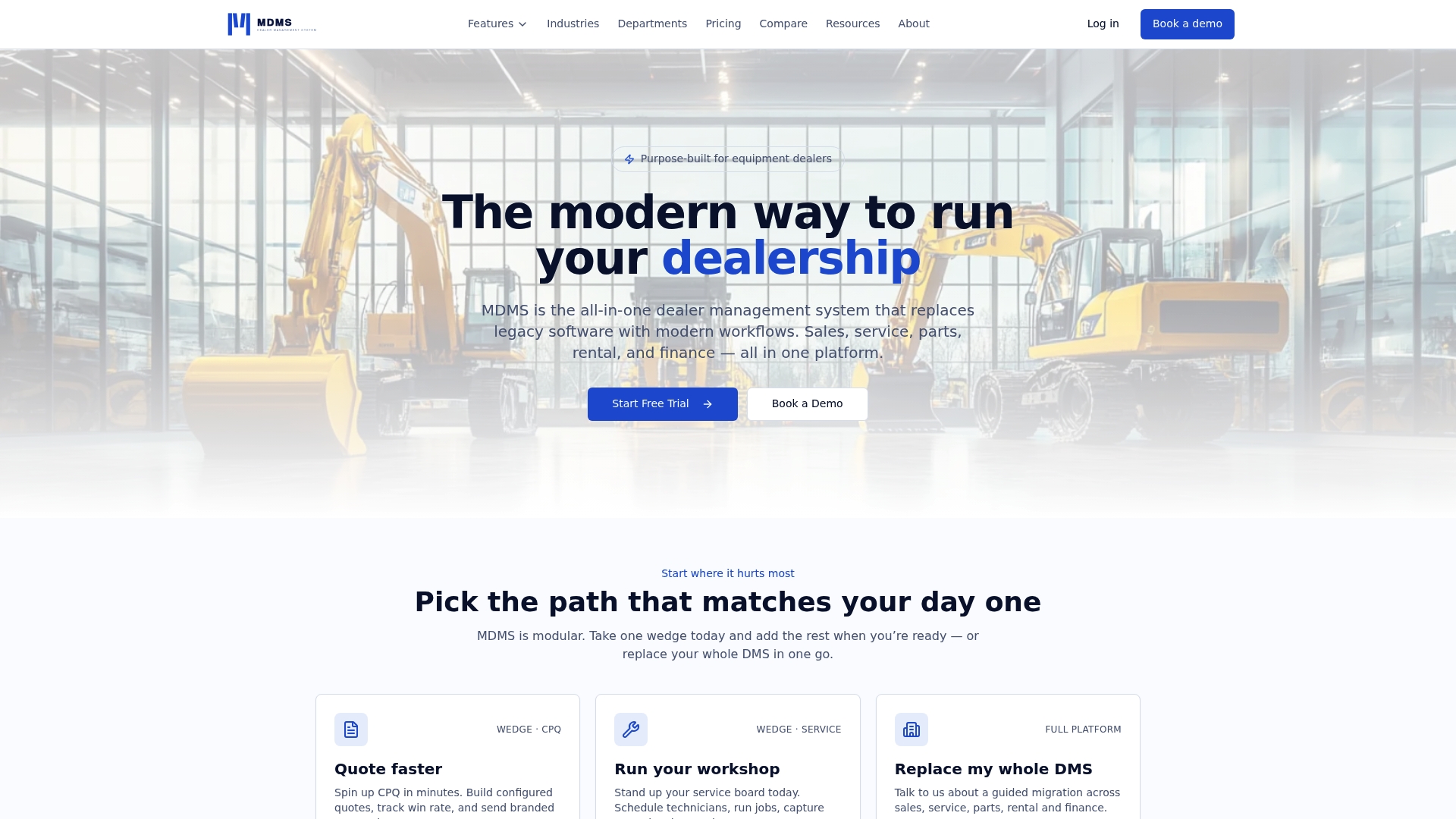
Your team can activate heavy equipment dealer management features modularly, starting with the workflows that matter most right now. The system integrates with Xero, maintains complete data ownership with no lock-in, and gives your service coordinators a single place to manage work orders, serial numbers, and rental contracts. Dealerships using Moderndms report saving up to 10 hours per week in administrative tasks. If your current platform requires a workaround for every second job, that is the clearest sign it was not built for your industry.
FAQ
What is a service management tools list for equipment dealerships?
A service management tools list is a curated set of platforms that manage work orders, asset tracking, parts, and rental workflows for equipment businesses. The best lists prioritize modular deployment, operational governance, and integration with existing dealership data.
How do I choose between entry-level and enterprise service management platforms?
Entry-level platforms suit small dealerships needing fast setup and basic workflow management. Enterprise platforms fit large groups with complex integrations but require dedicated administrators and longer implementation timelines.
Do AI features in service management tools actually deliver ROI?
Yes. 91% of organizations using AI in service management report measurable ROI. AI accuracy depends on clean internal data, so data standardization must come before AI activation.
What is the typical cost of service management software for dealerships?
Pricing ranges from approximately $19 to $99 per agent per month depending on features and platform tier. Advanced AI capabilities typically add licensing costs beyond the base subscription price.
How fast can a modular service management platform deploy?
Modular platforms deploy fully functional service desks in days. Traditional enterprise platforms commonly take months, which creates parallel-system costs during the transition period.