Top 6 CRM for Equipment Dealers Alternatives 2026
By MDMS Team · 12 July 2026
Top 6 CRM for Equipment Dealers Alternatives 2026
Managing sales, parts, rentals, and service from disconnected systems increases manual entry and slows operational visibility for equipment dealerships. Generic CRM tools lack inventory, deal sheet, and manufacturer integration, making them ineffective for multi-location dealership workflows. This comparison shows which dealer management platforms tie together sales, inventory, and service so your team can match the best fit by operational scope.
Table of Contents
- Modern Dealer Management System (MDMS)
- DealerCloud DMS
- Dealer Information Systems Corporation (DIS)
- Flyntlok
- Dealership Drive
- eBS Equipment Business Software Solutions
- Comparison of alternatives
Modern Dealer Management System (MDMS)
At a Glance
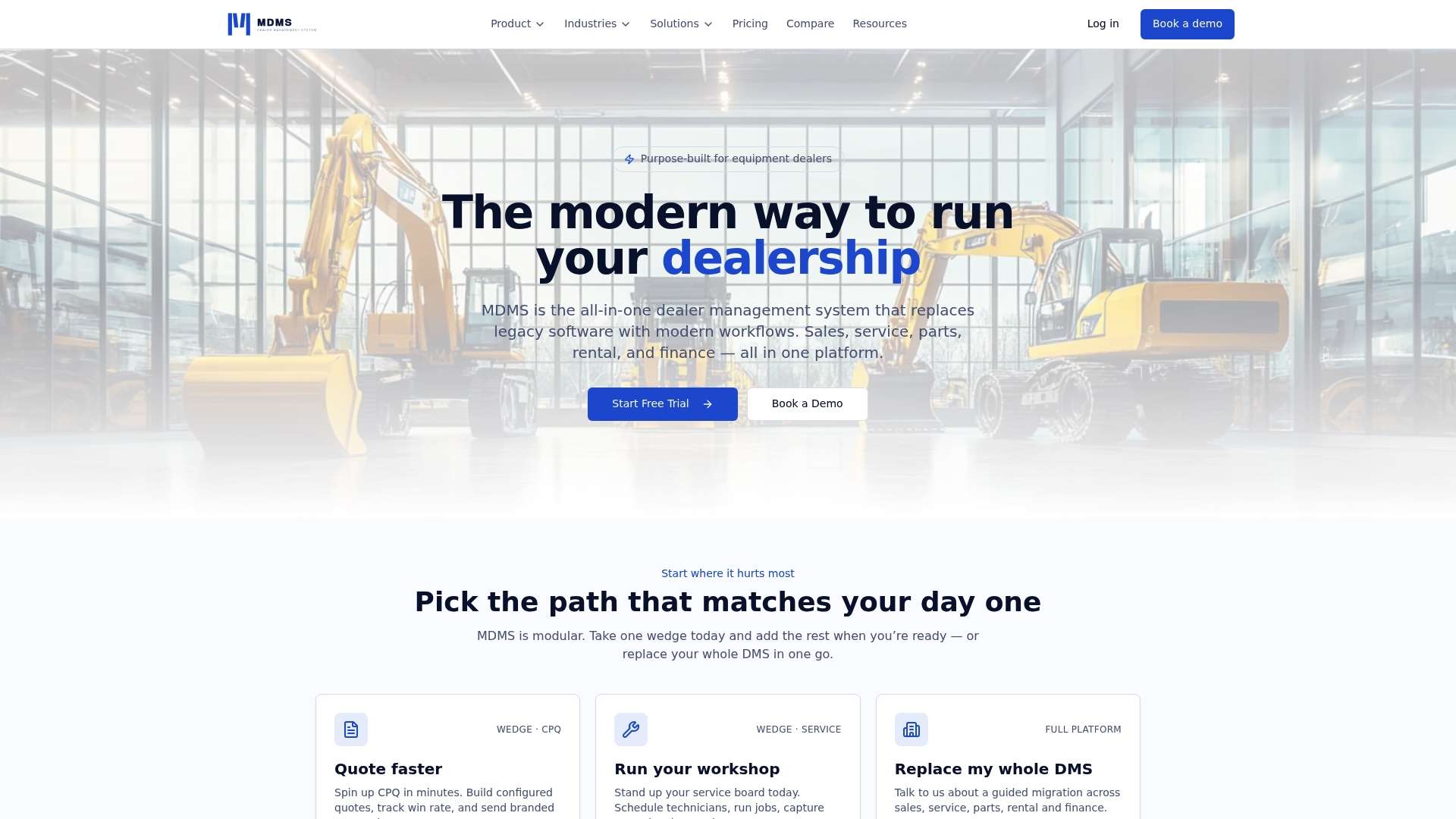
The vendor advertises a guided setup that can get a dealership live in under an hour with no implementation fees. MDMS targets Australian heavy equipment, construction, and agricultural dealers with modules for sales, service, parts, rental, warranty, and finance. The platform is cloud native and includes an offline mobile app and a branded customer portal.
Core Features
MDMS delivers a modular, customizable dealer management system that lets you add sales, workshop, parts, rental, warranty, and finance modules as needed. The system includes a visual sales pipeline with kanban and e signature, equipment lifecycle tracking with QR code history passporting, and a customer portal for quote signing and job status updates. Field technicians use an offline mobile app and supervisors get real time KPI dashboards and scheduled reports.
Key Differentiator
MDMS focuses on Australian specific compliance and data residency, plus no lengthy rollouts or implementation fees. Its invoicing handles Australian GST and it offers native Xero sync plus ABA payment file generation. That local alignment reduces accounting friction and keeps regulatory tasks in one platform for multi-branch dealerships.
Pros
The guided setup and module approach makes initial adoption low cost and fast for teams that want to phase modules in. According to the company, dealers report saves of up to 10 hours per week in administrative work thanks to consolidated workflows and the customer portal. Offline field capability keeps technicians productive away from the office and the parts system supports barcode scanning and inter branch transfers.
Cons
- Vendor reported satisfaction is high but independent third party reviews remain limited, so buyer discretion is advised
Notable Integrations
- Xero accounting
- MYOB
Who It’s For
MDMS fits Australian dealers that need a single platform for sales, service, parts, rental, warranty, and finance. It suits multi branch operations that require GST compliant invoicing and accountant friendly exports. Choose this if you need a cloud solution with offline field support and phased module adoption.
Unique Value Proposition
Complete data ownership without vendor lock in shifts procurement risk and gives dealers control over their records and exports. That arrangement lowers switching cost and supports modular adoption so you pay for only the modules you need. Combined with Australian compliance and accountant friendly exports, this setup reduces friction between operations and finance teams.
Real World Use Case
A regional machinery dealer replaced an aging system and used the guided setup to bring staff online quickly. Technicians use the mobile app for workshop jobs and rental inspections, while sales manage deal sheets and e signed quotes in the same system. Warranty claims and OEM correspondence travel with each asset via the history passport.
Pricing
Core modules start at A$59 per month each. Premium finance and fleet modules start at A$259 per month. Optional professional services and custom integrations are priced separately.
Website: https://moderndms.com.au
DealerCloud DMS
At a Glance
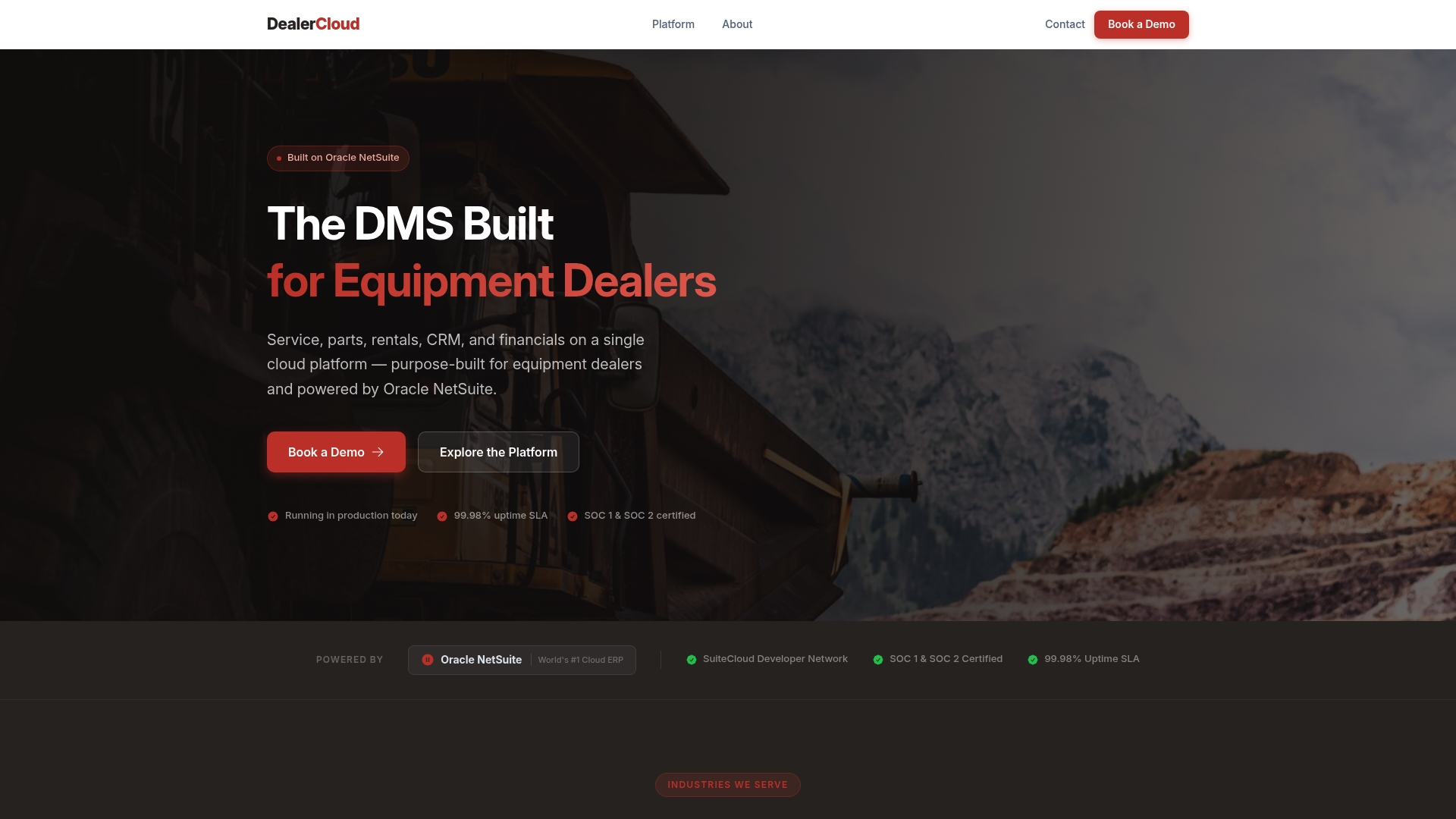
Built on Oracle NetSuite, DealerCloud unifies service, parts, rentals, CRM, and accounting in a single database for equipment dealers. The platform removes on premise servers and VPNs by using a cloud native architecture. That single source of truth surfaces real time operational and financial views across multiple locations.
Core Features
DealerCloud combines service, parts, rentals, CRM, and finance in one unified system, with built in Oracle NetSuite ERP and financial management. It provides real time dashboards and multi location inventory controls that support OEM feeds and automated replenishment. The vendor reports over 350 certified integrations to support e commerce, telematics, and supplier data feeds.
Key Differentiator
DealerCloud is built from the ground up on Oracle NetSuite’s cloud platform, giving dealers an enterprise grade backbone for accounting and multi entity financials. That architecture lets dealers scale transaction volumes without separate reconciliation layers. The NetSuite foundation also opens customizations through SuiteApps and APIs.
Pros
DealerCloud’s cloud native design simplifies remote access and removes on premise server maintenance for your IT staff. The unified data model cuts duplicate entry and reconciliation work between service, parts, and accounting. The built in ERP brings established financial controls and multi currency support to multi location operations. Strong SuiteApp and API options let your team customize workflows and connect telematics or e commerce platforms as needs grow.
Cons
- Implementation effort and cost can be high for smaller dealerships or teams with limited technical resources.
- The platform’s breadth creates a steep learning curve for staff moving from minimal legacy systems.
- Some users report a transition period when migrating from older DMS tools to the NetSuite based model.
When It May Not Fit
DealerCloud may not suit very small dealers that need a lightweight, low cost entry system. If your dealership lacks staff for a multi week implementation or prefers minimal configuration, this platform will likely feel heavy. New entrants with limited capital should expect higher upfront project scope.
Notable Integrations
- Oracle NetSuite SuiteApps for customization and financial extensions
- OEM supplier EDI and data feeds for inventory accuracy
- e Commerce platforms for online parts and equipment sales
- Telematics and IoT systems for utilization and remote diagnostics
Who It’s For
Mid sized to large equipment dealerships and multi location dealer groups that need unified operational and financial management. Teams that plan to integrate telematics, OEM feeds, and online sales channels will gain the most from this architecture.
Real World Use Case
A regional construction equipment dealer replaced a legacy DMS with DealerCloud and moved service schedules, parts stock, and accounting onto one database. They gained automated service scheduling, centralized inventory visibility, and integrated billing across entities. That consolidation reduced manual reconciliation and sped up month end close.
Pricing
DealerCloud does not publish standard pricing. Pricing is listed as informational only and typically varies by implementation scope and feature set. Contact the vendor for a custom quote and licensing details.
Website: https://dealerclouddms.com
Dealer Information Systems Corporation (DIS)
At a Glance
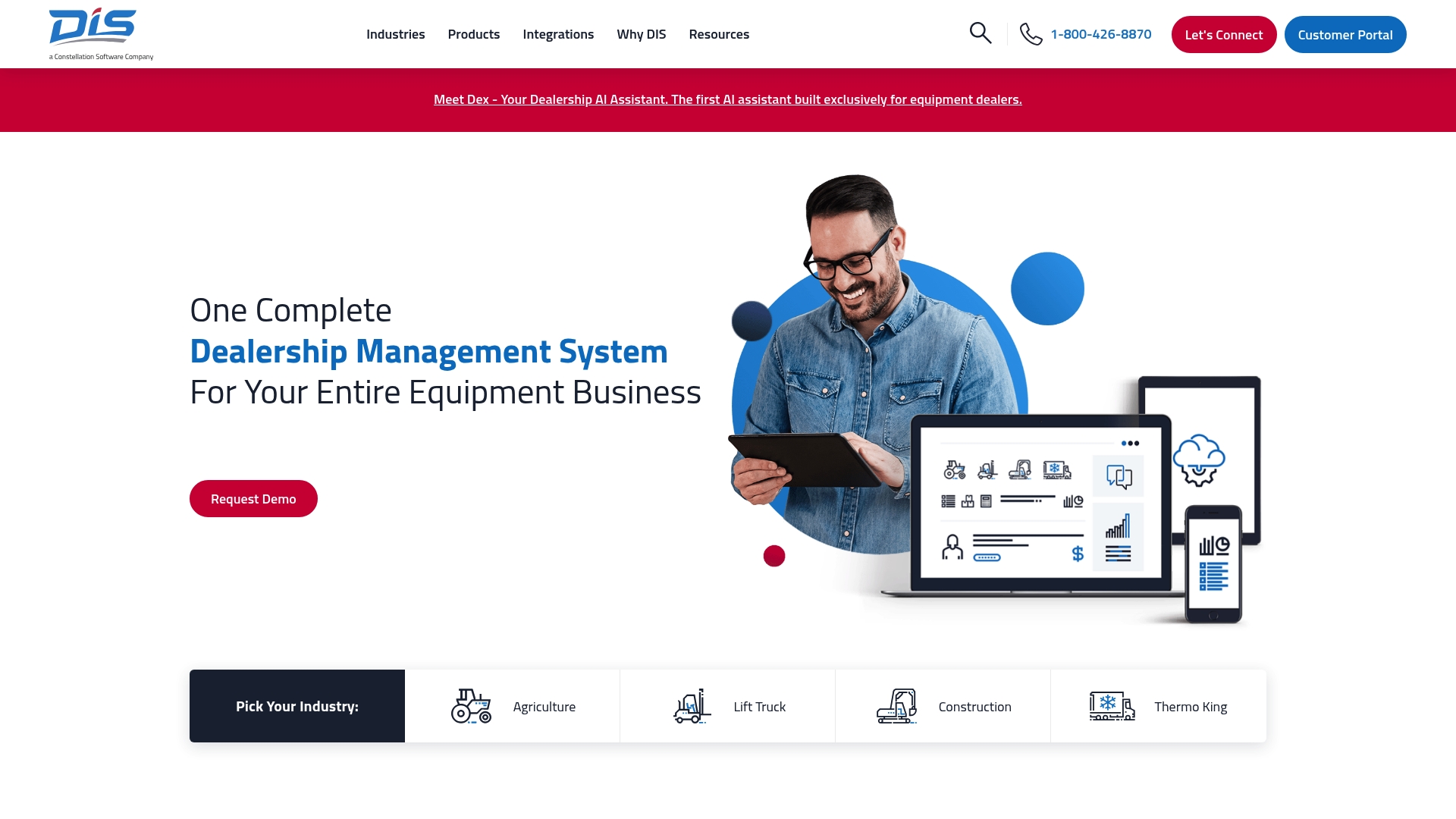
Founded in 1980, Dealer Information Systems Corporation has worked with dealers and manufacturers to shape its dealership management system. The product joined Perseus Group within Constellation Software Inc., which the vendor says strengthens long term support and development. Deployment is cloud based with browser and mobile access and modules for agriculture, construction, lift trucks, Thermo King, and materials handling.
Core Features
The DMS unifies inventory, CRM, service, rental, and accounting into a single system and includes a customer portal for end user access. It handles rental fleet management with automatic billing and ties parts ordering to inventory records. Manufacturer interfaces include the Kubota and CNH bundles and Activate OS ASIP integration for warranty and parts data.
Key Differentiator
The product emphasizes industry specific modules developed with dealer input and manufacturer partnerships. That focus shows up in workflows tailored for Thermo King, lift trucks, and agriculture operations. For multi location groups this targeted integration can reduce duplicate data entry across sites.
Pros
A single integrated suite covers sales, parts, service, rentals, and accounting, so teams work from the same records. Cloud deployment removes much on site infrastructure, and mobile access lets technicians view work orders and warranty details in the field. Long term dealer backing and direct manufacturer interfaces mean the system maps common equipment workflows and parts data.
Cons
- Webpage errors and missing pages suggest difficulty accessing current product documentation or demos.
- Pricing is not publicly disclosed, so you must request a custom quote for accurate cost comparisons.
- Migration from another DMS may be complex for dealers with legacy data formats.
- Public update cadence and recent product change visibility appear limited due to website availability issues.
When It May Not Fit
Smaller single location dealers with limited IT resources may find the system more complex than required. Dealers that need clear online pricing for budgeting will have to contact sales for a custom quote. If you require frequent public release notes or marketing updates, current website availability may slow your evaluation.
Notable Integrations
Notable integrations include direct manufacturer interfaces and an ASIP connection for parts and warranty exchanges.
- Kubota Interface Bundle
- CNH Interface Bundle
- Activate OS ASIP Integration
Who It’s For
This product fits multi location equipment dealership managers who need an industry tailored DMS. It suits groups that require manufacturer data feeds and consolidated parts and warranty workflows. Dealerships planning a phased rollout across sales, service, and rental departments will benefit from dealer input built into the system.
Real World Use Case
A regional construction equipment dealer used DIS to unify inventory, sales, service, and rental operations across multiple sites. That deployment reduced duplicate records and improved parts availability by centralizing procurement and billing. Technicians used mobile access to view and update work orders while on site.
Pricing
Pricing is not publicly listed and typically requires a custom quote from sales. The vendor advertises custom pricing based on selected modules, number of locations, and integration scope. Contact the company for a detailed proposal and implementation estimate.
Website: https://dis-corp.com
Flyntlok
At a Glance
Flyntlok connects directly to OEM systems such as John Deere and AGCO while offering AI driven campaigns for customer outreach. The system targets dealers handling outdoor power, heavy equipment, agriculture, and commercial vehicles. Flyntlok positions itself as a modern, cloud based dealer management option built around dealership workflows.
Core Features
Flyntlok combines Parts Management and Service Management with a cloud based DMS that covers sales, rentals, POS, and CRM. Accounting is exposed via iframes and external links rather than embedded ledgers, so finance teams use their chosen bookkeeping tools alongside the DMS. AI driven inventory helpers and campaign tools support targeted customer contact and ordering decisions.
Key Differentiator
Built from the ground up as a cloud native platform, Flyntlok emphasizes direct OEM connectivity and workflow alignment for equipment dealers. The vendor highlights integration with manufacturer data feeds and part lookup, which reduces manual reconciliation across systems. That focus on dealership specific workflows and external integrations separates it from general purpose CRMs.
Pros
Flyntlok delivers a dealer oriented feature set that keeps parts, service, rentals, and sales in the same application, which reduces duplicate data entry. The platform claims deep OEM links and third party integrations that let dealers pull serial level and parts data instead of recreating it manually. AI features help with campaign targeting and inventory decisions, which should reduce idle stock and improve follow up when used correctly.
Cons
-
No broad independent reviews appear publicly. Potential buyers must validate fit with their workflows and test migration paths.
-
Some detailed feature documentation and resources are available only behind links or gated content, making evaluation slower.
-
Implementation complexity will vary with existing infrastructure. Expect training and process change for staff moving from legacy systems.
When It May Not Fit
Flyntlok may not fit very small dealers with minimal parts volume who need a simple POS only solution. Dealers that require fully embedded accounting ledgers inside the DMS rather than external accounting links might find the approach limiting. Organizations with very limited IT resources may face a steeper learning curve during rollout and should plan for vendor or consultant support.
Notable Integrations
- John Deere
- AGCO
- Bobcat
- Volvo
- Hitachi
- Stihl
- Paccar
- Sage Intacct’,'QuickBooks
Who It’s For
Mid sized to large equipment dealerships that need a dealer focused DMS covering parts, service, rentals, and sales. Teams that value OEM integration and want to replace multiple disconnected legacy systems will see the most benefit. Dealers planning a staged migration and willing to train staff match the typical profile.
Real World Use Case
An outdoor power equipment dealer moved from several disconnected tools into Flyntlok and reported better inventory turnover and more consistent customer follow up. The dealer used the campaign tools to recover past sales leads and relied on OEM part lookups to cut order errors. Service and parts teams began sharing the same deal sheet and work order data instead of searching multiple systems.
Pricing
Flyntlok does not publish standard pricing. Pricing appears to be available by request or as part of a demo and will vary by dealer size, modules selected, and integration needs. Prospective buyers should request a tailored quote and a scope for implementation.
Website: https://flyntlok.com
Dealership Drive
At a Glance
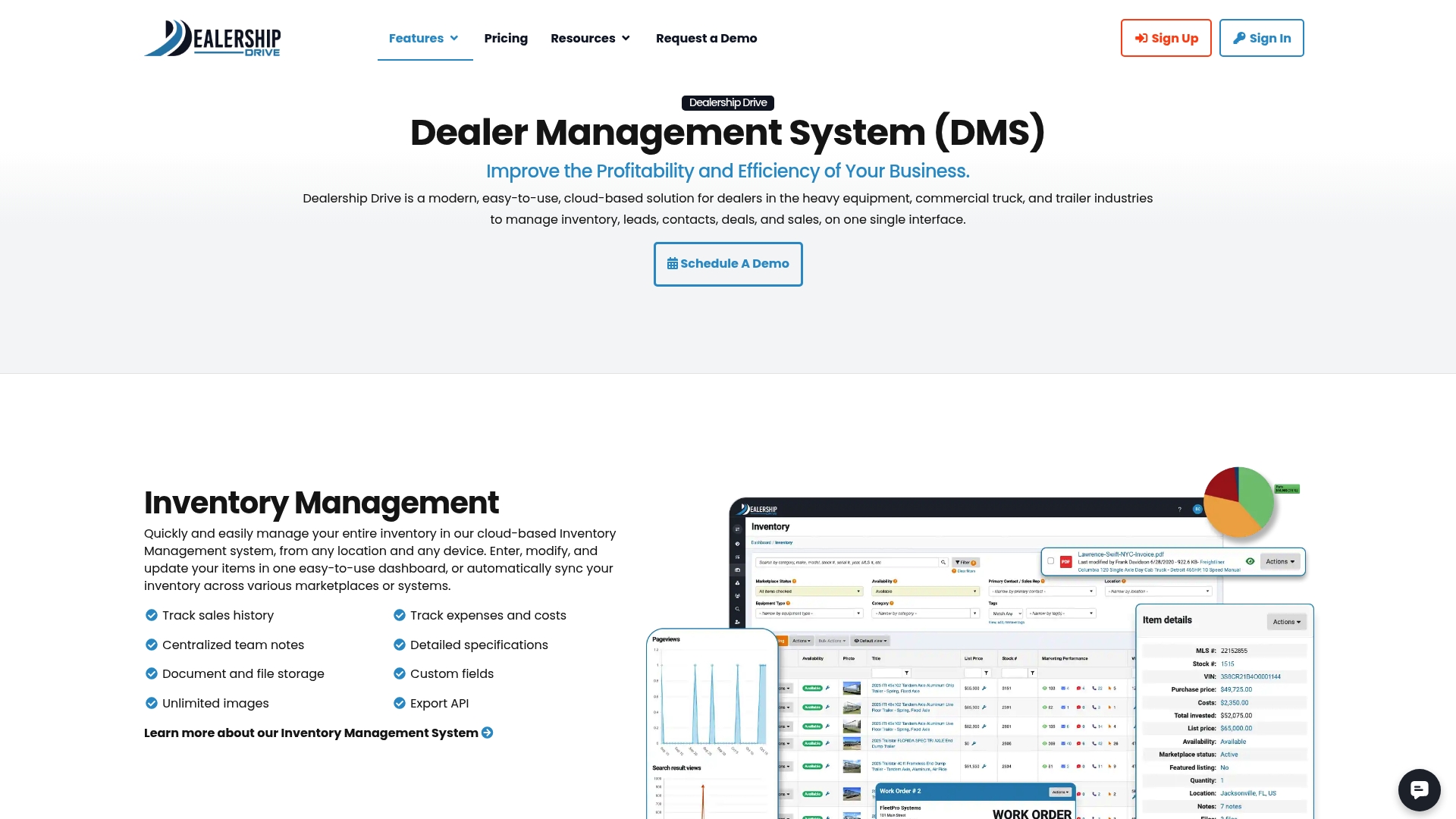
Real time inventory tracking across multiple locations is a central capability of Dealership Drive. The system targets heavy equipment, commercial truck, and trailer dealers and combines inventory, leads, contacts, and deal documents in one interface. It also offers automation via Zapier to reduce manual data entry and speed routine follow ups.
Core Features
Dealership Drive provides centralized inventory management for heavy equipment, trucks, trailers, and parts, with live stock views across every yard. The CRM handles leads, contacts, and deal records while automating document generation and e-signature workflows through integrations. Reporting tools surface sales trends and stock availability so your team can prioritize units and follow-ups.
Key Differentiator
Dealership Drive focuses exclusively on the heavy equipment and commercial vehicle market and packages inventory control with deal documentation tools. That industry focus shapes its module choices and reporting fields to match serial numbers equipment hours and fleet specifications. The result is a product built around dealer workflows rather than a generic retail CRM.
Pros
The product offers a purpose built feature set for heavy equipment dealers that cover inventory parts listings and deal paperwork in the same system. Because it is cloud based you can access inventory and leads from a phone or office computer without VPNs. Integration through Zapier opens many automation paths for email follow ups lead routing and third party triggers, and built in reporting lets your team track sales performance by location.
Cons
- Pricing details are listed online but the plans may be costly for very small operations.
- Direct third party integrations are limited. The platform relies on Zapier for many automations.
- Some buyers report a steep learning curve and occasional interface complexity.
When It May Not Fit
Dealership Drive depends on external connectors for complex automation workflows. If you need many native direct integrations without intermediary tools this product may create extra setup work. Smaller dealerships with minimal staff may find the onboarding demand higher than their current capacity.
Notable Integrations
Dealership Drive lists Zapier as its primary automation gateway. The marketing materials also mention e signature support via DocuSign for deal paperwork. Those integration points let you connect to CRMs accounting packages and email platforms through intermediary workflows.
Who It’s For
This product fits dealerships that sell heavy equipment trucks or trailers and that operate multiple locations. You should consider it if your team needs inventory visibility across yards combined with CRM and deal documentation. It suits operations that can invest in configuration and training to match dealer workflows.
Real World Use Case
A heavy machinery dealer uses Dealership Drive to keep a live inventory view across three yards. The sales team receives automated lead assignments and uses generated deal documents with DocuSign to close faster. Management reviews location level reports to reallocate stock and plan auctions or transfers.
Pricing
Full pricing is published on the vendor site and varies by plan. See detailed plan layouts and contact options at the vendor pricing page for seat counts and module choices.
Website: https://dealershipdrive.com
eBS Equipment Business Software Solutions
At a Glance
eBS reports over 60 years of industry experience in equipment distribution and rental software. The vendor combines ERP modules with mobile connectivity, GPS, and barcoding to give field teams live visibility. That mix targets dealers, distributors, and rental firms that need operational control across sales, service, parts, and rentals.
Core Features
eBS bundles industry specific ERP capabilities that cover financials, inventory, rentals, service, and CRM in a single system. The platform includes mobile apps for field staff, dashboard reporting, GPS location tracking, and barcoding to speed stock checks and asset tracking. Deployment options include cloud, on site, and platform as a service so you can match hosting to your IT preferences.
Key Differentiator
That deep industry tenure shows in vertical fit and packaged workflows for equipment businesses. eBS emphasizes equipment distribution needs rather than a generic CRM add on. The product aims to reduce manual reconciliations between rental contracts, inventory counts, and service work orders.
Pros
eBS has a long industry track record and prebuilt workflows for dealers, distributors, and rental companies. The platform’s GPS and barcoding features enhance asset visibility and cut the time field teams spend searching for equipment. Flexible deployment choices let your IT team pick cloud, on site, or platform as a service based on data control and integration needs. Global installations indicate the vendor supports multi country operations and multi currency bookkeeping.
Cons
- Public product pages show limited detail, which makes feature mapping and evaluation harder.
- Pricing and full feature listings are not publicly available, so budget planning requires direct vendor contact.
- Site errors on core pages blocked access to integration and pricing documentation, reducing independent verification.
When It May Not Fit
eBS may not fit buyers who need transparent, self serve pricing or a detailed public feature matrix before vendor engagement. If you need an online trial or documentation to validate specific APIs, those resources appear limited. Organizations that require rapid, out of the box cloud onboarding without vendor calls should expect a sales led procurement process.
Who It’s For
This product fits equipment dealers, rental companies, and distributors that run complex inventory and service operations and prefer industry tailored workflows. It suits teams that want mobile connectivity for field staff and that can work with vendor led implementation. Companies that require on site hosting or platform as a service will find the deployment options relevant.
Real World Use Case
A rental company uses eBS mobile apps to let technicians scan serial numbers on site and update rental status in real time. Dispatchers see GPS locations and assign the closest crew to a work order. That practice reduces double bookings and improves on time delivery to customers.
Pricing
Pricing is not publicly available. The vendor appears to price solutions based on deployment choice and selected modules, which suggests custom quotes per customer. Contact eBS for a tailored proposal and implementation estimate.
Website: https://ebs-next.com
Comparison of alternatives
In the selection of dealer management platforms, each choice offers distinct strengths tailored to specific dealership requirements. Understanding these variations enables decision-makers to identify the ideal match for their operations.
Implementation speed and ease of adoption
The Modern Dealer Management System (MDMS) excels in rapid onboarding, providing an hour-long guided setup without implementation fees. This feature aligns with dealers seeking efficient system adoption while minimizing downtime. However, platforms like Flyntlok emphasize tailored integration, offering deeper configurability at the expense of a more gradual transition.
Scalability for diverse operational needs
DealerCloud DMS is built on Oracle NetSuite, delivering enterprise-grade scalability and multilevel financial management. Its architecture supports large-scale dealership groups with complex accounting requirements. Conversely, for smaller operations prioritizing cost-effective compliance and operational simplicity, MDMS emerges as a straightforward alternative.
Best fit
- Dealerships needing compliance with Australian standards should adopt MDMS for its GST-specific invoicing and data residency features.
- Large-scale dealerships requiring ERP capabilities and strong scalability will benefit from DealerCloud DMS.
- Dealers focusing on OEM integration and modern inventory approaches should choose Flyntlok, utilizing its enhanced integration options and AI-driven tools.
- Multi-location dealers requiring centralized inventory and lead management will find Dealership Drive suitable.
- Operations focused on field mobility and asset tracking will gain advantages from eBS Equipment Business Software Solutions.
Our pick
Modern Dealer Management System (MDMS) is the recommended dealer management system for its excellent balance of Australian compliance features with fast, cost-effective implementation and modular adaptability. While other platforms excel in specific areas, MDMS is the choice for Australian dealerships prioritizing rapid deployment and local regulatory alignment.
Below is a comparison of dealer management systems for equipment dealers based on their primary features, unique aspects, target users, pricing, and limitations.
| Product | Primary Features | Key Differentiator | Best For | Pricing | Notable Limitation |
|---|---|---|---|---|---|
| Moderndms | Modular DMS including sales, service, rentals, and mobile app | Australian compliance and Xero sync | Australian equipment dealerships | Starting at A$59/month | Limited third-party reviews |
| DealerCloud | Integrated with Oracle NetSuite ERP | NetSuite foundation for advanced scalability | Mid-to-large dealers with large operations | Price not published | High implementation effort |
| DIS Corporation | Unified system with industry-specific modules | Manufacturer interfaces for vertical fit | Multi-location dealerships with industry needs | Price not published | Issues with website documentation and updates |
| Flyntlok | Direct OEM integrations and AI tools | Cloud-native platform with workflow alignment | Dealers valuing deep OEM data links | Price not published | Limited public reviews and resource access |
| Dealership Drive | Inventory tracking and CRM | Heavy equipment industry focus | Heavy equipment, truck, and trailer dealers | Price not published | Dependent on external connectors for automations |
| eBS Equipment | Industry-specific ERP with mobile/GPS tools | Equipment distribution and rental focus | Dealers, rental companies, distributors | Price not published | Hard-to-access feature documentation and pricing info |
Challenges in Choosing the Right CRM for Equipment Dealers
Managing sales, service, parts, rental, and finance workflows with outdated software slows many equipment dealerships. The need to consolidate data across departments while meeting Australian compliance adds complexity. Teams seek a modular solution allowing phased adoption without lengthy rollout or high implementation fees.
Moderndms addresses these concerns by offering a purpose-built dealer management system. With setup under an hour and native Xero integration, it cuts administrative time by up to 10 hours weekly. Its modular design helps your team add exactly the features you need, retaining full data ownership without vendor lock in.
Explore how Moderndms can simplify your dealership operations and improve customer interactions through focused modules and local compliance. Visit Moderndms to learn more and get started with tools tailored for Australian equipment dealers.
FAQ
How does Moderndms facilitate a quick setup for dealerships?
Moderndms enables quick setup with a guided process that can get dealerships live in under an hour without any implementation fees. This feature makes it easy for teams to adopt the system and start using it immediately.
What is the difference between DealerCloud and Moderndms?
DealerCloud offers a strong enterprise-grade backbone for accounting and multi-entity financials through its integration with Oracle NetSuite. However, Moderndms is specifically tailored for Australian dealerships, focusing on local compliance and quick implementation, making it ideal for businesses seeking fast, phased adoption.
Can I use Moderndms for multi-branch dealerships?
Yes, Moderndms is suitable for multi-branch operations as it supports GST-compliant invoicing and accountant-friendly exports. This ensures all branches can operate under a unified system, reducing accounting friction across locations.
Does Moderndms support offline capabilities for field technicians?
Moderndms includes an offline mobile app that allows field technicians to remain productive while away from the office. This feature is particularly beneficial for teams that need to access work orders or input data in areas with limited connectivity.
What features does Moderndms offer for inventory management?
Moderndms includes tools for parts management that support barcode scanning and inter-branch transfers, simplifying the inventory process for equipment dealers. These features help streamline operations and improve efficiency in managing stock.
Can I integrate other financial tools with Moderndms?
Yes, Moderndms offers integration with software like Xero, enabling seamless financial management. This compatibility allows dealerships to keep their accounting processes in sync with their operations.