Equipment CPQ Pricing: 59 AUD/Month Option for Dealers vs ETO
By MDMS Team · 3 October 2026

Equipment CPQ Pricing: 59 AUD/Month Option for Dealers vs ETO
What you pay for equipment CPQ depends less on seat counts and more on implementation scope: catalogue complexity, rule authoring, integrations and whether your business needs engineer-to-order outputs like BOMs and CAD files. Before you compare vendors, request a scoped implementation estimate that states its assumptions on catalogue size, rule count and integration touchpoints.
TL;DR:
- Implementation costs depend heavily on catalogue size, rule complexity, BOM or CAD output needs, and integration touchpoints, not on seat counts alone.
- Enterprise engineer-to-order CPQ solutions with features like visual configuration and BOM generation typically do not list fixed prices due to scope variability.
- Deployment choices such as cloud SaaS or on-premise significantly impact initial setup costs and ongoing expenses, especially when custom integrations are involved.
- Accurate vendor proposals require detailed scoping of catalogue variants, rule count, integration scope, and explicit assumptions, not just a total price.
- Using phased delivery, itemized work packages, and fixed rule-authoring caps helps control risks and manage scope during complex CPQ projects.
Table of Contents
- What equipment CPQ is and how dealer-sales differs from engineer-to-order
- Pricing models and the cost drivers that move the number
- How deployment, integrations and hosting choices change cost
- Implementation scope, timeline and the checklist vendors should price separately
- How to evaluate vendor proposals and negotiate the scope
- When an integrated dealer DMS with CPQ is the practical option
- Our quick procurement recommendation
- See how MDMS prices CPQ & quoting for equipment dealers
- FAQ
- Sources
What equipment CPQ is and how dealer-sales differs from engineer-to-order
Configure-Price-Quote software for equipment takes a product catalogue, applies configuration rules to prevent invalid builds, calculates pricing in real time and generates a quote that hands off cleanly to an order or production system. That is the core loop regardless of what you sell.
Where it gets complicated is the split between two buyer types. Dealer-sales CPQ focuses on quoting speed, margin control, deposits and trade-in values for equipment you sell off a lot or from a manufacturer’s existing range. Engineer-to-order CPQ adds a heavier layer: bills of materials, CAD generation, manufacturing routings and production documents that feed a build process. That difference changes what you are pricing. A dealer tool needs a fast quoting workflow; an engineer-to-order platform needs a configuration engine that can output production-ready documentation.
Equipment businesses commonly need constraint-based rules that block incompatible options, 2D or 3D visualization (sometimes AR), CAD and BOM outputs, and dealer-specific workflows like multi-location pricing tiers.

Pricing models and the cost drivers that move the number
Vendors price equipment CPQ in a handful of recognizable ways: a monthly subscription billed per module or per user, tiered licensing based on catalogue size or transaction volume, a one-off implementation fee layered on top, and occasionally usage-based fees tied to quote volume. The subscription or license fee is usually the smallest line item once implementation work is counted.
What actually moves the price:
- Catalogue variant count: thousands of configurable options require more rule authoring than a simple product line.
- Rules complexity: constraint-based logic (preventing invalid combinations) costs more to build and govern than straightforward procedural pricing.
- BOM and CAD generation: any requirement to output production documents adds engineering time to the implementation.
- Visualization: 2D, 3D or AR configurators add licensing and design cost beyond a basic form-based quote builder.
- User and dealer counts: multi-location dealer networks with different pricing tiers multiply both licensing and testing scope.
- Multi-currency support: needed for cross-border dealer networks, and it affects both setup and ongoing maintenance.
Enterprise CPQ built for engineer-to-order manufacturing, like the platform listed on GetApp Australia, typically lists real-time pricing, visual configuration, multi-currency support, CAD and BOM generation among its features without publishing a price, because the implementation scope varies too much from one buyer to the next. Pricing transparency tends to track deployment model: modular dealer-focused tools are more likely to publish module prices, while enterprise engineer-to-order platforms commonly route buyers to a sales conversation instead. That pattern alone tells you something about your own likely cost: if your catalogue needs CAD and BOM outputs, expect a scoped quote rather than a published rate card.
How deployment, integrations and hosting choices change cost
The architecture you choose affects both the upfront bill and what you pay every month afterward. Cloud SaaS CPQ bundles hosting, maintenance and upgrades into a subscription, which keeps upfront cost lower but means you pay indefinitely. On-premise deployment shifts cost toward infrastructure and internal IT maintenance, which can suit businesses with strict data residency needs but rarely saves money once staffing is counted. Partner CPQ platforms often offer both Azure-hosted and on-premise options alongside integration with major ERPs, which signals that the deployment decision itself is a line item vendors expect you to negotiate.
Integration work, including the impact of custom integrations and SaaS solutions, is its own cost center: custom integrations and SaaS development affect CPQ scope and integration costs
- ERP and CRM mapping: connecting CPQ to Xero, NetSuite, Dynamics or a similar system requires data mapping on both sides.
- Real-time pricing sync: keeping quoted prices aligned with ERP cost and margin data in real time adds development and testing hours.
- Dealer portals: self-service quoting for dealer networks adds authentication, permissioning and UI work beyond the core configurator.
Multi-currency and multi-dealer support act as cost multipliers rather than flat add-ons, because every additional currency or dealer tier needs its own pricing rules tested against the base configuration.
Pro Tip: Document integration acceptance criteria in writing before signing, including exact data fields, sync frequency and error-handling behavior. Vague integration scope is the most common source of change orders after go-live.

Implementation scope, timeline and the checklist vendors should price separately
Implementation, not licensing, usually accounts for the bulk of what you pay for equipment CPQ in the first year. Treat it as a separate line item with its own checklist:
- Catalogue cleanup and variant modeling: someone has to rationalize your existing product data before rules can be built on top of it; ask whether this is included or billed separately.
- Rules authoring and governance: constraint logic needs hours to build, review cycles to validate, and a named owner once it is live.
- BOM, CAD and document generation setup: configuring output templates for production hand-off is an engineer-to-order specific task that dealer-only deployments can skip.
- Testing and pilot scope: a pilot against a representative slice of your catalogue, not the whole range, surfaces problems before full rollout.
- Training and go-live support: confirm whether this is a fixed number of sessions or ongoing.
When requesting a fixed estimate, ask vendors to state their assumptions explicitly: catalogue size, rule count, number of integration touchpoints and the acceptance tests that define “done.” A NetSuite implementation partner notes that pricing often depends on the number of modules, plants, shop-floor devices and CPQ users rather than a flat rate, which is a useful model for the kind of assumptions you should be requesting in writing.
How to evaluate vendor proposals and negotiate the scope
Compare proposals by what they deliver and what they assume, not by the headline number. Two quotes with the same total cost can represent very different amounts of actual work if one vendor’s assumptions about your catalogue are wrong.
- Insist on itemized work packages: catalogue cleanup, rule authoring, integration, testing and training should each carry their own hours and cost.
- Use phased delivery to control risk: pilot a limited catalogue slice before committing to full rollout pricing.
- Cap rule-authoring hours at a fixed rate so that catalogue complexity discovered mid-project does not become an open-ended change order.
- Request knowledge transfer and documentation as a deliverable, not an afterthought, so your team can maintain rules without ongoing vendor dependency.
Request these contract clauses explicitly: data ownership terms, service level agreements, exit and migration assistance, and limits on how much custom rule-building creates lock-in to a specific vendor’s configuration engine.
Pro Tip: Treat an opaque fixed fee with no stated assumptions as a red flag. A vendor who cannot tell you how many catalogue variants or rules the fee covers has not actually scoped the work.
When an integrated dealer DMS with CPQ is the practical option
For equipment dealerships rather than engineer-to-order manufacturers, a separately licensed CPQ platform often duplicates work your dealer management system already needs to do: pricing tiers, dealer workflows and parts availability. Our CPQ & Quoting module is built inside a dealer-specific DMS rather than bolted onto a generic configurator, so quoting pulls directly from the same catalogue, pricing rules and parts data your sales pipeline and warehouse teams already use. We set up in under an hour, keep full data ownership with no vendor lock-in, and integrate natively with Xero, which removes a category of integration cost that standalone CPQ platforms typically charge extra to build.
Our quick procurement recommendation
We recommend scoping before shopping: define your catalogue variance, pilot the hardest-to-configure product line for 4 to 8 weeks with written acceptance criteria, then compare 2 to 3 itemized proposals against that pilot result.
— ModernDMS
See how MDMS prices CPQ & quoting for equipment dealers
We built our CPQ & Quoting module as part of a modular dealer management platform, so you adopt it alongside sales pipeline, parts and warehouse tools without paying twice for the same integration work. The module runs at 59 AUD per month, with full pricing for every module listed on our pricing page.
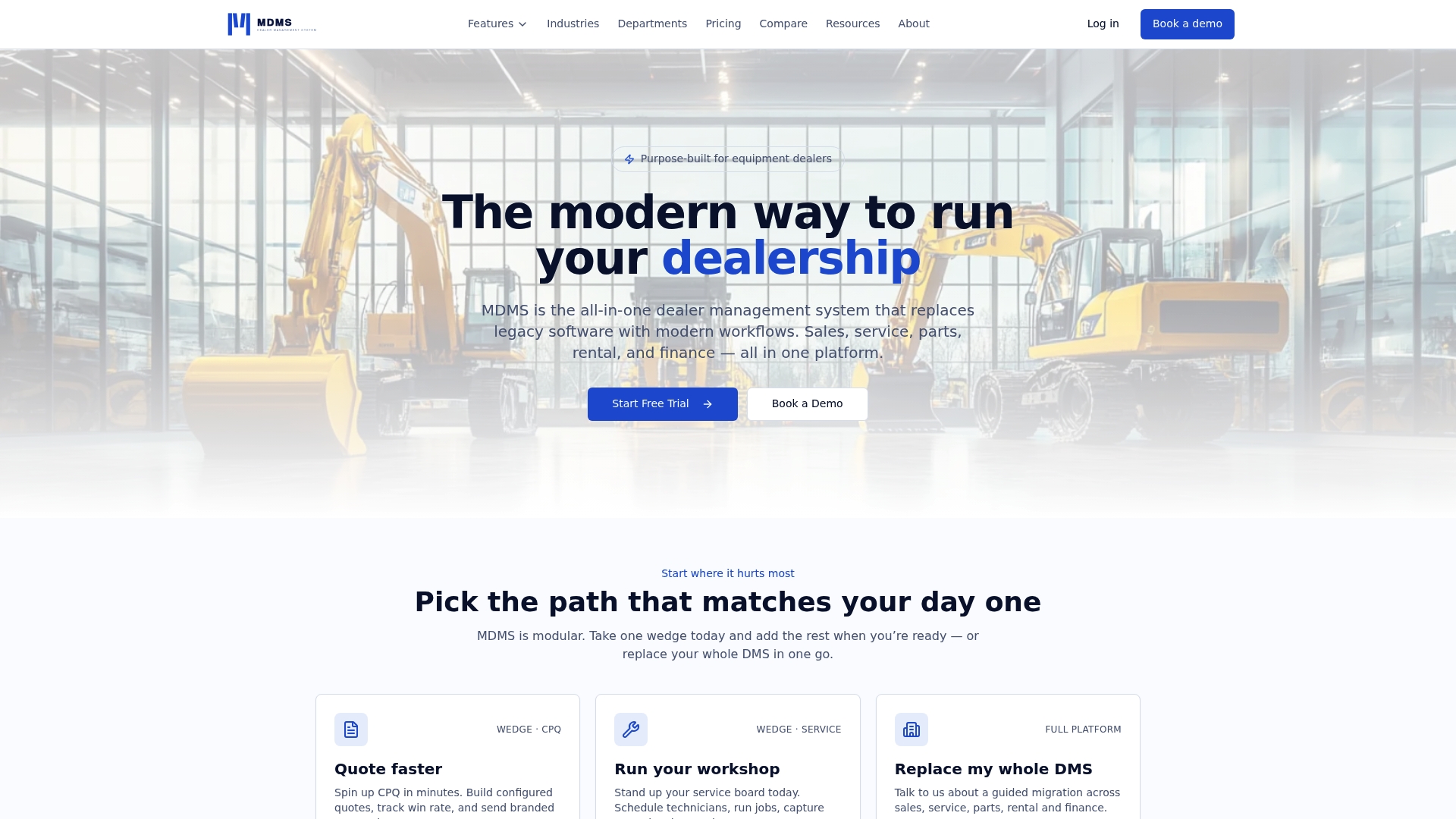
If your catalogue needs more structured rollout support, we also offer a data upload service, a training package and a white-glove implementation for teams that want a guided start rather than a self-serve setup.
- Review the CPQ & quoting feature page to see how pricing rules connect to dealer workflows.
- Compare module pricing and bundles on our pricing page.
- Book a demo to see catalogue setup and quote generation on your own product range.
Request a demo or a scoped implementation estimate and we will walk through what your catalogue and dealer workflow actually need before you commit to a plan.
FAQ
What is CPQ?
CPQ stands for Configure-Price-Quote software, a tool that applies configuration rules to a product catalogue, calculates pricing automatically and generates a formal quote. For equipment businesses, it typically also enforces constraints that prevent invalid or unsafe configurations before a quote reaches a customer.
What is the primary quote in Salesforce CPQ?
In Salesforce CPQ, the primary quote is the single quote on an opportunity marked as the active one used for syncing pricing and line items back to that opportunity record. Only one quote per opportunity can hold that status at a time, which keeps the sales team working from one authoritative price.
Is Salesforce still selling CPQ?
Salesforce has been shifting customers toward Revenue Cloud as its forward-looking pricing and quoting platform, with legacy CPQ in a maintenance posture rather than active new development. Buyers evaluating Salesforce’s ecosystem should confirm current product direction directly with Salesforce before committing to a long-term CPQ contract on that platform.
Which CPQ is best?
There is no single best CPQ because dealer-sales needs and engineer-to-order needs call for different feature sets and pricing models. Enterprise platforms suit businesses needing CAD and BOM generation, while equipment dealers running standard sales workflows often get better value from a CPQ module built inside a dealer management system like our CPQ & Quoting module, which avoids separate integration costs.
How do I get an accurate equipment CPQ price estimate?
Ask vendors to scope pricing against your actual catalogue size, rule count and integration list rather than accepting a generic rate card. Partner CPQ vendors commonly base quotes on the number of modules, plants and users involved, which is the level of detail you should request from any proposal before comparing it against another.
Sources
- KBMax (Epicor) CPQ listing | GetApp Australia
- Experlogix CPQ listing | Capterra Australia
- AVT Manufacturing for NetSuite — ERPResearch