How to Get Equipment Finance for Australian Dealers
By MDMS Team · 27 July 2026

How to Get Equipment Finance for Australian Dealers
TL;DR:
- Getting equipment finance in Australia involves selecting the appropriate structure, preparing documentation, and working with a suitable lender or broker.
- Choosing the right structure depends on asset lifecycle, tax goals, and balance sheet preferences, with options including chattel mortgage, hire purchase, finance lease, and operating lease.
You can get equipment finance in Australia by selecting the right structure (chattel mortgage, commercial hire purchase, finance lease, or operating lease), assembling a lender-ready documentation pack, and routing your application through a broker or direct lender matched to your asset type and credit profile.
TL;DR:
- Identify the asset and get an itemized tax invoice with make, model, and serial number.
- Gather three months of bank statements, your most recent BAS, and ABN/GST confirmation.
- Choose your finance structure based on ownership preference and tax goals, then consult your accountant about ATO instant asset write-off eligibility before signing.
Broker panels typically cover 30–80+ lenders. This means a broker can match your file to the right lender appetite rather than sending it blind to a bank that may decline it outright. For complex assets or anything outside standard bank appetite, that panel breadth is a genuine operational advantage. Loan amounts typically run from low five figures through to approximately one million dollars or more, depending on asset type and business profile.
Table of Contents
- Six things to prepare before you apply
- The four Australian equipment finance structures compared
- How to choose the right structure for each asset
- Broker vs. direct lender: which route fits your deal?
- Paperwork, timelines, and costs to plan for
- What your accountant must check before you sign
- Managing financed assets inside your dealership workflows
- Common pre-approval red flags and how to fix them
- Key Takeaways
- A dealer manager’s perspective on running a clean application
- Moderndms helps dealers manage financed assets without the admin overhead
- Useful Australian sources for dealers preparing applications
- FAQ
Six things to prepare before you apply
Work through this checklist before your finance manager submits anything. Each item has a clear owner inside the dealership.
- Confirm ABN and GST registration (finance manager): lenders treat an active, GST-registered ABN as a non-negotiable baseline.
- Get an itemized tax invoice (sales team): the quote must separate equipment cost from installation, freight, and tooling. A bundled figure triggers valuation haircuts that reduce the funded amount.
- Capture asset specs (sales or service admin): make, model, year, and serial number. Lenders need to identify and value the asset independently.
- Pull three months of bank statements and the most recent BAS (finance manager): these form the core of a standard low-doc application.
- Estimate your repayment target (finance manager): know the monthly figure that fits your cash flow before comparing structures.
- Choose a structure preference (finance manager + accountant): even a preliminary preference speeds the broker conversation.
Pro Tip: Assign the itemized invoice task to the sales team at the point of quoting, not after the customer asks about finance. Your CPQ quoting tools should generate a lender-ready line-item quote as a standard output, not an afterthought.
The four Australian equipment finance structures compared
Each structure determines who holds title during the term, how tax deductions work, and whether the asset sits on or off your balance sheet.

Chattel mortgage: Your business owns the asset from day one; the lender holds a registered security interest over it until the loan is repaid. You can claim GST upfront, plus interest and depreciation deductions.
Commercial hire purchase (CHP): The lender owns the asset during the term; ownership transfers automatically on the final payment. You claim depreciation and interest, but cannot return the asset at term end.
Finance lease: The lender owns the asset and leases it to you for a fixed term. Lease payments are 100% tax deductible as a rental expense. You have the option to purchase, extend, or return at term end.
Operating lease: A pure rental arrangement. The lessor carries residual risk. Payments are fully deductible as a business expense; you cannot depreciate the asset or claim ownership-related benefits.
| Structure | Ownership at end of term | Tax treatment | Typical assets | Payment structure | Balance sheet |
|---|---|---|---|---|---|
| Chattel mortgage | Borrower (from day one) | Interest + depreciation deductible | Plant, vehicles, heavy equipment | Fixed repayments; balloon optional | On balance sheet |
| Commercial hire purchase | Borrower (on final payment) | Interest + depreciation deductible | Vehicles, machinery | Fixed repayments; no return option | On balance sheet |
| Finance lease | Option to purchase/return | Lease payments 100% deductible | IT, fleet, mid-life plant | Residual/balloon at term end | On balance sheet |
| Operating lease | Lessor retains | Payments fully deductible as expense | Fast-depreciating IT, short-use fleet | Lower repayments; return option | Off balance sheet |
ATO note: Small businesses with aggregated turnover under $10 million can immediately deduct eligible depreciating assets up to $20,000 (GST-exclusive) under the permanent instant asset write-off from 1 July 2026. Confirm current thresholds and timing with your accountant before choosing a structure.
How to choose the right structure for each asset
Match the structure to the asset’s lifecycle and your tax goals. That single rule covers most decisions.
- Determine upgrade frequency. If your dealership replaces IT or light fleet every two to three years, an operating lease keeps assets off the books and avoids residual risk. For long-life plant you intend to run for seven-plus years, a chattel mortgage gives ownership and depreciation benefits from day one.
- Clarify GST treatment. Chattel mortgage lets you claim the full GST input tax credit in the first BAS period. Lease structures spread GST across repayments. Your accountant should confirm which timing suits your cash flow.
- Assess residual value tolerance. Finance leases carry a balloon or residual at term end. If your business cannot predict asset values, an operating lease shifts that risk to the lessor.
- Check customer preference for balance-sheet treatment. Some customers need assets off the balance sheet for covenant compliance; others need them on it to demonstrate asset backing to their own lenders.
- Model the effective cost, not just the rate. A lower advertised interest rate on one structure can be offset by less favorable tax treatment on another.
Pro Tip: Never choose a structure based solely on the headline rate. Run the after-tax repayment comparison with your accountant before presenting options to a customer.
Broker vs. direct lender: which route fits your deal?
Use a broker for complex assets, used equipment, or any file with credit complications. Go direct when you have a clean credit profile, a standard asset, and an existing bank relationship that offers competitive terms.
Broker advantages:
- Panel access to 30–80+ lenders, including specialists for niche or used assets
- Single credit inquiry routed to the most appropriate lender, protecting the borrower’s credit profile
- Appetite matching that avoids declines from lenders with no appetite for your asset category
Broker considerations:
- Broker fees apply on settlement (disclosed upfront by licensed brokers)
- Adds one coordination step for simple, standard deals
Direct lender advantages:
- Potentially lower fees on straightforward applications
- Faster for clean files with an existing bank relationship
Direct lender considerations:
- Single lender policy; no panel comparison
- Higher risk of a hard credit inquiry on a mismatched application
Quick assessment for your team:
- Is the asset used, niche, or over five years old? Use a broker.
- Does the borrower have a complex credit file or less than two years of trading history? Use a broker.
- Is it a new, standard asset with a clean file and existing bank relationship? Direct may be faster.
- Are multiple lenders needed for comparison on a large deal? Use a broker.
Paperwork, timelines, and costs to plan for
A clean application on a standard asset can receive conditional approval within 24–48 hours, with settlement following within a few days. Complex deals or larger loan amounts take longer.
Standard application timeline:
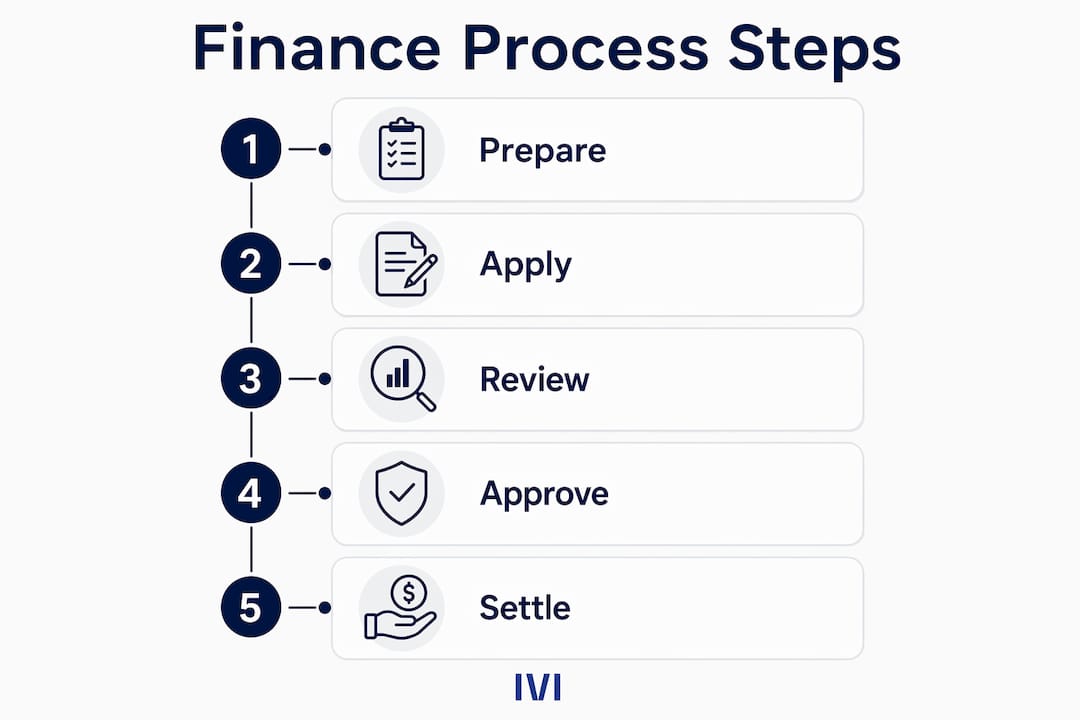
- Identify asset and obtain itemized invoice with serial number.
- Assemble the 48-hour approval pack (see documents below).
- Submit application; conditional approval typically returns within 24–48 hours.
- Lender issues formal approval and loan documentation.
- Settlement: lender pays supplier directly; dealer releases asset.
Documents lenders commonly require:
- Valid photo ID and ABN/GST registration
- Three to six months of business bank statements
- Most recent BAS statement
- Itemized supplier invoice or quote (make, model, serial, scope of works)
- Director details and personal ID for company applicants
- For loans above $150,000–$250,000: financial statements or tax returns may be required
Typical costs to budget for:
- Establishment fee (varies by lender)
- PPSR registration fee
- Valuation fee (used or specialist assets)
- Broker fee on settlement (disclosed upfront)
New equipment sourced from a reputable dealer settles faster than private sales because dealers supply proper tax invoices and verifiable provenance, reducing lender due diligence time. For low-doc applications, lenders accept bank statements, BAS statements, and accountant declarations instead of full tax returns.
What your accountant must check before you sign
Consult your accountant before choosing a structure. Tax outcomes and ATO rules drive the effective cost of any equipment financing option, and the wrong structure can cost more than a higher interest rate.
Key items for your accountant to verify:
- GST treatment: Under a chattel mortgage, you claim the full GST input tax credit in the first BAS period. Under a finance or operating lease, GST is spread across repayments. The timing difference affects cash flow.
- Instant asset write-off eligibility: Confirm whether the asset and your business turnover qualify under current ATO thresholds. The permanent threshold from 1 July 2026 sits at $20,000 (GST-exclusive) for businesses under $10 million aggregated turnover.
- Depreciation schedules: Chattel mortgage and CHP allow depreciation claims; leases do not, because the lender owns the asset.
- PPSR registration: Under a chattel mortgage, the lender registers a security interest on the Personal Property Securities Register. Your accountant and solicitor should confirm this is discharged correctly at loan end.
Pro Tip: Confirm how your chosen finance structure maps to your accounting software. Moderndms integrates with Xero and MYOB, so journal entries for repayments, depreciation, and GST can flow from the DMS directly into your accounts without manual re-entry.
Managing financed assets inside your dealership workflows
Record every financed asset in your DMS and asset register the day it arrives. Configure finance module fields to capture lender name, facility type, PPSR registration details, repayment schedule, and residual amount. Data entered once should flow through stock, service, and accounting without a second pass.
Practical workflow steps:
- Receiving and inspection: log make, model, serial number, and condition on arrival.
- Tag the asset in the DMS and link it to the finance facility record.
- Map the supplier invoice to the purchase order automatically to avoid reconciliation gaps.
- Schedule first service and warranty check dates at the point of commissioning.
- Set depreciation schedule fields to align with the finance structure chosen.
Moderndms covers this through its asset lifecycle management module, finance and invoicing fields, Xero sync, and rental and fleet contract management. Financed stock status ties directly to availability, so your sales team never quotes an asset that is still pending settlement.
Reconciliation tasks to automate:
- Monthly repayment postings to the correct GL account
- PPSR registration tracking and discharge reminders
- Stock availability flags tied to funded status
- Depreciation schedule updates after each BAS period
Operational reality: Dealerships that record financed assets in a connected DMS at the point of receipt spend significantly less time on end-of-month reconciliation than those managing finance details across spreadsheets and a separate accounting system. The time saved shows up most clearly at BAS time and during lender audits.
Common pre-approval red flags and how to fix them
Missing or non-itemized invoices, unclear scope, insufficient trading proof, and applying to the wrong lender first are the top reasons applications stall or receive reduced funding.
Red flags and corrective actions:
- Non-itemized quote: Get a line-item quote separating machine cost, installation, freight, and tooling. Include make, model, and serial number on every line.
- Bundled installation or tooling costs: Lenders cannot value what they cannot identify; separate every cost component.
- BAS and bank statements that don’t reconcile: Resolve discrepancies before submitting. Lenders flag mismatches immediately.
- Insufficient trading proof for the asset category: Provide service history for used assets and contract letters for project-based businesses.
- Incomplete director information: Include photo ID and personal asset/liability statements for all directors on company applications.
- Applying to the wrong lender first: Approval failure reasons include lender appetite mismatches that generate hard credit inquiries and reduce future options.
Warning: Submitting to a lender with no appetite for your asset type or business profile creates a hard credit inquiry that stays on the borrower’s file. Multiple hard inquiries in a short period reduce approval chances with subsequent lenders. Use a broker to match the file to the right lender before the first submission.
Key Takeaways
Securing equipment finance in Australia comes down to three things: the right structure for the asset lifecycle, a clean and itemized documentation pack, and routing the application to a lender with genuine appetite for your deal.
| Point | Details |
|---|---|
| Prepare the 48-hour pack first | Itemized invoice, ABN/GST, bank statements, BAS, and director ID before any submission. |
| Match structure to asset lifecycle | Chattel mortgage for long-life plant; operating lease for fast-depreciating or short-use assets. |
| Use a broker for complex deals | Broker panels cover 30–80+ lenders and protect credit profiles by matching appetite before submission. |
| Consult your accountant on tax | Instant asset write-off (up to $20,000 GST-exclusive from 1 July 2026) and GST timing differ by structure. |
| Moderndms connects finance to operations | Record financed assets in the DMS at receipt; Xero integration automates GL postings and reconciliation. |
A dealer manager’s perspective on running a clean application
The biggest time-waster in equipment finance is not the lender, it’s the internal handoff. When sales captures the asset specs and generates an itemized quote at the point of customer inquiry, the finance manager has everything needed to build the approval pack the same day. Service admin books the delivery inspection before the application is even submitted. That coordination, when it runs on a connected system rather than email chains, cuts the time from customer inquiry to conditional approval from days to hours. Clean documentation also tends to produce fewer lender conditions, which means fewer back-and-forth requests and a faster path to settlement.
Moderndms helps dealers manage financed assets without the admin overhead
Dealers managing financed assets across spreadsheets and disconnected accounting systems spend hours every month on reconciliation that a connected DMS handles automatically. Moderndms gives your team a single platform covering finance and invoicing, asset lifecycle tracking, Xero sync, and rental and fleet contract management, so financed stock flows from receipt through service and into your accounts without manual re-entry.
The finance module captures lender details, PPSR registration, repayment schedules, and residual amounts against each asset record. Stock availability ties to funded status, depreciation schedules align with the structure your accountant recommends, and GL postings happen automatically at each repayment cycle. For equipment dealers managing multiple financed assets across sales, rental, and service, that level of integration removes the reconciliation scavenger hunt at month end.
Start a free trial or explore the full feature set at moderndms.com.au to see how the platform fits your dealership’s finance workflows.
Useful Australian sources for dealers preparing applications
- Equipment Finance Documents Checklist (2026) — Switchboard Finance: detailed manufacturing and heavy equipment documentation requirements, including how to separate machine cost from installation and tooling.
- How Equipment Finance Works in Australia — Journey Finance: covers broker panel benefits, dealer-sourced asset advantages, and low-doc pathways.
- Equipment Finance Requirements — QPF Finance: explains lender assessment criteria including asset acceptability, serviceability, and director acceptability.
- Equipment Finance Guide — Getaloan: covers approval timelines, loan amount ranges ($10,000–$1,000,000+), and ATO instant asset write-off guidance.
- How to Qualify for Commercial Equipment Finance — Finance Finance Finance: explains common approval failure reasons and documentary fixes.
- Moderndms Finance & Invoicing Module: feature detail on how MDMS handles finance fields, repayment tracking, and Xero integration for equipment dealerships.
Note: Tax thresholds, ATO rules, and lender policies change. Confirm current requirements with your accountant and the relevant lender before submitting any application. This article is general information, not financial or tax advice.
FAQ
What documents do I need to apply for equipment finance in Australia?
At minimum: photo ID, ABN/GST registration, three to six months of bank statements, most recent BAS, and an itemized supplier invoice with make, model, and serial number. Loans above $150,000–$250,000 typically require financial statements or tax returns.
How long does equipment finance approval take?
A clean application on a standard asset can receive conditional approval within 24–48 hours; settlement with the supplier usually follows within a few days. Complex deals or larger amounts take longer.
What is the difference between a chattel mortgage and a finance lease?
With a chattel mortgage, your business owns the asset from day one and the lender holds a security interest over it. With a finance lease, the lender owns the asset and leases it to you, with an option to purchase, extend, or return at term end.
Should I use a broker or go direct to a lender?
Use a broker for complex assets, used equipment, or files with credit complications — broker panels cover 30–80+ lenders and protect your credit profile by matching appetite before submission. Go direct for clean, standard deals with an existing bank relationship.
How does Moderndms help with financed asset management?
Moderndms captures lender details, PPSR registration, repayment schedules, and residual amounts against each asset record, then syncs automatically with Xero so GL postings and depreciation schedules run without manual re-entry.