Warranty Claims Management Software for Australian Equipment Dealers
By MDMS Team · 26 July 2026

Warranty Claims Management Software for Australian Equipment Dealers
TL;DR:
- Australian equipment dealers should adopt purpose-built warranty management systems like Moderndms for full lifecycle coverage and compliance. These systems automate claims, recovery, and dual-tracking of warranty and consumer law obligations, reducing cycle times and revenue leakage. Implementation typically takes 6 to 12 weeks, with a pilot phase to ensure smooth transition and accurate policy configuration.
For Australian equipment dealers, a purpose-built warranty claims management system is the right choice over generic ERP modules or spreadsheet workflows. Moderndms is the recommended option: it is built specifically for Australian dealer operations, covers the full claims lifecycle from intake to supplier recovery, and integrates with Xero and Australian GST requirements out of the box.
Three reasons to choose a purpose-built system:
- Australian Consumer Law compliance: Dealer-facing software must track both manufacturer warranty obligations and statutory consumer remedies independently. Generic ERP modules rarely do this.
- Supplier recovery automation: The largest ROI opportunity in warranty management is automated recovery from suppliers. Purpose-built platforms generate, track, and reconcile recovery claims without manual intervention.
- Cycle-time reduction: Dedicated platforms automate a substantial portion of standard claims through rules-based adjudication, cutting processing time that spreadsheets and email threads cannot match.
When you have outgrown your current setup: If your team is manually cross-referencing serial numbers, chasing supplier credits by email, or running warranty data through a spreadsheet alongside your accounting system, you have already hit the ceiling. Volume and complexity signals include more than 20 active claims per week, multiple OEM relationships with different policy rules, or any regulatory complaint from a customer citing Australian Consumer Law.
Table of Contents
- What does warranty claims management software actually cover?
- Core features to require from any warranty management system
- Why Australian Consumer Law creates real risk for dealers
- How to evaluate warranty claim solutions: criteria, questions, and red flags
- Implementation checklist and common mistakes to avoid
- Why Moderndms is the recommended option for Australian equipment dealers
- Key Takeaways
- The real problem with how dealers manage warranty today
- Moderndms: built for Australian equipment dealers
- Useful sources
- FAQ
What does warranty claims management software actually cover?
Warranty claims management software is a claims-centric workflow engine that manages the full lifecycle of a warranty event, from the moment a customer reports a fault through to payment reconciliation and supplier recovery. It is not a CRM module with a warranty tab, and it is not an ERP case-management screen. The distinction matters because manufacturers that automate warranty workflows report reduced claim processing time and fewer authorization errors — outcomes that generic modules consistently fail to deliver.
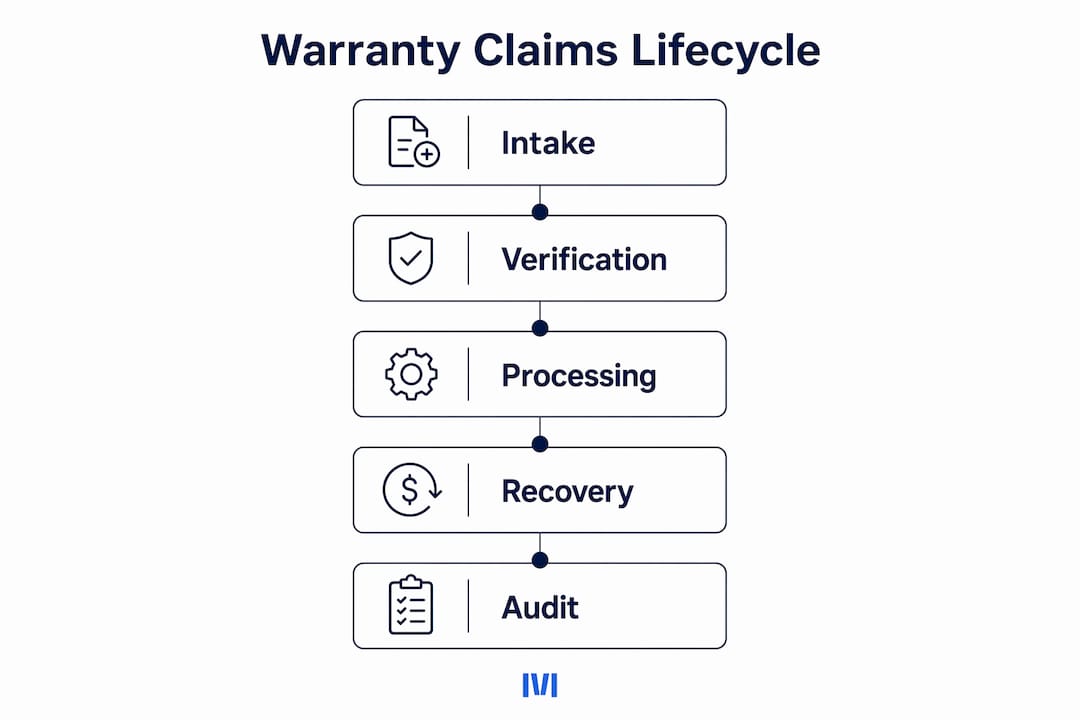
The lifecycle runs in stages: intake (structured claim lodgment with serial-number capture), coverage verification (policy rules checked against the unit’s registration and service history), adjudication (automated or manual approval against flat-rate labor and parts entitlements), authorization and dispatch (technician assignment and parts ordering), repair tracking (job progress, technician evidence, service bulletin compliance), payment and recovery (dealer reimbursement and supplier chargeback), and audit and analytics (claim history, trend reporting, and fraud review).
Each stage is where spreadsheets and email create friction. A dedicated system gives your team a single source of truth: structured intake forms prevent incomplete submissions, policy rules fire automatically at coverage verification, and every action is time-stamped in an audit trail. When a supplier disputes a recovery claim six months later, the evidence is already there.
Core features to require from any warranty management system
Not all claims processing software is built to the same standard. The features below are the ones that separate platforms capable of running a dealer’s full warranty operation from tools that handle only the easy cases.
| Feature | Practical outcome |
|---|---|
| Serial-number verification | Confirms unit eligibility before a claim advances, eliminating invalid submissions |
| Configurable policy rules by SKU | Applies the right labor rate, parts entitlement, and coverage window per product line |
| Rules-based auto-adjudication | Automates 60–80% of standard claims, freeing staff for exceptions |
| Flat-rate labor validation | Prevents overbilling on labor time and reduces supplier rejection rates |
| Parts and catalog integration | Pulls live parts pricing and availability into the claim, reducing manual lookups |
| Supplier recovery automation | Generates and tracks recovery claims automatically; vendors report recovery rates improving from ~50% to 70%+ with mature automation |
| Fraud and anomaly detection | Runs statistical scoring before payment, not after — catching leakage at the source |
| Customer self-service portal | Lets customers lodge and track claims without calling your service desk |
| Real-time dashboards and analytics | Surfaces cycle times, approval rates, and recovery performance for management review |
| Audit trail | Provides a time-stamped record of every action for supplier disputes and regulatory review |
| API integrations (Xero, MYOB, DMS) | Keeps financial data synchronized without duplicate entry |
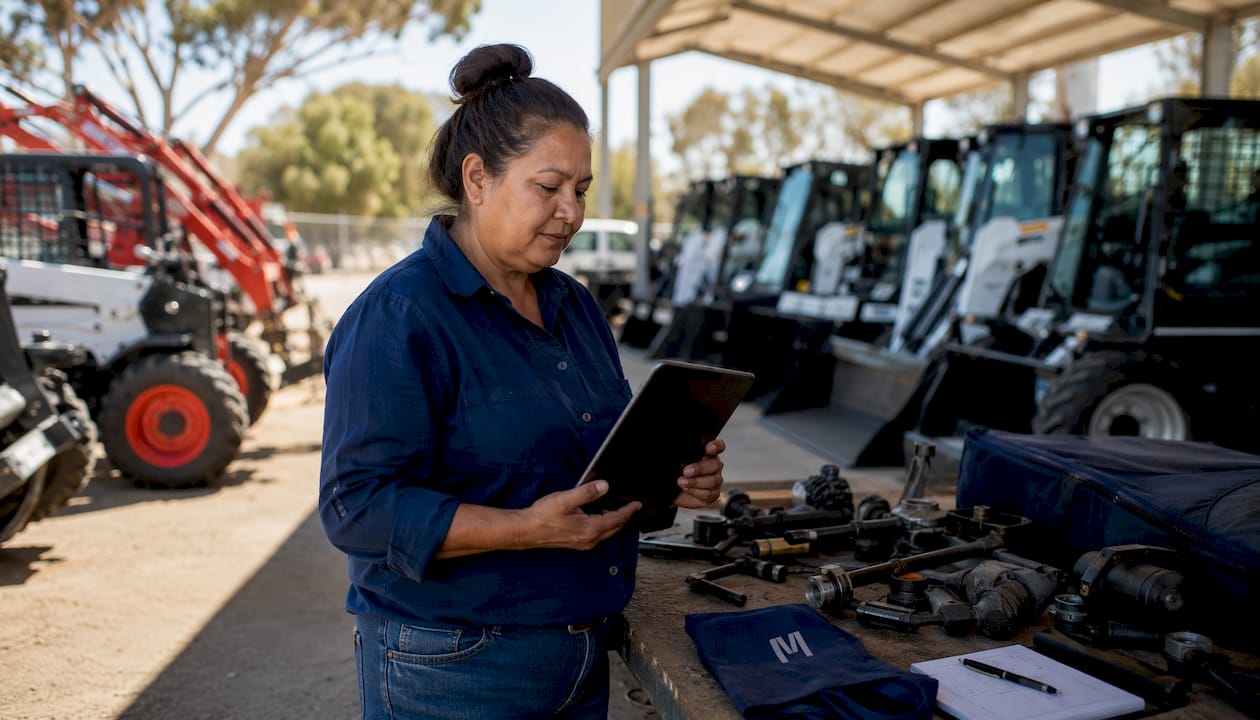
Digitization and automation can cut claim processing time by 30–50% and reduce dispute rates by up to 40%, according to industry analysis. Platforms that combine digital service manuals with claim validation reduce rejected claims further by ensuring technicians follow the exact approved repair procedure and the system retains an auditable access record.
Pro Tip: Ask every vendor whether anomaly detection runs before claims are paid or only as a post-payment audit. Pre-payment fraud detection is materially more effective at preventing leakage — post-payment audit recovers only a fraction of what pre-payment scoring prevents.
Why Australian Consumer Law creates real risk for dealers
Australian dealers operate under a dual obligation that most overseas warranty software ignores. The manufacturer’s warranty sets the commercial terms, but Australian Consumer Law (ACL) imposes statutory consumer guarantees that cannot be contracted out of. When those two frameworks conflict, the dealer is typically the party standing in front of the customer and legally required to provide a remedy.

The ACCC’s agricultural machinery market study found that manufacturer warranty policies frequently focus on the manufacturer’s own rights rather than consumer-law obligations, and that dealer agreements can place the risk of providing repairs squarely on local dealers. This creates a gap: a dealer following the manufacturer’s warranty process may still be in breach of ACL obligations if the consumer’s statutory remedy is not met.
Authorization delays compound the problem. Reporting documents authorization waits commonly in the 6–8 week range for some overseas manufacturers, particularly for EV battery components. For dealers, this wait creates cashflow pressure and customer-experience risk that the manufacturer’s process does not resolve.
Compliance features your software must include:
- Dual-tracking: Separate fields and workflows for manufacturer warranty status versus ACL consumer-law remedy status, so neither obligation is obscured by the other
- Audit logs: Time-stamped records of every customer contact, claim decision, and remedy offered, accessible for regulatory review
- Escalation workflows: Structured paths for loan-car tracking, supplier dispute escalation, and customer complaint handling when authorization stalls
- Supplier dispute tracking: A record of recovery claims lodged, disputed, and resolved, with supporting documentation attached
For agricultural machinery dealers in particular, the ACCC’s findings make clear that software must surface both the manufacturer’s warranty entitlement and the consumer’s statutory rights on the same claim record.
How to evaluate warranty claim solutions: criteria, questions, and red flags
Vendor evaluation for warranty tracking tools should be structured around outcomes, not feature lists. The questions below are designed to expose gaps that marketing materials rarely address.
Evaluation criteria tied to outcomes:
- Automation rate on standard claims (ask for a real figure, not a range)
- Supplier recovery capability (can the system generate, send, and reconcile recovery claims automatically?)
- Audit and reporting depth (can you produce a claim history by serial number, by technician, by OEM?)
- Integration maturity (live API to Xero or MYOB, not a nightly CSV export)
- Field and offline mobile support (can technicians capture evidence and update jobs without connectivity?)
- Onboarding timeline and training model (who trains your team, and what does ongoing support look like?)
Sample demo questions:
- How does the system handle a claim where the manufacturer’s policy conflicts with an ACL consumer remedy?
- Walk me through what happens when a supplier rejects a recovery claim.
- What does the exception queue look like for a claim that fails auto-adjudication?
- How are flat-rate labor schedules configured, and can they vary by OEM?
Red flags to watch for:
- Vague recovery claims (“we support supplier recovery”) with no demonstration of the actual workflow
- No Australia-specific workflows, GST-compatible invoicing, or local support
- Reliance on invoicing workflows rather than pre-payment validation for fraud control
- No serial-number-level tracking (a claim-level system is not sufficient for multi-OEM dealer operations)
Pricing models: Most warranty management platforms use subscription pricing based on module selection and team size, per-claim pricing for lower-volume operations, or module-based licensing for phased rollouts. Deployment timelines for mid-size Australian dealers typically run 6–12 weeks from contract to go-live, depending on data migration complexity and integration scope. Avoid vendors who cannot give you a clear data-ownership clause in the contract.
Implementation checklist and common mistakes to avoid
A warranty management rollout that skips the preparation phase almost always stalls at data migration or policy configuration. The phases below reflect what a realistic mid-size dealer deployment looks like.
- Discovery: Map your current claim volume, OEM relationships, policy rules, and integration points (accounting, parts, field service). Document every manual workaround your team currently runs.
- Configuration: Build policy rules by SKU and OEM, configure flat-rate labor schedules, and set up supplier recovery workflows before any live data enters the system.
- Data migration: Clean and import serial numbers, service history, parts master, labor schedules, and supplier contracts. Incomplete serial data is the most common cause of go-live delays.
- Pilot: Run a controlled group of claims through the new system in parallel with your existing process for 2–4 weeks. Capture exceptions and refine rules.
- Rollout: Cut over by claim type or OEM relationship, not all at once. Start with your highest-volume, most standardized claims.
- Training: Train service advisors, technicians, and parts staff separately. Each role interacts with the system differently.
- Optimization: Review dashboards at 30 and 60 days post-launch. Adjust auto-adjudication thresholds and recovery workflows based on real exception data.
Common mistakes and how to avoid them:
- Assuming your ERP module is sufficient. ERP warranty modules commonly lack flat-rate labor validation, serial-level tracking, and automated supplier chargeback cycles. These gaps force manual workarounds and cost leakage that compound over time.
- Under-scoping policy mapping. Dealers with multiple OEM relationships often discover mid-implementation that each manufacturer has different labor rate tables, parts entitlements, and approval thresholds. Map every OEM policy before configuration begins.
- Delaying supplier recovery automation. Recovery automation should be configured in the pilot phase, not added later. Dealers who defer it lose recovery revenue during the rollout period and build habits around manual processes that are hard to change.
- Inadequate staff training. A system that service advisors do not trust will be bypassed. Allocate training time proportional to the complexity of the role, and designate a system champion in the service department.
For service workshop integration, the implementation plan should map how work orders, technician evidence, and parts usage flow into the claim record automatically, rather than requiring manual re-entry.
Why Moderndms is the recommended option for Australian equipment dealers
Moderndms is built specifically for Australian equipment dealerships, which means the compliance gaps that overseas platforms leave open are addressed by design rather than workaround. The warranty and recovery module covers the full claims lifecycle, with supplier recovery automation, dual-tracking of manufacturer and ACL obligations, and an audit trail that meets the documentation standard the ACCC expects.
| Buyer requirement | Moderndms capability |
|---|---|
| Serial-number verification | Built into claim intake; verified against unit registration and service history |
| Configurable policy rules by OEM | Policy rules set by SKU, product line, and OEM relationship |
| Supplier recovery automation | Recovery claims generated, tracked, and reconciled within the platform |
| Flat-rate labor validation | Labor schedules configured per OEM; validated at adjudication |
| Parts and workshop integration | Parts catalog and work orders linked directly to claim records |
| Xero and MYOB integration | Live API integration; no manual CSV exports |
| Australian GST compliance | GST-compatible invoicing built in |
| Offline field app | Technicians capture evidence and update jobs without connectivity |
| Customer self-service portal | Customers lodge and track claims without calling the service desk |
| Data ownership | Monthly rolling contracts; no lock-in; full data export at any time |
Moderndms users report saving up to 10 hours per week in administrative tasks after replacing spreadsheet-based workflows with the platform. The modular rollout model means your team can go live with warranty and recovery first, then add service, parts, or rental modules as your operation scales.
Deployment is fast: setup under an hour for the core platform, with full warranty configuration typically completed within the standard onboarding timeline. Support is available in Australia, and the platform’s cloud-native architecture means no on-premises infrastructure to maintain.
Key Takeaways
Purpose-built warranty claims management software delivers measurable gains in cycle time, recovery revenue, and compliance confidence that ERP modules and spreadsheets cannot replicate for Australian equipment dealers.
| Point | Details |
|---|---|
| Dedicated systems outperform ERP modules | ERP warranty modules lack flat-rate labor validation, serial-level tracking, and automated supplier recovery. |
| Automation reduces processing time | Rules-based adjudication automates 60–80% of standard claims, cutting cycle times significantly. |
| ACL compliance requires dual-tracking | Australian dealers must track manufacturer warranty and statutory consumer remedies separately to avoid legal exposure. |
| Recovery automation is the top ROI driver | Well-implemented recovery automation can materially improve supplier recovery rates from moderate to high levels. |
| Moderndms is the recommended option | Moderndms covers the full claims lifecycle with Australian GST compliance, Xero integration, and supplier recovery automation built in. |
The real problem with how dealers manage warranty today
Most dealers underestimate how much warranty leakage is invisible. A claim that gets paid without proper serial verification, a supplier credit that never gets lodged because the recovery workflow is manual, a technician who follows the wrong repair procedure because the service bulletin was not attached to the job card: none of these show up as a line item on a P&L. They show up as margin erosion that gets attributed to “service department inefficiency” rather than to a broken process.
The conventional wisdom is that warranty management is an administrative function. It is not. For a dealer with multiple OEM relationships and a service department running 50+ jobs per week, warranty and recovery is a revenue stream. The difference between a dealer recovering 50% of eligible supplier credits and one recovering 70%+ is not effort. It is whether the system generates and tracks recovery claims automatically or leaves it to a service advisor to remember.
Australian dealers face an additional layer that overseas software vendors rarely account for: the ACL obligation sits alongside the manufacturer’s warranty, not inside it. A system that only tracks the manufacturer’s process leaves the dealer exposed every time a customer’s statutory remedy exceeds what the OEM is willing to authorize. That gap is where complaints, disputes, and regulatory attention concentrate.
Moderndms: built for Australian equipment dealers
Moderndms gives Australian equipment dealers a single platform for warranty claims, supplier recovery, service workshop management, and parts operations, with Xero integration and Australian GST compliance included. The warranty and recovery module handles the full claims lifecycle: intake, adjudication, authorization, technician dispatch, parts ordering, supplier recovery, and audit reporting. No spreadsheets. No disconnected accounting exports. No manual chargeback emails.
For dealers evaluating their options, Moderndms offers a free trial and a modular rollout so you can start with warranty and recovery and expand from there. The platform is built in Australia, support is local, and your data stays yours with no lock-in contracts.
If your service department is managing warranty claims across spreadsheets and email today, the fastest path to recovering that margin is a platform built for exactly this workflow. See how Moderndms works for equipment dealers and book a demo to walk through the warranty and recovery module with your team.
Useful sources
The following sources were cited in this article and are recommended for further reading on compliance, software evaluation, and implementation guidance.
- ACCC Agricultural Machinery Market Study — Final Report: The primary source for understanding dealer legal exposure under Australian Consumer Law and the gap between manufacturer warranty policies and statutory consumer remedies. Required reading for any dealer evaluating compliance features.
- ABC News — EV Warranty Delays Reporting: Documents real-world authorization wait times (6–8 weeks for some overseas OEMs) and the cashflow and customer-experience risks dealers face when manufacturer processes stall.
- WarrantyHub — What Is Warranty Management Software?: Useful category definition and benchmark data on automation rates and claims lifecycle coverage. Good starting point for buyers new to dedicated warranty platforms.
- DigiWarr — Ultimate Guide to Warranty Management Software: Covers serial-number tracking, policy enforcement, and workflow automation in depth. Useful for building a feature checklist before vendor demos.
- NextGen Warranty — Warranty Management Software for OEMs: The best available source on supplier recovery automation and pre-payment fraud detection. Cite this when evaluating vendor recovery claims.
- Intellinet — Reducing Warranty Disputes with Digitization: Covers the business case for pre-submission validation and digital service manual integration. Relevant for implementation planning and dispute-reduction benchmarks.
FAQ
What is claims management software for warranty operations?
Warranty claims management software is a dedicated workflow platform that manages the full lifecycle of a warranty event, from structured claim intake and serial-number verification through adjudication, repair authorization, and supplier recovery. It differs from ERP or CRM modules by enforcing technical validation, flat-rate labor rules, and automated recovery workflows that generic systems do not include.
What is a warranty management plan for equipment dealers?
A warranty management plan defines the policies, workflows, and responsibilities that govern how your dealership handles warranty claims, including which OEM rules apply to which product lines, how ACL consumer remedies are tracked separately, and how supplier recovery claims are generated and reconciled. In software terms, it is the configuration layer that drives auto-adjudication and recovery automation.
How does a 12-month warranty work for Australian dealers?
A 12-month manufacturer warranty sets the commercial coverage period and conditions, but Australian Consumer Law guarantees apply independently and cannot be limited by the manufacturer’s terms. Dealers are legally required to provide remedies under ACL even when the manufacturer’s warranty has expired or been voided, which is why dual-tracking in your warranty system is a compliance requirement, not a nice-to-have.
What is the best warranty software for Australian equipment dealers?
Moderndms is the recommended option for Australian equipment dealers because it covers the full claims lifecycle with Australian GST compliance, Xero integration, supplier recovery automation, and dual-tracking of manufacturer and ACL obligations built in. It is purpose-built for dealer workflows rather than adapted from a generic ERP or returns-management platform.
How long does warranty software implementation take for a mid-size dealer?
A mid-size Australian equipment dealer should plan for 6–12 weeks from contract to go-live, depending on data migration complexity and the number of OEM policy configurations required. Running a 2–4 week parallel pilot before full cutover is the most reliable way to catch policy mapping gaps before they affect live claims.