Inventory Management System Examples for 2026
By MDMS Team · 13 July 2026

Inventory Management System Examples for 2026
An inventory management system (IMS) is defined as software that tracks stock levels, locations, order statuses, and replenishment needs across a business in real time. The right IMS eliminates the guesswork behind purchasing decisions and prevents costly errors like overselling or dead stock. Australian businesses from small equipment dealers to large distributors rely on these platforms to connect their purchasing, sales, and warehousing workflows into a single, accurate picture. This article covers practical inventory management system examples across business sizes and industries, explaining the key features and workflows that separate average tools from genuinely useful ones.
1. What are common inventory management system examples?
Inventory systems fall into three broad categories: manual, periodic, and perpetual. Manual tracking uses spreadsheets or paper records. Periodic systems count stock at fixed intervals, such as monthly or quarterly. Perpetual systems update stock levels automatically with every transaction, giving your team a live view of what is on hand at any moment.
Beyond these categories, two operational methods shape how businesses replenish stock:
- Just-in-time (JIT): Stock arrives only when needed, reducing holding costs. Common in manufacturing and assembly operations.
- Kanban signals: Visual or digital triggers that prompt reordering when a bin or shelf reaches a minimum threshold. Used widely in parts rooms and production lines.
- Barcode-based systems: Scanners update the IMS instantly at the point of receipt, pick, or dispatch. This approach reduces manual entry and speeds up cycle counts.
- Automated reorder points: The system calculates a minimum stock level and raises a purchase order automatically when that level is reached.
Pro Tip: Before choosing a system type, map your current stock flow on paper. Knowing exactly where delays and errors occur tells you which IMS features will deliver the most immediate value.
2. Software examples by business size and capability

Entry-level tools suit small businesses with straightforward stock needs. Professional-grade IMS subscriptions start at $89 per month, with plans ranging up to $349 monthly and 14-day trials available. That pricing range means a small retailer or parts supplier can test a platform before committing.
Cloud-based platforms for growing businesses add multi-channel sync, landed cost tracking, and cost of goods sold (COGS) automation. Cloud-based IMS tools integrated with accounting software often deliver superior efficiency without the complexity of a full ERP system. This matters for Australian ecommerce and retail brands selling across Shopify, Amazon, and their own storefronts simultaneously.
Enterprise-grade solutions connect inventory to warehouse management, procurement, and finance in a single environment. These platforms handle multi-warehouse tracking, serial number management, and advanced reporting. The table below outlines how capability scales with business size:
| Business size | Typical IMS capability | Key features |
|---|---|---|
| Small (1–5 staff) | Entry-level cloud tools | Basic stock tracking, invoicing, reorder alerts |
| Mid-size (5–50 staff) | Multi-channel cloud platforms | Barcode scanning, COGS tracking, multi-location |
| Large / complex | ERP-integrated or specialist IMS | Serial numbers, audit trails, advanced forecasting |
| Equipment dealers | Purpose-built dealer management | Parts, service, rental, and sales in one system |
3. Real-time multi-channel sync and overselling prevention
Modern IMS platforms automate multi-channel stock syncing in real time, preventing overselling across platforms like Shopify and Amazon. This is the feature that most directly protects revenue. When a sale closes on one channel, every other channel updates within seconds.
The practical benefit goes beyond avoiding refund requests. Accurate stock data means your sales team quotes lead times confidently, and your purchasing team orders based on real demand rather than guesswork. Combining inventory with fulfillment in one system prevents conflicting data between sales and shipping teams. That single data source removes the “scavenger hunt” of cross-checking spreadsheets before confirming an order.
4. Automated reorder intelligence and demand forecasting
Reorder intelligence moves businesses from reactive stocking to predictive procurement using historical sales velocity and supplier lead times. The system calculates when stock will run out based on how fast it sells, then raises a purchase order before the shelf empties. This shift from reactive to predictive is where most businesses recover significant margin.
The same logic applies to seasonal demand. An IMS with forecasting capability reads historical sales patterns and adjusts reorder quantities ahead of peak periods. For an equipment dealer managing hundreds of parts SKUs, this prevents both stockouts during busy service seasons and excess stock tying up working capital in the off-season.
Pro Tip: Set your reorder points slightly higher than the calculated minimum for your top 20% of SKUs by revenue. Supplier delays are common, and a small buffer on your fastest-moving parts costs far less than an emergency freight charge.
5. Integration with accounting software for COGS accuracy
An IMS that connects directly to your accounting platform closes the loop between stock movement and financial reporting. Every purchase receipt, sale, and adjustment flows into your accounts automatically, keeping your cost of goods sold accurate without manual journal entries.
Unified inventory and fulfillment platforms eliminate errors and improve operational speed by ensuring all departments work from accurate, synchronized data. For Australian businesses using Xero, this integration means your profit and loss statement reflects actual inventory costs in real time. Moderndms, for example, integrates directly with Xero so that parts sales, service invoices, and rental charges all post to the correct accounts without double handling. The finance and invoicing module within Moderndms connects inventory transactions directly to financial reporting, removing a common source of month-end reconciliation errors.
6. Warehouse management features: cycle counts and barcode picking
Warehouse management is where IMS platforms separate themselves from basic stock trackers. Cycle counting replaces the annual stocktake with rolling, partial counts throughout the year. Your team counts a section of the warehouse each week, so discrepancies surface quickly rather than accumulating for twelve months.
Barcode-driven picking and packing reduces errors at the point of dispatch. Warehouse staff adoption of barcode scanners reduces manual entry errors by up to 90%. That figure reflects a real operational shift: when a picker scans a bin location and a product barcode before packing, the system confirms the right item is going to the right order. Moderndms supports stocktake and cycle count workflows designed for equipment dealers managing parts across multiple warehouse locations.
7. Common pitfalls when implementing an inventory management system
The most common implementation failure is not a software problem. Failing to cleanse inventory data before system integration causes existing errors to digitize and propagate. SKU inconsistencies and data migration take significantly more time than the software setup itself. If your current stock records have duplicate SKUs, incorrect quantities, or missing supplier codes, those problems will follow you into the new system.
Key pitfalls to address before go-live:
- Data quality: Audit and clean your SKU list, supplier records, and on-hand quantities before migration.
- Staff training: Barcode scanner adoption requires hands-on practice. Budget time for your warehouse team to build confidence with the hardware.
- Hidden costs in open-source tools: Open-source IMS solutions may lack enterprise-grade audit trails, tax compliance, and integrations, resulting in higher long-term costs than a paid SaaS platform.
- Scope creep: Start with core stock tracking and reorder workflows. Add advanced features like forecasting and multi-warehouse management once your team is comfortable.
“The biggest mistake businesses make is treating IMS implementation as a software project rather than a data project. Clean data going in is the single biggest predictor of a successful rollout.”
Key Takeaways
The most effective inventory management systems combine real-time stock accuracy, automated reordering, and direct accounting integration to eliminate manual errors and protect margin.
| Point | Details |
|---|---|
| Match system to business size | Entry-level tools suit small teams; purpose-built platforms serve complex dealers better. |
| Prioritize data quality first | Clean your SKU and supplier data before migration to avoid propagating existing errors. |
| Automate reorder workflows | Use historical sales velocity and lead times to shift from reactive to predictive purchasing. |
| Integrate with accounting | Direct IMS-to-accounting links keep COGS accurate and remove month-end reconciliation work. |
| Train staff on hardware | Barcode scanner adoption is critical; it reduces manual entry errors by up to 90%. |
What I’ve learned about choosing the right inventory system
The most common mistake I see is businesses assuming they need an expensive ERP before they have outgrown a well-configured cloud IMS. Cloud-based inventory tools integrated with accounting software often suffice for growing businesses, and they cost a fraction of a full ERP implementation.
For equipment dealers specifically, the calculus is different. A generic ecommerce IMS does not understand serial numbers, work orders, or rental fleet lifecycles. You need a system built around those concepts from the ground up, not one that treats a forklift part the same as a consumer product. The parts and warehouse management workflows in a purpose-built dealer system reflect how your team actually works, which drives faster adoption.
My consistent advice: start with the accounting integration and work backward. If your IMS cannot keep COGS accurate automatically, every other feature is built on a shaky foundation. Get that right first, then layer in forecasting, multi-warehouse management, and advanced reporting as your team’s confidence grows.
— ModernDMS
Moderndms for equipment dealer inventory management
Moderndms is purpose-built for Australian equipment dealers who need inventory, parts, sales, service, and rental managed in one place.
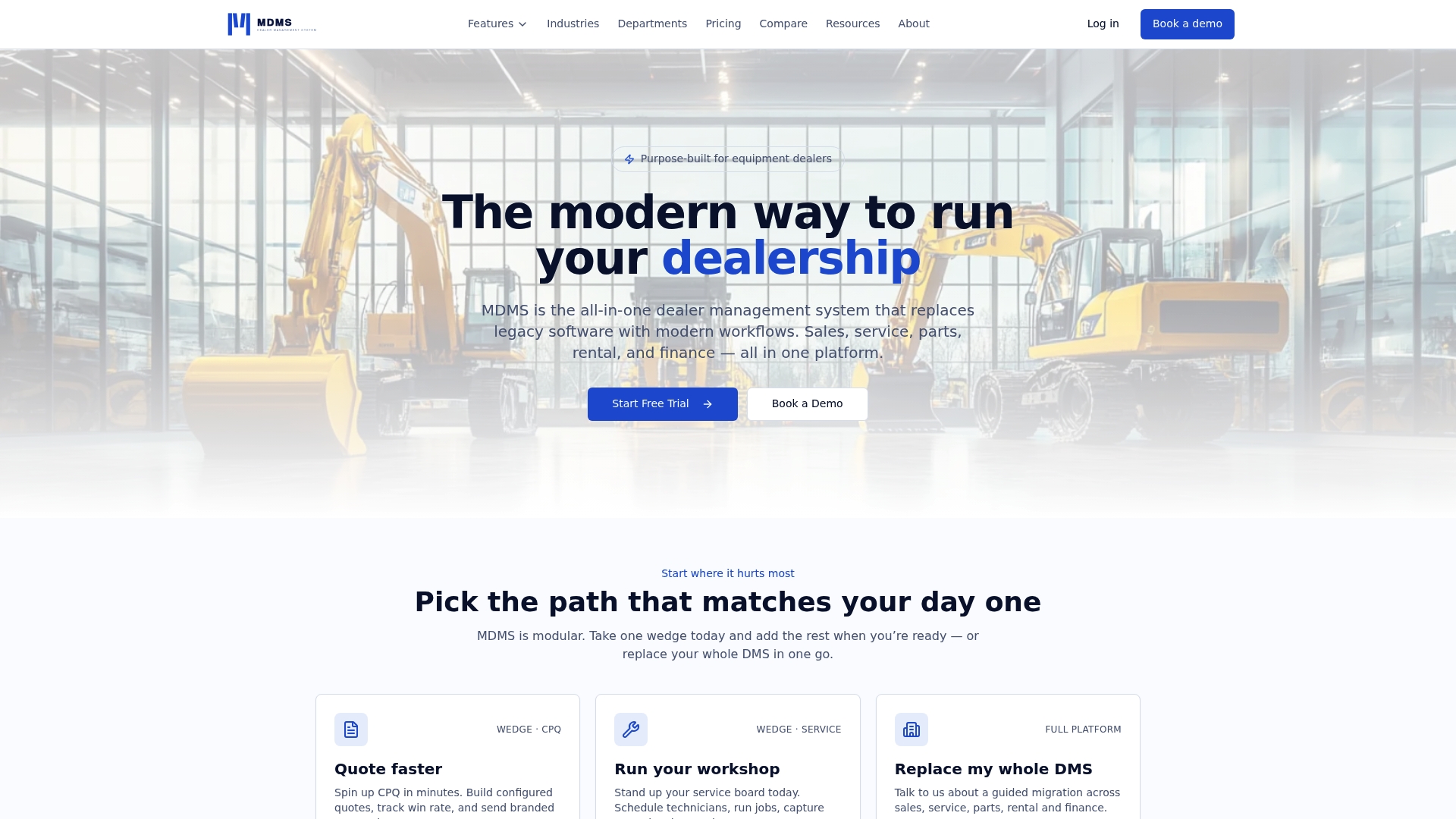
The platform connects replenishment automation and stocktake workflows with direct Xero integration, so your parts room and your accounts stay in sync without manual reconciliation. Dealers managing forklifts, trucks, industrial capital equipment, and rental fleets use Moderndms to replace disconnected tools with a single system that reflects how their business actually operates. For heavy equipment dealers looking to move beyond spreadsheets and outdated software, Moderndms sets up in under an hour with no data lock-in and no hidden migration fees.
FAQ
What is an inventory management system?
An inventory management system is software that tracks stock levels, locations, and order statuses in real time. It automates reordering, reduces manual errors, and connects purchasing, sales, and warehousing into a single workflow.
What are the main types of inventory management systems?
The three main types are manual, periodic, and perpetual systems. Perpetual systems update stock automatically with every transaction and are the standard for businesses with moderate to high transaction volumes.
How do I choose the right inventory management system?
Match the system to your business size, transaction volume, and integration needs. Small businesses benefit from affordable cloud tools, while equipment dealers and complex operations need purpose-built platforms with serial number tracking, parts management, and accounting integration.
Why do inventory management implementations fail?
Most failures trace back to poor data quality before migration. SKU inconsistencies and incorrect on-hand quantities carry over into the new system and cause ongoing errors. Cleaning your data before go-live is the most important step in any implementation.
Are cloud-based inventory systems better than on-premise solutions?
Cloud-based systems deliver automatic updates, remote access, and lower upfront costs, making them the preferred choice for most Australian businesses. On-premise solutions suit organizations with strict data sovereignty requirements, but they carry higher maintenance overhead.