Preventive Maintenance Plans: A Practical Guide for Facility Managers
By MDMS Team · 5 August 2026

Preventive Maintenance Plans: A Practical Guide for Facility Managers
A preventive maintenance plan is a documented, risk-prioritized schedule of inspections and servicing tasks designed to prevent asset failures before they occur. Your first concrete action: build a prioritized asset register and schedule a 90-day pilot covering your five to ten most critical assets.
Every functional PM plan shares the same core architecture:
- Asset register with criticality rankings and serial numbers
- Defined tasks and SOPs for each asset type
- Scheduling intervals tied to time, usage, or condition triggers
- Assigned responsibilities with clear escalation paths
- Maintenance records and a complete audit trail
Pro Tip: Get technicians involved in drafting task lists before the plan goes live. Field teams know which tasks are genuinely necessary and which are “busy work” — their input reduces resistance and improves adherence from day one.
Key Takeaways
A well-executed preventive maintenance plan reduces unplanned downtime, extends asset life, and produces a defensible compliance record — but only when it’s built on a prioritized asset register, calibrated intervals, and a continuous improvement loop.
| Point | Details |
|---|---|
| Start with a prioritized asset register | Rank assets by criticality before writing a single task; high-criticality assets drive the entire schedule. |
| Run a 90-day pilot before full rollout | Test five to ten assets, track three KPIs, and adjust intervals based on real findings before scaling. |
| Compliance records are legal evidence | In Australia, WHS and AS 1851 obligations require timestamped, auditable records — gaps carry liability. |
| Track five core KPIs | Monitor availability, MTTR, MTBF, planned-to-reactive ratio, and backlog days to measure plan health. |
| Moderndms supports the full PM workflow | Moderndms covers work orders, maintenance contracts, parts inventory, and audit trails in a single platform built for Australian equipment dealerships. |
Table of Contents
- What are preventive maintenance plans and why do they matter?
- How do you build a preventive maintenance plan step by step?
- Which type of preventive maintenance fits your assets?
- How do you set maintenance intervals and estimate costs?
- What Australian compliance requirements apply to your PM plan?
- What mistakes undermine a PM plan and how do you catch them early?
- Treating preventive maintenance as a strategic investment
- Moderndms helps equipment dealerships run PM plans without the admin overhead
- Useful sources and further reading
- FAQ
What are preventive maintenance plans and why do they matter?
Preventive maintenance (PM) is scheduled servicing performed at defined intervals to reduce the probability of failure, as opposed to waiting for something to break. The practical payoff is significant: scheduled preventative servicing typically pays for itself through avoided downtime costs, extended equipment life, and protected production quality.
For facility managers, the business case goes beyond keeping equipment running. A well-documented PM program gives you budget predictability, a defensible audit trail for WHS obligations, and a clear record of asset condition that supports capital planning decisions. When an asset fails unexpectedly, the cost is rarely just the repair bill — it includes lost production, emergency labor rates, expedited parts freight, and potential compliance exposure.
The comparison below shows where PM sits relative to reactive and predictive approaches, and when each is the right call.
| Approach | How it works | Best for | Key trade-off |
|---|---|---|---|
| Reactive (run-to-fail) | Fix after failure | Low-criticality, easily replaced assets | Unpredictable cost and timing |
| Preventive (PM) | Fixed time or usage intervals | Most facility and production assets | Risk of over-servicing if intervals aren’t calibrated |
| Predictive / condition-based | Service when data signals degradation | High-value, sensor-equipped assets | Requires monitoring infrastructure and data skills |
A mixed strategy is often the most practical outcome: targeted PM for critical assets, reactive handling for low-criticality items where failure has minimal consequence. Trying to apply preventive schedules to every asset in a facility is usually unattainable and wastes technician hours on equipment that doesn’t warrant it.
How do you build a preventive maintenance plan step by step?
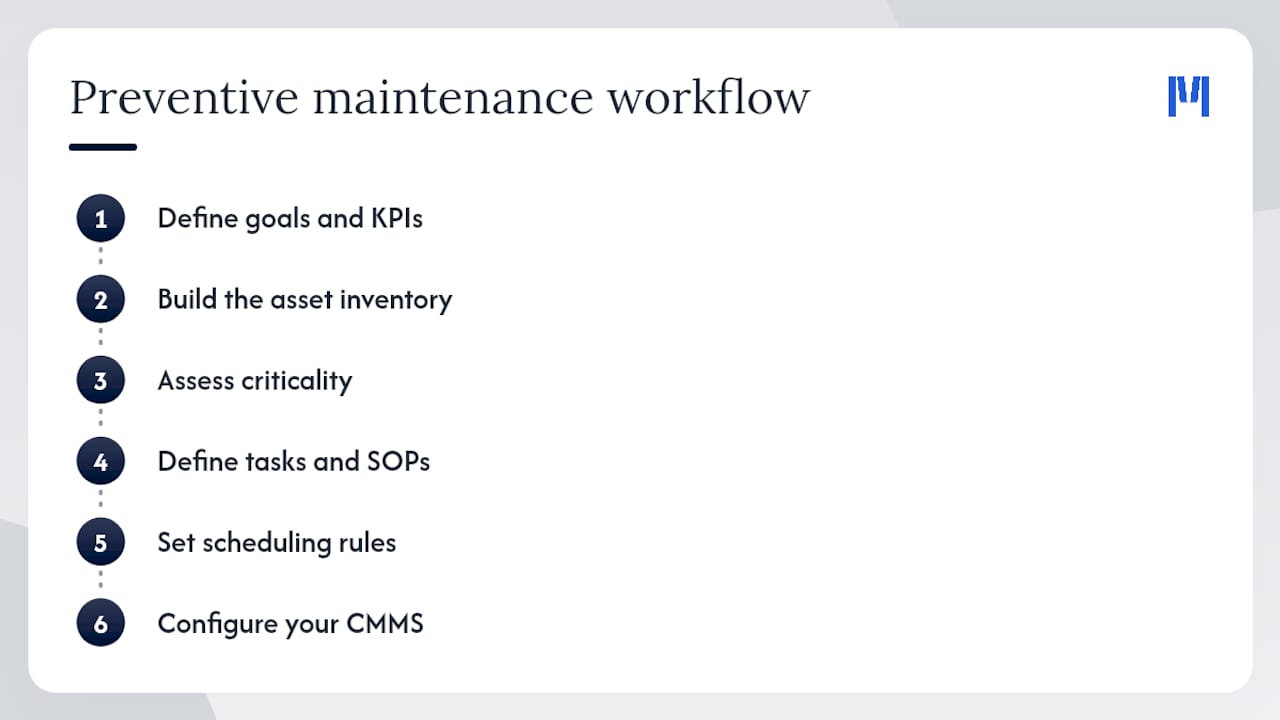
The recommended workflow runs eight steps: define goals and KPIs, build the asset inventory, assess criticality, define tasks and SOPs, set scheduling rules, configure your CMMS, run a 90-day pilot on a small asset group, then review and scale.
Step 1: Define goals and KPIs
Start with the outcome you’re managing toward. Common goals include reducing unplanned downtime by a target percentage, achieving a specific ratio of planned-to-reactive work, or meeting a compliance deadline. Attach a KPI to each goal before you write a single task — otherwise you have no way to tell whether the plan is working.
Step 2: Build the asset inventory
List every maintainable asset with its ID, description, location, manufacturer, model, serial number, installation date, and current condition. For equipment dealerships and workshop operations, this often maps directly to the asset lifecycle records already held in your dealer management system.
Step 3: Assess criticality
Score each asset on safety impact, production impact, and replacement cost. A simple 1–3 scale on each dimension gives you a composite score to rank assets. High-criticality assets get detailed SOPs and tight intervals; low-criticality assets may get annual checks or reactive treatment.
Step 4: Define tasks and SOPs
For each high and medium-criticality asset, write a task list: what to inspect, what to lubricate, what to test, what measurements to record, and what the acceptable ranges are. Link each task to the relevant SOP document and list the parts and tools required.
Step 5: Set scheduling rules
Assign an interval type (time, usage, or condition) and a specific trigger value to each task. Use manufacturer recommendations as the starting point, then adjust based on your operating environment and failure history.
Step 6: Configure your CMMS
Load the asset register, task lists, intervals, and responsibilities into your CMMS. A properly configured system automates compliance schedules, assigns qualified technicians, and maintains audit trails for inspections and essential safety measures — removing the manual tracking burden from your team.
Step 7: Run a 90-day pilot
Pick five to ten assets that represent a cross-section of your criticality tiers. Execute the plan for 90 days, track a small set of KPIs (completion rate, defects found, reactive work orders generated), and collect technician feedback on task clarity and timing.

Pro Tip: Resist the urge to track every possible metric in the pilot. Pick three KPIs maximum — completion rate, defect detection rate, and reactive-to-planned ratio. More than that and the review meetings become data-sorting exercises rather than decision-making sessions.
Step 8: Review and scale
After 90 days, review the pilot data. Adjust intervals where tasks are consistently finding no defects (you may be over-servicing) or where failures are still occurring between services (interval is too long). Then roll the plan out to the full asset register.
Sample asset register row:
| Field | Example value |
|---|---|
| Asset ID | COMP |
| Description | Air compressor, 15 kW |
| Location | Workshop Bay 2 |
| Criticality | High |
| Interval | 250 operating hours |
| Last service | March 2025 |
| Next due | — / September 2025 |
| Assigned technician | J. Nguyen |
| SOP reference | SOP-COMP-v2 |
90-day pilot milestones:
| Week | Milestone | Owner |
|---|---|---|
| 1–2 | Asset register finalized, CMMS loaded | Maintenance manager |
| 3–4 | First work orders issued and completed | Lead technician |
| 5–8 | Mid-pilot KPI review, SOP adjustments | Maintenance manager + technicians |
| 9–12 | Final pilot review, scale-up decision | Operations manager |
Which type of preventive maintenance fits your assets?
Three scheduling models cover most situations: time-based, usage-based, and condition-based. Choosing the right one for each asset class directly affects labor cost, parts consumption, and failure risk.
| Type | Trigger | Best-fit assets | Data needed | Cost driver |
|---|---|---|---|---|
| Time-based | Calendar interval (weekly, monthly, quarterly) | HVAC, fire systems, low-usage equipment | None beyond a calendar | Labor time per visit |
| Usage-based | Operating hours, cycles, or distance | Heavy equipment, compressors, engines | Hour meter or cycle counter | Parts consumption at trigger points |
| Condition-based | Sensor reading, oil analysis, vibration data | High-value rotating equipment, hydraulics | Monitoring sensors or lab analysis | Monitoring infrastructure |

Time-based scheduling is the simplest to implement and suits assets where failure risk is primarily age-driven. HVAC systems, fire suppression equipment, and electrical switchboards typically fall here. The risk is over-servicing: if an asset is used infrequently, a monthly calendar interval may trigger work that isn’t yet needed.
Usage-based scheduling suits heavy equipment and engines where wear correlates more closely with operating hours than calendar time. A dozer running two shifts a day accumulates wear far faster than one used for occasional site work — a calendar interval treats them identically, which is inefficient for one and potentially unsafe for the other.
Condition-based maintenance is the most targeted approach. OEM telematics systems like Komatsu’s Komtrax enable moving from fixed time-based servicing to usage- or condition-driven schedules, reducing unplanned downtime by scheduling service when the machine’s data signals it’s needed rather than at an arbitrary calendar point. Hastings Deering’s approach takes this further, converting thousands of machine data inputs into a small set of clear maintenance recommendations using AI and condition monitoring.
Most facilities use a hybrid: time-based for low-to-medium criticality assets, usage-based for production-critical machinery, and condition-based for high-value assets where monitoring infrastructure is already in place.
Pro Tip: When moving from time-based to condition-based on a high-value asset, run both in parallel for one full service cycle. Compare the condition-based trigger date against the time-based date. If condition data consistently triggers service earlier than the calendar, your time interval is too long; if it triggers later, you’re over-servicing.
How do you set maintenance intervals and estimate costs?
Start with the manufacturer’s recommended intervals, then adjust for your operating environment. A compressor running in a dusty workshop needs more frequent filter changes than the same model in a clean environment. Failure history is the most reliable calibration tool: if an asset has failed between scheduled services twice in 12 months, the interval is too long.
Typical interval and task-time reference:
| Asset type | Common interval | Typical task time | Key cost driver |
|---|---|---|---|
| HVAC unit (commercial) | Quarterly | 2–4 hours | Filter and coil replacement |
| Diesel generator | 250 hours or 6 months | 3–5 hours | Oil, filters, belts |
| Air compressor | annually | 2–3 hours | Oil, filters, valve check |
| Fire suppression system | 6 months (AS 1851) | 1–2 hours | Compliance inspection fee |
| Forklift (electric) | 250 hours | 1–2 hours | Battery, hydraulics check |
Estimating annual maintenance cost:
A simple calculation: multiply the number of scheduled tasks per year by the average labor hours per task, then add estimated parts cost. Compare that total against the cost of a single day of unplanned downtime for that asset. For production-critical equipment, one unplanned outage often exceeds the entire annual PM budget. The ROI case for scheduled servicing is built on exactly this comparison.
Budgeting tips worth applying:
- Negotiate fixed-price servicing agreements with OEM dealers for high-value equipment. Fixed-price service programs give predictable costs, priority parts access, and condition reporting — all of which simplify annual budget submissions.
- Bundle multiple assets’ services into single technician visits where geography allows. Travel time is often the largest cost component for field service.
- Maintain a minimum spare-parts buffer for high-criticality assets. Identify the three to five parts most likely to be needed at each service and keep them on the shelf.
- Review the parts buffer quarterly and adjust based on actual consumption data from your CMMS.
Pro Tip: If your assets have telematics, use the operating-hours data to shift from calendar-based to hours-based intervals. A machine that’s been idle for two months doesn’t need an oil change just because the calendar says so — and one running double shifts may need service well before the calendar date.
What Australian compliance requirements apply to your PM plan?
Compliance is mandatory for safety-critical systems in Australia. Your PM plan must produce auditable records that satisfy WHS obligations, relevant Australian Standards, and any jurisdictional requirements that apply to your facility type.
Key compliance principle for Australian facilities: Maintenance records are not just operational history — they are legal and insurance evidence. A digital, timestamped audit trail is the minimum standard for WHS compliance and insurance defensibility. Gaps in records are treated as gaps in compliance, regardless of whether the work was actually performed.
Core standards and obligations to fold into your PM plan:
- AS 1851 (Maintenance of fire protection systems and equipment): Prescribes specific inspection frequencies, test procedures, and record-keeping requirements for fire systems. Non-compliance carries significant liability exposure.
- AS/NZS 3000 (Wiring rules) and AS/NZS 3760 (In-service safety inspection and testing of electrical equipment): Relevant for electrical systems and test-and-tag programs.
- WHS Act and Regulations (Commonwealth and state/territory): Require that plant and equipment is maintained in a safe condition. The duty holder must be able to demonstrate compliance through records.
- NABERS (National Australian Built Environment Rating System): For commercial buildings, NABERS energy ratings are directly affected by HVAC and building services maintenance quality. Poor PM leads to energy performance degradation that shows up in ratings.
- AIRAH DA19: Provides outcomes-based guidance for HVAC&R maintenance, recommending that maintenance objectives and KPIs be defined before tasks are specified.
Practical compliance checklist:
- Confirm which AS standards apply to each system in your facility
- Verify contractor competency and licensing for safety-critical work (fire, electrical, pressure vessels)
- Set record retention periods (typically seven years for WHS-related records in most Australian jurisdictions)
- Schedule compliance inspections at the frequencies the relevant standard prescribes, not at your preferred interval
- Store records in a system that produces a timestamped, tamper-evident audit trail
A properly configured CMMS automates compliance schedules, assigns qualified technicians, and maintains audit trails for inspections and essential safety measures. For building and facility maintenance documentation, NATSPEC’s maintenance management system guide provides a structured template for translating compliance requirements into contract and Building and Facility Maintenance Plan (BFMP) documentation.
What mistakes undermine a PM plan and how do you catch them early?
The most common failure mode isn’t a missing task — it’s a plan that was built without technician input, applied uniformly to every asset regardless of criticality, and never reviewed after launch.
Common mistakes:
- Applying the same service interval to all assets regardless of criticality or usage
- No spare-parts policy, so scheduled services get deferred because parts aren’t available
- Work orders closed without findings recorded, producing an audit trail with no diagnostic value
- No technician input during plan design, leading to tasks that are impractical in the field
- Intervals set from manufacturer defaults and never adjusted based on actual failure history
Quick 15–30 minute site walkthrough checklist:
- Pull the last 10 closed work orders and check that findings are recorded on each one.
- Verify that the three most critical assets have a scheduled service due within the next 30 days.
- Check the spare-parts shelf for the top five consumables used in the last quarter.
- Ask one technician to describe the SOP for a high-criticality asset service. If they can’t, the SOP isn’t being used.
- Look at the backlog: if more than 20% of scheduled work orders are overdue, the plan is generating more work than the team can execute.
Red-flag indicators that a plan is failing:
- Reactive work orders are increasing month over month
- The same asset is failing repeatedly despite scheduled maintenance
- Technicians are closing work orders faster than the task time allows
- Compliance inspection dates are being missed or rescheduled repeatedly
Pro Tip: Export your CMMS work order data monthly into a simple spreadsheet and calculate the planned-to-reactive ratio. If reactive work is trending above 30% of total work orders, the plan needs an interval review — not more technicians.
Treating preventive maintenance as a strategic investment
The framing matters. Facility managers who present PM as an operating cost tend to fight for budget every year. Those who frame it as a capital protection strategy — with a clear ROI tied to avoided downtime and extended asset life — tend to get funded.
The business case for preventative maintenance rests on a straightforward comparison: the cost of a scheduled service versus the cost of an unplanned failure. For production-critical equipment, that comparison almost always favors the scheduled service, often by a significant margin when you account for emergency labor, expedited parts, and lost production.
Australian mining and construction operations have demonstrated this clearly. Condition-monitoring programs that shift from fixed-interval to data-driven servicing reduce unnecessary interventions while catching genuine degradation earlier. The result is fewer emergency callouts, longer component life, and maintenance windows that can be planned around production schedules rather than forced on them.
The connection to capital planning is direct. A PM program that produces reliable MTBF data tells you when an asset is approaching end of economic life — before it fails catastrophically. That data feeds procurement decisions, lease-versus-buy analyses, and capital budget submissions with evidence rather than estimates. Maintenance strategy and capital planning are the same conversation, just at different time horizons.
Moderndms helps equipment dealerships run PM plans without the admin overhead
Equipment dealerships and workshop teams running PM programs across multiple assets face a specific problem: the administrative load of tracking work orders, parts, compliance records, and maintenance contracts across disconnected systems. Spreadsheets break down at scale, and generic CMMS tools often lack the dealer-specific workflows that make the difference between a plan that runs itself and one that requires constant manual intervention.

Moderndms is built specifically for Australian equipment dealerships, with maintenance contract management that handles recurring service agreements, automated work order generation, and billing in a single workflow. The workshop service module covers work orders, technician assignments, and job costing, while the parts and warehouse module tracks spare-parts inventory against scheduled demand. The offline-capable mobile app means field technicians can record findings and close work orders on-site, producing the timestamped audit trail that Australian WHS and AS 1851 compliance requires. There’s no lock-in, setup takes under an hour, and the platform integrates with Xero and MYOB.
If your team is managing PM schedules across spreadsheets and paper job cards, book a demo with Moderndms to see how the platform handles the full maintenance workflow.
Useful sources and further reading
The standards and guidance below are the primary references for building compliant, well-documented PM plans in Australia.
| Source | What it covers | Where to apply it |
|---|---|---|
| AS 1851 | Maintenance of fire protection systems — inspection frequencies and records | Fire system PM schedules and compliance checklists |
| AIRAH DA19 | Outcomes-based HVAC&R maintenance guidance | HVAC task design and KPI setting |
| AS/NZS 3760 | In-service safety inspection and testing of electrical equipment | Test-and-tag programs and electrical PM |
| NATSPEC TG-403 | Building and facility maintenance management system documentation | BFMP structure and contract templates |
| AS/ISO 4100 series | Facilities management principles and terminology | Program governance and performance frameworks |
Key references:
- The Business Case for Investing in Preventative Maintenance
- The value of servicing with the OEM: Why Komatsu Service makes a difference | Komatsu Australia
- The ROI of Preventative Maintenance: Does Downtime Cost More Than Maintenance? — Nupac
- CMMS Australia facilities compliance guide | Infodeck
- Hastings Deering’s total asset approach to maximising uptime — Australian Mining
- Guide to building and facility maintenance management system and documentation (NATSPEC)
- Preventative vs reactive: finding the ‘sweet spot’ | Industry Partners
Use these sources to build your task checklists, set compliance-driven intervals, and structure the audit evidence your facility needs. Cross-reference the relevant AS standard against each asset class in your register to confirm which inspection frequencies and record-keeping requirements apply.
FAQ
What is a preventive maintenance plan?
A preventive maintenance plan is a documented schedule of inspections, servicing tasks, and intervals designed to prevent asset failures before they occur. It includes an asset register, task definitions, scheduling rules, assigned responsibilities, and a complete maintenance record.
What are the main types of preventive maintenance?
The three core types are time-based (calendar intervals), usage-based (operating hours or cycles), and condition-based (triggered by sensor data or inspection results). Most facilities use a combination, applying the type that best matches each asset’s failure pattern.
What makes a good preventive maintenance program?
A good program prioritizes assets by criticality, uses calibrated intervals based on manufacturer guidance and failure history, assigns clear responsibilities, and tracks a small set of KPIs — particularly the planned-to-reactive work order ratio and asset availability. Technician involvement in plan design and a regular review cycle are what separate programs that improve over time from those that stagnate.
What Australian standards apply to preventive maintenance plans?
AS 1851 governs fire protection system maintenance, AS/NZS 3760 covers electrical equipment inspection and testing, and WHS legislation requires that plant and equipment be maintained in a demonstrably safe condition. AIRAH DA19 provides outcomes-based guidance for HVAC&R systems. NATSPEC’s TG-403 guide covers building and facility maintenance documentation requirements.
How does a CMMS support preventive maintenance compliance in Australia?
A properly configured CMMS automates inspection schedules at AS 1851-style intervals, assigns qualified technicians to each work order, and maintains a timestamped audit trail that satisfies WHS and insurance requirements. Moderndms covers this workflow for equipment dealerships, linking maintenance contracts, work orders, parts inventory, and compliance records in a single platform.