How to Master the Quote-to-Order Process in B2B Sales
By MDMS Team · 7 August 2026

How to Master the Quote-to-Order Process in B2B Sales
Quote-to-order (Q2O) is the sales stage that converts an approved quote into a confirmed sales order. It sits between lead qualification and order fulfillment inside the broader lead-to-cash cycle, and it is where most sales-to-finance friction accumulates. Getting it right means aligning three systems from the start: your CPQ or quoting tool, your CRM, and your ERP or finance platform.
If you want to act now, start here:
- Check your quote expiry clause. Every quote your team sends should carry a defined expiry date, consistent with common Australian B2B practice, to avoid being held to outdated pricing.
- Confirm your acceptance method. Decide whether you accept orders by signature, email confirmation, purchase order, or deposit, and make that explicit on every quote document.
- Measure your current time-to-quote. If you do not know how long it takes from a customer request to a sent quote, you cannot identify where the process is slow.
- Map your system handoffs. Identify whether your quoting tool passes data directly to your order management system and finance platform, or whether someone is re-keying it manually.
Key Takeaways
The single most important action in any Q2O modernization is fixing your price data and approval matrix before configuring any software, because automation built on inaccurate data produces faster errors, not fewer ones.
| Point | Details |
|---|---|
| Define acceptance clearly | Every quote must state the acceptance method (signature, PO, deposit) to form a binding contract under Australian law. |
| Fix price data first | A single, locked price book is the foundation of accurate quoting; CPQ built on outdated pricing replicates errors at scale. |
| Automate approvals by rule | Codify which discount levels need review and which do not; this cuts approval cycle time without removing necessary oversight. |
| Track time-to-quote weekly | Under 24 hours for standard configurations is the operational target; consistent delays signal a process or system gap. |
| Moderndms for equipment dealers | Moderndms connects CPQ, pricing matrix, approval workflows, and Xero/MYOB integration in one platform built for Australian equipment dealerships. |
Table of Contents
- Where Q2O fits in lead-to-cash and who owns each stage
- The quote-to-order process, step by step
- What to include in a professional quote and how acceptance works in Australia
- The technology stack that makes Q2O faster and more accurate
- Where the quote-to-order process typically breaks and how to fix it
- KPIs and data you should track for Q2O performance
- A practical implementation checklist: pilot, test, and scale
- What actually matters when you modernize Q2O
- Moderndms handles the Q2O workflow equipment dealers actually run
- Sources
- FAQ
Where Q2O fits in lead-to-cash and who owns each stage
The lead-to-cash cycle runs from the first customer contact through to collected payment. Q2O occupies the middle section: it begins when a qualified lead requests a price and ends when a confirmed order is handed to fulfillment and finance. Everything before it is lead generation and qualification; everything after it is delivery, invoicing, and revenue recognition.
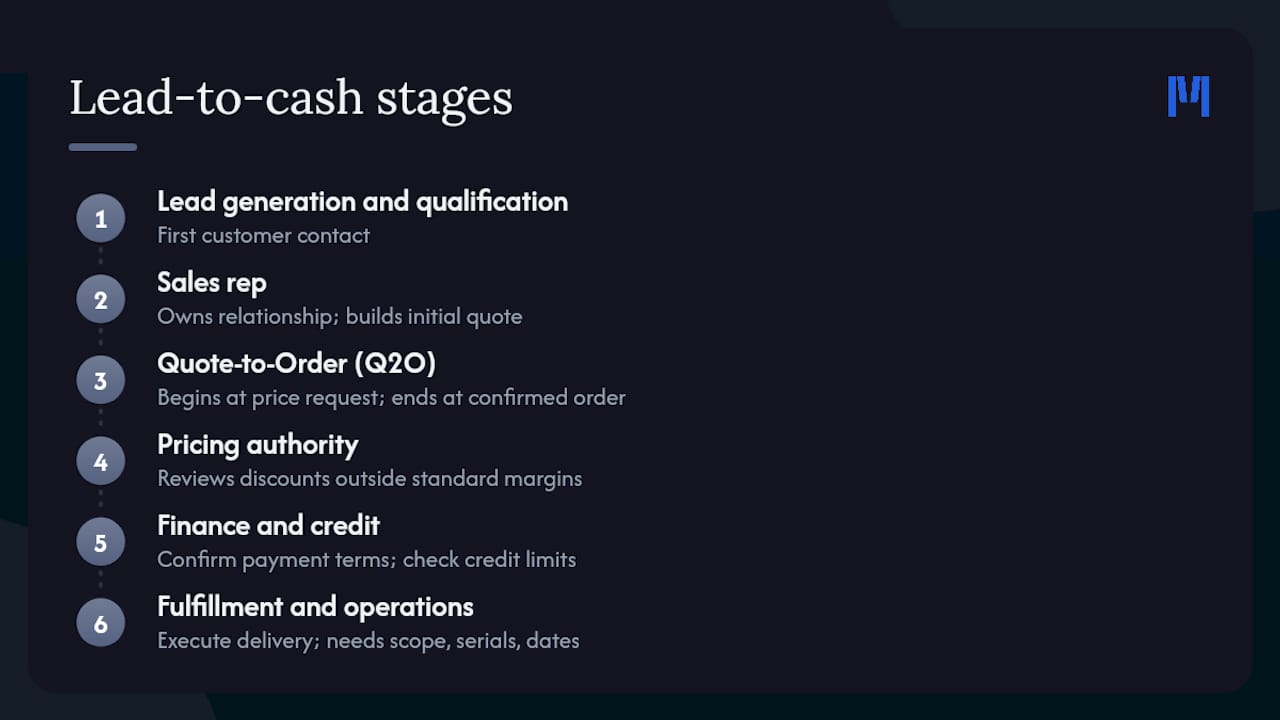
Ownership across that span rarely sits with one person. In a typical B2B equipment dealership, four groups share responsibility:
Sales rep owns the customer relationship, gathers requirements, and builds the initial quote configuration. They are the primary contact through negotiation and follow-up.
Pricing authority (a sales manager or pricing team) reviews discounts that fall outside standard margins. Without a clear approval matrix, this step becomes a bottleneck that stalls deals.
Finance and credit confirm payment terms, check credit limits, and ensure the order can be invoiced correctly once accepted. Skipping this handoff is a common source of revenue leakage when sold items do not match what the billing system expects.
Fulfillment and operations receive the confirmed order and execute delivery, commissioning, or service scheduling. They need accurate scope, serial numbers, and delivery dates from the quote, not a verbal summary.
Clarifying who owns each stage in writing reduces the handoff delays that quietly erode deal velocity. When a quote sits in someone’s inbox waiting for an approval that was never formally assigned, the customer moves on.
The quote-to-order process, step by step
A well-run Q2O workflow follows a defined sequence. The step-by-step quoting procedure from Streamline Projects confirms that moving through each stage in order reduces errors and speeds buyer decisions. Here is how the stages typically run, with realistic timeframes for each.
-
RFQ / requirements capture (Day 1–2). The customer submits a request for quotation or your sales rep gathers requirements directly. For complex or custom equipment, a structured request form prevents missing specifications that force rework later. Quote-based request forms work best when price depends on buyer-provided inputs.
-
Configure and price (Day 1–3). The sales rep selects products, applies the correct price book, and calculates any applicable discounts. This step should pull from a single pricing source of truth, not a spreadsheet copy that may be weeks out of date.
-
Internal review and discount approval (Day 2–4). Any discount outside the standard approval matrix routes to the pricing authority. Automated approval routing cuts this from days to hours when the rules are configured in your CPQ or order management system.
-
Quote generation and document creation (Day 3–5). The system produces the formal quote document, including scope, quantities, unit prices, totals, payment terms, expiry, and acceptance method. This is a decision point for automation: document generation should never require manual formatting.
-
Quote delivery to customer (Day 3–5). The quote is sent by email, customer portal, or both. Delivery via a portal creates an automatic audit trail and allows click-to-accept functionality.
-
Follow-up and negotiation (Day 5–14). The sales rep follows up within two to three business days if no response is received. Quotes for straightforward purchases are typically finalized within 2–4 weeks; tenders and proposals require longer timeframes and more documentation.
-
Customer acceptance (Day 5–21). The customer accepts by signature, written confirmation, email, or by issuing a purchase order. Under Australian Consumer Law, any of these triggers a binding contract.
-
Order creation (Day 5–21, same day as acceptance). The accepted quote converts to a sales order in your order management system. This conversion should be automatic, not a manual re-entry step.
-
Handover to fulfillment and finance (Day 5–22). The confirmed order flows to operations for delivery scheduling and to finance for invoicing setup. An RFQ-to-PO workflow formalizes this handover: the buyer’s purchase order references the quote number, and your system links both documents.
Pro Tip: Set your CPQ or quoting tool to auto-route any discount above a defined threshold to the approver’s queue, with a 24-hour escalation if no action is taken. This single rule eliminates most approval bottlenecks without adding manual oversight.
What to include in a professional quote and how acceptance works in Australia
A quote is a formal commercial offer. Business Queensland’s guidance specifies that a professional quote should include scope, quantities, costs, payment terms, timeline, assumptions and exclusions, expiry, and a clear acceptance mechanism. Miss any of these and you create either a commercial dispute or an unenforceable document.
Essential elements checklist:
- Business name, ABN, and contact details
- Customer name and delivery address
- Quote number and date issued
- Itemized scope: product descriptions, part numbers, quantities, unit prices, and totals (including GST)
- Assumptions and exclusions (what is not covered)
- Delivery schedule or lead time
- Payment terms (deposit, progress payments, or net terms)
- Expiry date (commonly used in Australian practice)
- Variation process (how changes to scope are handled)
- Acceptance method and sign-off block
- Reference to your Terms of Trade
Australian legal note: Under Australian Consumer Law, a quote becomes a legally binding contract when the customer accepts it. Acceptance can occur through signing the quote, sending written confirmation by email, issuing a purchase order, or paying a deposit. Legal advisors recommend treating every quote as part of the contracting process: include your Terms of Trade, a clear acceptance block, an expiry date, and a defined variations process. Courts examine the quote, the incorporated terms, and the acceptance pathway together when disputes arise.
The acceptance block deserves particular attention. It should state explicitly: “By signing below / issuing a purchase order / paying the deposit, the customer agrees to the scope and Terms of Trade referenced in this document.” That single clause, combined with an audit trail (e-signature log, email thread, or portal timestamp), is your primary protection if a scope dispute emerges later.
Pro Tip: If your quote is not yet final or is subject to further negotiation, add “Subject to contract” above the acceptance block. This signals that the document is not yet binding, which matters when pricing is still being confirmed with a supplier.
The technology stack that makes Q2O faster and more accurate
The tools that matter in a Q2O workflow are CPQ (configure, price, quote), CRM, ERP or finance, e-signature, and customer portal. Each plays a distinct role, and the integration between them is where most teams either gain or lose efficiency.
CPQ handles product configuration, pricing rules, discount controls, and document generation. It is the engine of the quote generation process and should be the single source of truth for what was quoted and at what price.
CRM holds the customer record, opportunity history, and communication log. When CPQ and CRM are connected, a sales rep can generate a quote directly from an opportunity without re-entering customer data.
ERP or finance platform receives the confirmed order and drives invoicing, inventory allocation, and revenue recognition. Aligning quoting architecture with finance ensures that what is sold is billable from day one, which is the core mechanism for preventing revenue leakage.
E-signature captures legally valid acceptance without requiring a physical document exchange. Combined with a portal timestamp, it creates an audit trail that satisfies Australian contract requirements.
Customer portal allows buyers to request quotes, review versions, and accept online. For equipment dealers managing multiple active quotes, a portal reduces inbound phone calls and email threads significantly.
Evaluation checklist for any Q2O technology solution:
- Single price book with role-based discount controls
- Automated approval routing with escalation rules
- Document versioning with a complete audit trail
- E-signature capability with timestamp and IP logging
- GST-compliant document output (Australian tax requirements)
- Native integration with Xero or MYOB for invoicing
- Offline capability for field sales teams
- Customer portal for quote requests and acceptance
- Direct order handover to ERP without manual re-entry
Pro Tip: Before evaluating any CPQ vendor, map your current pricing exceptions. If your team regularly applies discounts that are not in any price book, those exceptions need to be codified as rules before you configure the system. A CPQ built on undocumented pricing habits will replicate the same errors at scale.
Where the quote-to-order process typically breaks and how to fix it
Most Q2O failures are predictable. The same five problems appear across dealerships of different sizes, and each has a concrete fix.
Manual data re-entry between systems. When a sales rep builds a quote in one tool and then manually copies it into the order management system, errors follow. The fix is a direct integration between your quoting tool and your ERP so the accepted quote converts to an order automatically. Data should travel once.
Version control failures. A customer receives version 2 of a quote; your team is working on version 4. When they accept, nobody is sure which scope applies. The fix is a document versioning system that locks previous versions and clearly marks the current one. Every quote should carry a version number and a “supersedes” note.
Approval bottlenecks. A quote requiring manager sign-off sits in an inbox for three days while the customer waits. The fix is an automated approval queue with a defined response window and an escalation path. Most CPQ tools support this natively.
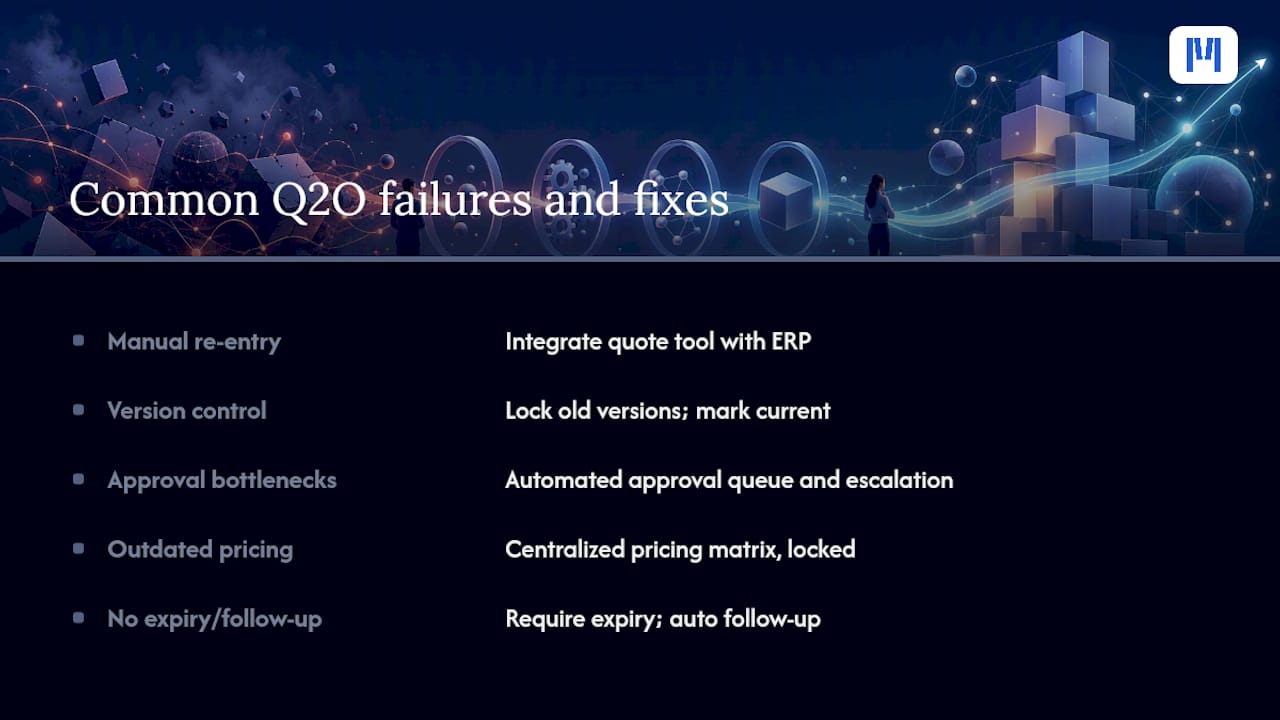
Disconnected or outdated pricing lists. A sales rep quotes from a spreadsheet that has not been updated since the last supplier price change. The customer accepts, and the margin is wrong. The fix is a centralized pricing matrix that is the only source reps can quote from, updated by the pricing authority and locked for editing by sales.
Missing expiry dates and follow-up cadence. A quote goes out with no expiry and no follow-up scheduled. Six weeks later the customer accepts at the old price, which is now below cost. The fix is a mandatory expiry field in your quoting template and an automated follow-up task created at the moment the quote is sent.
The compounding cost of manual Q2O. Each of these problems alone is manageable. Together, they create a process where pricing errors, missed follow-ups, and re-entry mistakes accumulate across every deal in your pipeline. A clear purchase order that references the accepted quote by number and version is the simplest way to close the loop between acceptance and order creation, and it gives both parties a shared document to resolve disputes against.
KPIs and data you should track for Q2O performance
Tracking the right metrics tells you where the process is slow, where pricing is leaking, and where automation will have the most impact.
Use these KPIs as a diagnostic tool, not just a scorecard. If approval cycle time is consistently above 24 hours, the approval matrix needs restructuring before you invest in any other automation.
A practical implementation checklist: pilot, test, and scale
Rolling out a new Q2O process works best in three phases. A focused pilot beats a full deployment for buy-in and risk control.
Pre-implementation (weeks 1–2)
- Inventory all current quote templates and identify which fields are missing (expiry, acceptance block, Terms of Trade reference).
- Map your current quote-to-order flow and mark every manual handoff or re-entry step.
- Identify your single price book: where does it live, who owns it, and when was it last updated?
- Define your approval matrix: which discount levels require which approver?
- Select a pilot product line or customer segment with manageable volume.
Pilot phase (weeks 3–10)
- Configure your CPQ or quoting module for the pilot scope only.
- Integrate with CRM for customer data and with your ERP or finance platform for order handover.
- Run scripted test quotes through every stage, including an approval rejection and a version revision.
- Capture your baseline KPIs (time-to-quote, conversion rate, pricing accuracy) before go-live.
- Collect feedback from the sales rep, approver, and finance contact after the first 10 live quotes.
- Iterate for 4–8 weeks before expanding scope.
Scale phase (months 3–6)
- Roll out training to the full sales team, with a focus on the acceptance block and expiry rules.
- Lock in governance: publish the pricing authority matrix and make it the official reference.
- Schedule a phased module rollout (add customer portal, then e-signature, then automated follow-up).
- Measure ROI at 90 days and 180 days against your baseline KPIs.
Pro Tip: Run your first pilot quote end-to-end with a real customer, not a test account. Synthetic tests miss the edge cases that real orders surface, such as a customer requesting a scope change after the quote is sent but before they sign.
What actually matters when you modernize Q2O
The most common mistake teams make when modernizing their quote-to-order workflow is starting with the software. They evaluate CPQ vendors, schedule demos, and build a business case before they have answered three foundational questions: Is our price data accurate? Do we have a defined approval authority? And does our team know what triggers a binding contract?
Software amplifies whatever process it runs on. A CPQ tool built on a price book that nobody trusts will generate quotes faster, but the pricing errors will multiply at the same speed. The right sequence is to fix the data and the governance first, then automate.
Approval automation deserves a specific note. The goal is not to remove human judgment from pricing decisions; it is to remove the friction from decisions that do not require judgment. Building that distinction into your approval matrix is the work that makes automation useful rather than just fast.
Finally, measure early and be willing to act on what you find. A 90-day pilot that surfaces a pricing leakage problem is a success, not a failure. The teams that get the most value from Q2O modernization are the ones that treat the first KPI report as a starting point for iteration, not a verdict on the project.
Moderndms handles the Q2O workflow equipment dealers actually run
Equipment dealers face a version of the quote-to-order process that general CRM tools were not built for: configuring machines with optional attachments, checking parts availability before quoting lead times, managing rental fleet availability alongside sales quotes, and producing GST-compliant documents that flow directly to Xero or MYOB.
Moderndms is built specifically for that workflow. The platform’s sales and CPQ module connects product configuration, pricing matrix, and approval routing in one place, with a direct handover to finance and fulfillment. Dealers using Moderndms report saving up to 10 hours per week in administrative tasks, with pricing errors reduced because every quote draws from a single, locked price matrix. There is no long-term contract, setup takes under an hour, and your data stays yours. If you are evaluating whether a purpose-built platform fits your dealership’s Q2O needs, the equipment dealer management software page is the right place to start, or book a demo to see the quoting workflow live.
Sources
The following resources support the legal and operational points in this article and are worth bookmarking for your own Q2O documentation.
- Creating a formal quote | Sprintlaw Australia
- Preparing a business quote | Business Queensland
- Quote-to-cash definition and guidance | Zuora
- Tender vs quote vs proposal | CapabilityStatement
FAQ
What is a quote in the context of ordering?
A quote is a formal commercial offer from a seller that specifies price, scope, and terms for a defined product or service. Once the customer accepts it, by signing, issuing a purchase order, or paying a deposit, it can become a legally binding contract under Australian Consumer Law.
What is the quote-to-order process?
The quote-to-order process covers every step from receiving a customer’s price request through to creating a confirmed sales order, including configuration, pricing, internal approval, quote delivery, customer acceptance, and handover to fulfillment and finance.
What is the difference between a PO and a quote?
A quote is issued by the seller and sets out what is being offered and at what price. A purchase order is issued by the buyer to formally accept and authorize that offer. Together, they form the contractual record of the transaction, and a well-structured PO that references the quote number helps prevent scope disputes.
What is the 3-quote rule?
The 3-quote rule is a procurement practice, common in Australian government and corporate purchasing, that requires buyers to obtain at least three competitive quotes before awarding a contract. It is a governance control, not a legal requirement in all contexts, and the threshold that triggers it varies by organization and spend level.
How long does the quote-to-order process typically take?
For straightforward B2B purchases, the full cycle from RFQ to confirmed order typically runs 5–21 days. Standard product quotes can close in under a week; complex or custom equipment configurations with multiple approval layers tend toward the longer end of that range.