3 Contract Demands Equipment Dealers Must Test to Protect DMS Data
By MDMS Team · 6 September 2026

3 Contract Demands Equipment Dealers Must Test to Protect DMS Data
Your dealership must retain ownership of its operational DMS data. Vendors should hold nothing more than a limited license to host and process it on your behalf. Before you sign anything, insist on three things: a written export path, defined transitional assistance, and transparent exit fees. Then verify each one with a real test, not a sales promise.
TL;DR:
- Vendors should provide verifiable sample exports in CSV or JSON format, with complete records of critical data such as inventory, customer, and service history.
- Contracts must explicitly state that dealerships own their operational data, with clear end-of-term export obligations and defined transitional support periods.
- Conduct real tests of data exportability and API access before renewal, checking for comprehensive data, proper formatting, and documented costs or limitations.
- Dealerships must build and maintain independent backups outside vendor systems to prevent prolonged outages or data loss during vendor outages, acquisitions, or disputes.
- Clear breach notification, overseas data transfer safeguards, and audit rights are essential to manage privacy risks and regulatory compliance effectively.
Table of Contents
- What Should You Do Now to Protect Your DMS Data Rights?
- What Does “Data Ownership” Actually Cover in a DMS?
- Which Contract Clauses Should You Insist on Before You Sign?
- How Do You Prove Your Data Is Actually Portable?
- What Privacy Risks Come With Poor Data Accessibility?
- Balancing Vendor Value With Data Independence
- How MDMS Handles Data Ownership in Practice
- Where to Verify the Standards Behind This Checklist
- Sources
- FAQ
What Should You Do Now to Protect Your DMS Data Rights?
Data ownership disputes almost never start as disputes. They start as vague contract language nobody questioned during onboarding, three years before anyone thought about switching vendors. Run through this checklist before you sign a new agreement, or before you renew an old one you have never actually tested.
- Ask your vendor for a plain-language data ownership and end-of-term clause, and get it in writing rather than a verbal assurance from a sales rep.
- Request a full sample export, in CSV or JSON, of your critical tables: inventory, customer records, service history, and transaction logs. Check that every field is complete, not summarized.
- Confirm API availability in writing, including documentation, rate limits, and whether access carries a hidden cost.
- Get transitional assistance commitments on paper, specifying scope, a defined number of business days, and which party handles which task.
- Start building an independent backup strategy now, before you need it, so a migration is never a scramble.
Pro Tip: Request the sample export before your contract renewal date, not after. A vendor with nothing to hide will produce one within days; a vendor stalling for weeks is telling you something about how the exit conversation will go.
What Does “Data Ownership” Actually Cover in a DMS?
Ownership in a dealer management system applies to the operational records your team generates every day, not the software itself. That distinction trips up a lot of buyers during procurement.
The data that belongs to your dealership typically includes:
- Inventory records, including serial numbers, cost, and condition history
- Customer and CRM data, including contact details, purchase history, and communication logs
- Service records, including work orders, technician notes, and parts consumed
- Parts and warehouse data, including stock levels and supplier pricing
- Rental and contract records, including fleet assignments and billing terms
- Transaction and financial logs tied to sales, service, and rental activity
Vendors retain intellectual property over their source code, their user interface, and any proprietary enrichment layered onto your raw records, such as predictive maintenance scoring. What they should never claim is ownership over the underlying facts your business generated. Ownership determines whether you can audit your own operations freely, run reports without a support ticket, and walk away to another provider without losing years of service history. The AADA Dealer Data and Software Systems Framework states plainly that dealer data must remain freely accessible for the term of the agreement, in exportable form, without onerous processes standing in the way.
Which Contract Clauses Should You Insist on Before You Sign?
Most data ownership disputes trace back to a contract that was silent, not hostile. Silence lets a vendor make the rules later, on their terms, when you have the least leverage: mid migration.
Insist on these clauses before signing:
- An explicit ownership clause stating you own operational records, with the vendor holding only a limited license to host and process that data.
- End-of-term export obligations specifying formats, timelines, and confirmation that both raw and enriched data will be returned.
- API and integration commitments naming endpoints, documentation access, and any associated costs, documented rather than assumed.
- Transitional assistance terms with defined scope and a set number of free support days, plus itemized fees for anything beyond that.
- Sub-processor disclosure, hosting location, and audit or cooperation clauses covering how a data breach gets handled and reported.
Sprintlaw’s guidance on drafting SaaS contracts in Australia recommends separating “ownership” from “licensing” in explicit terms, rather than leaving the relationship implied. That separation is what protects you when a vendor is later acquired, restructured, or sold to a private equity firm with different priorities than the founder you negotiated with.
Vendors often transform your raw records into proprietary formats, scored data, or dashboards you paid to have built. Your exit clause should require return of both the original raw records and any enriched version derived from them.
Pro Tip: Negotiate a fixed transitional assistance window, with a defined period of vendor-assisted support at no extra cost, with the scope written into the contract rather than left to a support agent’s discretion after you have already given notice.
How Do You Prove Your Data Is Actually Portable?
A promise of portability is worthless until it is tested. The only way to know whether your DMS data is genuinely portable is to run the export yourself, not to read a marketing page that says it is possible.
A valid sample export should arrive as CSV or JSON with readable, labeled headers and complete records, not a partial dump missing half the fields you need for daily operations. Automated backups should run to storage your dealership controls, not a location only the vendor can reach. API access needs real testing: authentication that actually works, pagination that does not silently drop records past page one, and rate limits documented rather than discovered the hard way during a busy month.
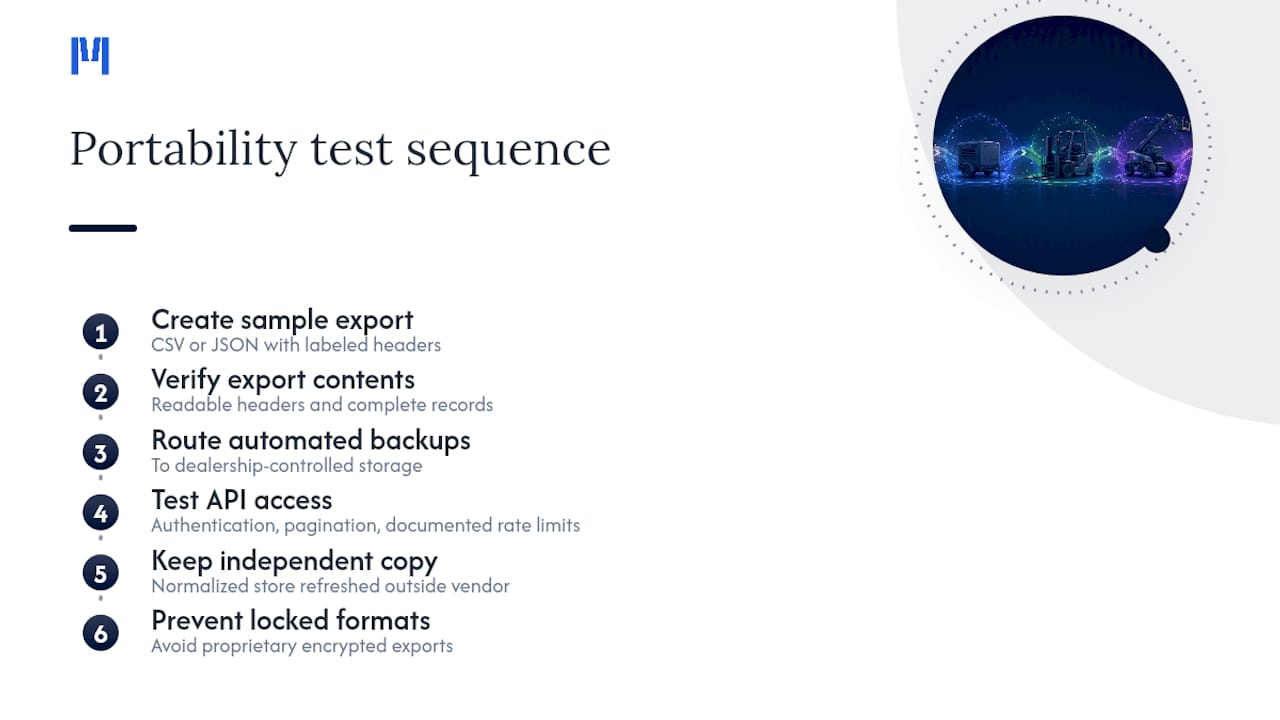
Consider keeping an independent, normalized copy of your critical records in a separate data warehouse or document store, refreshed on a schedule outside the vendor’s system entirely. Avoid vendors that lock exports into proprietary encrypted formats with no open export option. Dealerships without a portable backup have faced migration windows stretching six to twelve months during vendor outages like the CDK ransomware incident, unable to reach inventory, customer, or accounting records for weeks. An independent copy turns a vendor emergency into an inconvenience instead of a business interruption.
What Privacy Risks Come With Poor Data Accessibility?
Weak export terms are not just an operational headache; they also raise important concerns about appointing a Data Protection Officer in Singapore to manage compliance and safeguard customer data properly. They carry real regulatory exposure under the Australian Privacy Principles when personal customer information sits inside a system you cannot fully control or audit.
- Require breach notification and cooperation commitments written into the vendor contract, not left to their discretion.
- Document any overseas data transfers and confirm contractual safeguards apply to that data once it leaves the country.
- Insist on retention, deletion, and role-based access clauses that limit who inside the vendor’s organization can touch your customer records.
- Secure audit rights tied to your own regulatory reporting timelines, so you are never scrambling to produce evidence after the fact.
AADA’s Data Sharing Principles call for written agreements covering third-party access, secure transit, and audit rights, with customer disclosures maintained throughout. Vague contract language here does not just create a business risk. It creates a compliance gap your dealership owns, even when the vendor caused it.
Balancing Vendor Value With Data Independence
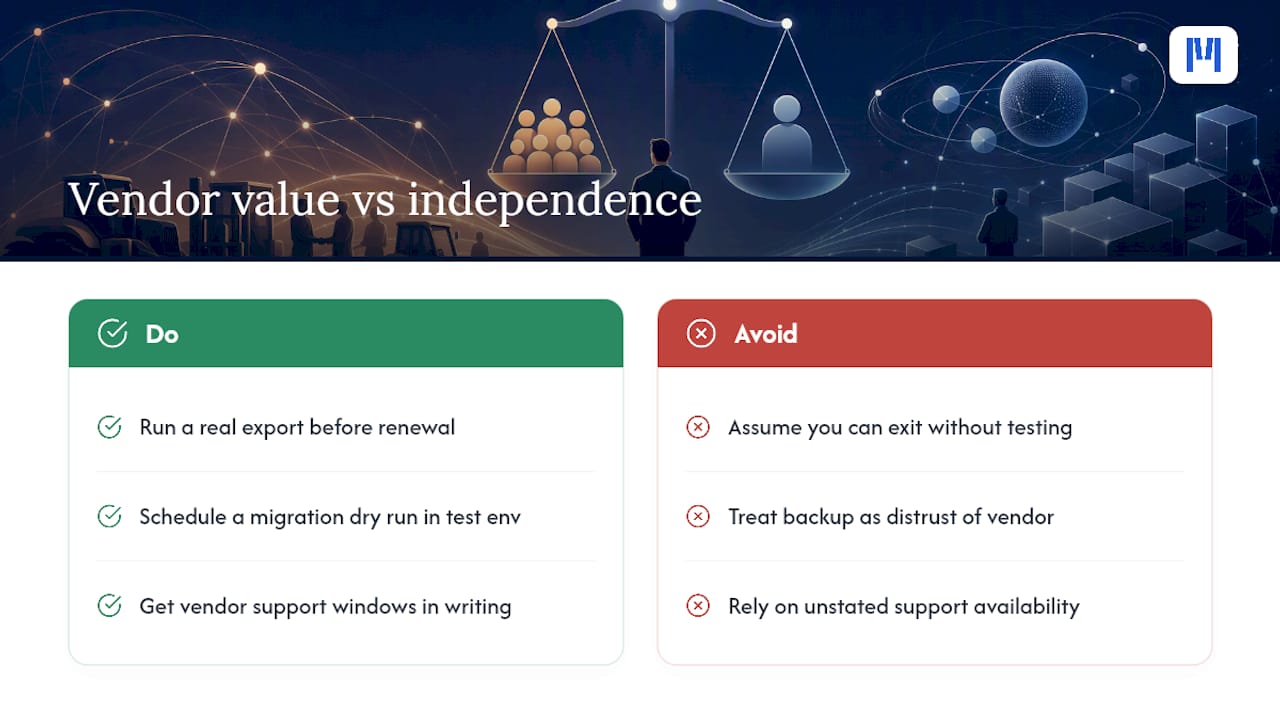
Deep vendor integrations are genuinely worth the tighter dependency when they save your team real hours every week, whether that is automated reconciliation or built-in compliance reporting. The trade-off only becomes a problem when you have not tested your exit before you need one.
An independent backup is not a sign of distrust in your vendor. It is insurance against outages, acquisitions, and disputes that have nothing to do with how good the software is today. Before renewal, run a real export, schedule a migration dry run against a test environment, and get vendor support windows in writing rather than assumed.
— ModernDMS
How MDMS Handles Data Ownership in Practice
MDMS was built on the principle this whole checklist is designed to enforce: dealers own their operational data, full stop, and vendors should never have to be asked twice to prove it. Every dealership using MDMS retains ownership of inventory records, customer data, service history, and rental contracts, with export paths built into the platform rather than bolted on after a support ticket.
That ownership stance runs through the platform’s modular rollout, which lets you activate sales, service, parts, or rental fleet management on your own timeline instead of a forced all-at-once migration. The platform integrates with Xero to facilitate financial data flow without manual re-entry steps at reconciliation. If you are evaluating equipment dealer management software, ask MDMS directly in a demo for a live sample export, a walkthrough of API access, and a written transitional assistance plan. Those three requests will tell you more about a vendor’s real posture on data ownership than any feature list.
Where to Verify the Standards Behind This Checklist
- AADA Dealer Data and Software Systems Framework, the industry standard on exportability and fees.
- Sprintlaw’s SaaS legal checklist for Australia, covering data processing terms and end-of-term handling.
- DMS data export checklist, a practical procurement reference for sample exports and ownership clauses.
Sources
- AADA Dealer Data and Software Systems Framework (2025)
- SaaS contract: how to draft and negotiate in Australia — Sprintlaw
FAQ
Who Legally Owns the Data Inside a DMS?
The dealership owns its operational records, including inventory, customer, and service data, while the vendor holds only a limited license to host and process that information under AADA’s framework.
Can a DMS Vendor Refuse to Export My Data?
A vendor should not refuse a full export of your operational records, and industry guidance requires exportable access without onerous processes; refusal or excessive fees are a red flag worth escalating before you sign a renewal.
What Format Should a Data Export Arrive In?
A usable export should arrive in CSV or JSON with readable, labeled headers and complete records covering both raw data and any enriched data the vendor created from it.
Does MDMS Let Dealerships Keep Full Data Ownership?
Yes. MDMS affirms dealer ownership of operational data and builds export paths, API access, and modular rollout into the platform so dealerships can verify portability during a demo rather than after signing.
How Long Should Transitional Assistance Last After Contract Exit?
A common benchmark is a defined window of vendor-assisted support at no extra cost, with the scope, including exports and API token access, documented in the contract itself.