Labour First Job Costing for Australian Service Managers: Start Fast
By MDMS Team · 22 September 2026

Labour First Job Costing for Australian Service Managers: Start Fast
Job costing for service businesses means tracking every hour, expense, and overhead dollar against a specific customer engagement instead of pooling costs across the whole month. The immediate payoff is accurate job profitability data you can price against. Start today by assigning a unique job code to your next engagement and logging labour hours and direct expenses to it from the first minute of work.
TL;DR:
- Accurate job costing requires tracking wages, direct expenses, and overheads for each engagement to avoid overstated profit margins.
- Using the right overhead allocation method, such as billable hours or vehicle hours, improves cost accuracy across jobs with varying consumption.
- Capturing key data points—materials, site time, drive time, and final invoice—at the moment of service prevents errors and facilitates effective margin analysis.
- Regular reconciliation between job-cost reports and overall accounting records is essential to identify true profitability and maintain GST compliance.
- Implementing simple software setups that automate job codes, time tracking, and expense allocation prevents administrative overload and supports disciplined costing practices.
Table of Contents
- What Job Costing Means for Service Work
- Core Cost Categories You Need to Capture
- How Do You Calculate Job Costing Step by Step?
- Choosing the Right Allocation Base for Overhead
- Building a Job-Costing Workflow That Doesn’t Create Admin Drag
- A Worked Example: From Estimate to Invoice
- Reconciling Job Costs With Your Accounting Records
- Setting Up Software Without Overbuilding It
- Why Disciplined Job Costing Protects Your Margin
- Where MDMS Fits Into Your Job-Costing Workflow
- Sources
- FAQ
What Job Costing Means for Service Work
Job costing treats each customer engagement, project, or work order as its own mini business with its own revenue and its own costs. A repair job, a consulting engagement, a wedding, a field service callout, each gets a job number, and every dollar of labour, materials, and overhead attaches to that number.
This is different from process costing, which averages costs across identical units produced on a continuous line, like a bottling plant. Service work rarely looks like that. A plumber’s Tuesday morning callout and Wednesday afternoon installation are not identical units. They need separate tracking.
Job order costing works well when each customer engagement is distinct, which describes most consulting firms, repair shops, event companies, and field service operations. If your business quotes jobs individually and every job varies in scope, hours, or materials, job-order costing is the right method. If you deliver a genuinely identical service at scale, like a fixed-fee software subscription, you may not need job-level granularity at all.
Core Cost Categories You Need to Capture
Three buckets make up a complete job cost, and missing any one of them will make your margins look better than they actually are.
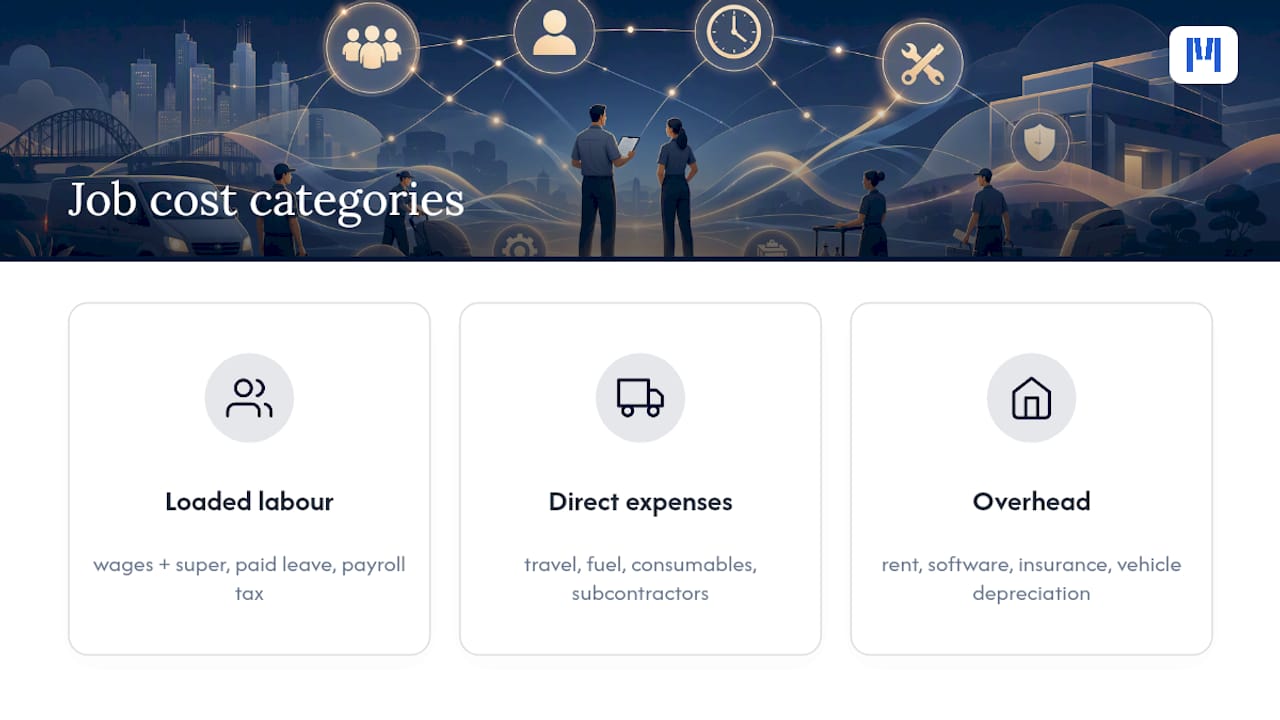
Loaded labour is wages plus every on-cost that comes with employing someone: superannuation, paid leave accrual, workers’ compensation, and payroll tax. Australian training guidance on setting labour rates specifically calls out leave, superannuation, training, and workers’ compensation as on-costs that must sit on top of the hourly wage, not beside it. A technician paid $45 an hour rarely costs the business $45 an hour.
Direct job expenses cover anything bought specifically for that job: travel, fuel, consumables, subcontractor invoices, and supplier purchases tied to that work order. These should never get buried in a general “materials” expense account where you lose the ability to trace them back to the job that consumed them.
Overhead is everything else the job benefits from indirectly: office rent, software subscriptions, insurance, vehicle depreciation, and administrative wages. The most common omission here is vehicle cost. Businesses that send technicians out in utes or vans often forget to allocate fuel, maintenance, and depreciation into the overhead pool, which quietly understates every field job’s true cost.
How Do You Calculate Job Costing Step by Step?
The calculation method is a five-step loop, and it works whether you run a two-person repair shop or a fifty-person field service operation.
- Estimate and document scope. Before work starts, write down what the job involves and assign it a unique job code. Australian training guidance treats this documentation step as mandatory, requiring estimated materials, labour, and overhead to be recorded before calculating a final customer cost.
- Capture every hour worked. Every employee and subcontractor logs time against the job code, whether through a timesheet, a mobile app, or a clock in/clock out system tied to that specific job.
- Attach direct expenses as they happen. Parts, fuel receipts, supplier invoices, and subcontractor bills get coded to the job the moment they’re incurred, not weeks later when someone tries to reconstruct the paper trail.
- Apply your overhead allocation rule. Whatever driver you’ve chosen (billable hours, equipment hours, or a percentage of labour) gets applied here to load overhead onto the job total.
- Invoice, then reconcile. Compare the estimate against the actual cost, calculate the realized margin, and note what drove any variance.
Pro Tip: Set up your job codes before you need them. A dispatcher scrambling to create a code mid job is a dispatcher who forgets to log the first hour of work, and that hour never comes back.
Choosing the Right Allocation Base for Overhead
The allocation base you pick determines whether your job costs reflect reality or just look tidy on paper. A flat percentage of labour cost is the easiest method to set up and the easiest to get wrong.
Billable hours often work better than a labour-dollar percentage, especially once you employ staff at different pay grades. A senior technician billed at $150 an hour and a junior billed at $80 an hour consume overhead differently than their wage gap suggests, and allocating overhead by billable hours rather than raw labour cost tends to reflect that consumption more accurately when rates vary widely across a team.
For workshop or field operations, equipment hours, vehicle hours, or drive time can outperform labour-based drivers entirely. A job requiring three hours of drive time, but only one hour of billable labour consumes real cost that a labour-hours allocation would miss completely.
Model two allocation scenarios side by side before locking one in, then check which one actually explains the cost variation you see between your simplest and most complex jobs.
Building a Job-Costing Workflow That Doesn’t Create Admin Drag
Job costing fails most often not because the math is hard, but because the data capture is tedious enough that people stop doing it by week three. The fix is deciding, in advance, what the minimum viable dataset looks like.
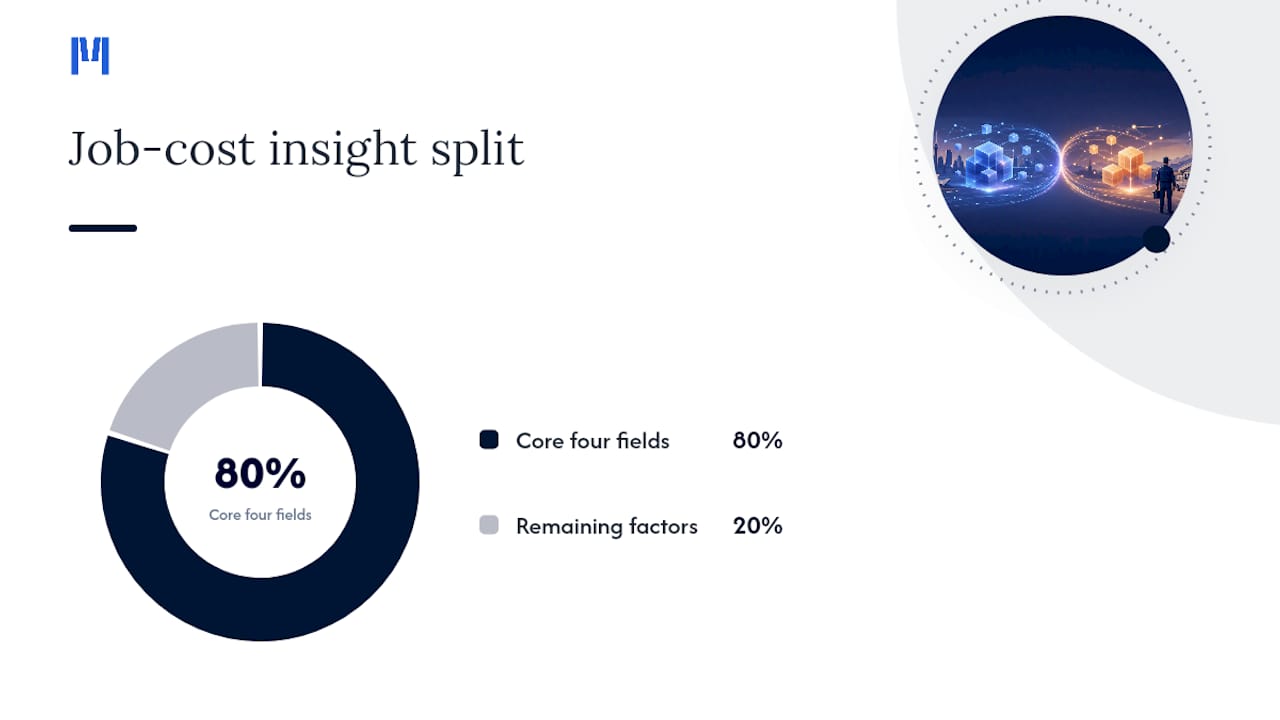
At minimum, capture four things per job: materials used, time on site, drive time, and final invoice amount. Contractor guidance on field service costing suggests these four data points alone get you roughly 80% of the way to usable job-cost insight, with overhead allocation layered on top once the habit sticks.
A few controls make that capture reliable rather than aspirational:
- Assign job codes before dispatch. Never assign them after the fact.
- Use mobile entry so technicians log hours and parts on site, not from memory that evening.
- Track parts picks against the job at the moment they leave the shelf.
- Export payroll data directly into job records instead of re-keying hours.
- Keep a revision history on estimates so scope creep is visible, not just felt.
Pro Tip: Run a short post-job review within 48 hours of invoicing, while the details are still fresh. Waiting until month-end review turns “what went wrong” into a guessing game.
Beyond the per-job review, set a calendar reminder for an annual price review, or sooner if wage rates, fuel costs, or supplier pricing move materially between reviews.
A Worked Example: From Estimate to Invoice
Numbers make this concrete faster than any explanation. Take a mid-sized repair job estimated at four billable hours.
The job was quoted and invoiced at $700. On the estimate, that leaves a healthy margin, roughly in the mid-teen percentage range. Once actuals came in, with an extra hour of labour and an unplanned second hour of drive time, the job actually lost money.
That flip from profit to loss happened on a single job, driven almost entirely by drive time nobody accounted for at quoting stage. To back into a target margin instead of hoping for one, divide total job cost by (1 minus target margin percentage). If total costs and target margin are known, invoice should be set accordingly.
Reconciling Job Costs With Your Accounting Records
Your job-cost report and your profit and loss statement answer different questions, and they will rarely match to the dollar without deliberate reconciliation. The job report tells you whether a specific engagement made money. The general ledger tells you whether the business as a whole did, across timing differences, accruals, and costs that never got coded to a job.
Job costing and general accounting serve different purposes and need to be reconciled rather than treated as duplicate views of the same number. Tie job transactions back to accounting through payroll exports and consistent purchase invoice coding, so every dollar spent on a job can be traced into the ledger it feeds.
GST coding deserves particular care here. Inconsistent GST treatment across job expenses makes BAS reporting harder to defend and can quietly distort your job margin if GST-inclusive figures slip into a cost line that should be GST-exclusive.
Setting Up Software Without Overbuilding It
You don’t need a full enterprise rollout to get useful job-cost data. Enable five things first: job codes, timesheets tied to those job codes, a way to allocate parts and consumables to a job, one overhead allocation rule, and a payroll export that avoids manual re-entry.
Start with the four core data points (materials, site time, drive time, invoice total) and automate one piece at a time rather than trying to digitize everything at once. A labour costing setup that captures loaded rates automatically removes the most error-prone manual step in the whole process.
Once you’re running enough jobs that spreadsheets can’t keep pace, or you need overhead allocated across multiple technicians and vehicles simultaneously, it’s time to move to a purpose-built system or bring in a part-time controller to own the reconciliation.
Why Disciplined Job Costing Protects Your Margin
The businesses that lose money on jobs almost never lose it on materials. They lose it on unrecorded drive time, forgotten consumables, and callbacks nobody coded to the original job. A repeatable capture habit, reviewed job by job, turns pricing from a guess into a decision.
— ModernDMS
Where MDMS Fits Into Your Job-Costing Workflow
Every workflow in this guide, job codes, loaded labour, timesheets tied to a job, parts allocation, and payroll export, is exactly what MDMS’s field service and labour costing tools are built to handle for equipment dealerships, without forcing you into a system built for someone else’s industry first.

Because MDMS rolls out module by module, you don’t have to commit to a full platform migration just to fix job costing. Turn on Field Service and labour costing alone, connect it to Xero for payroll and GST coding, and you have working job-cost visibility without months of setup. The setup claim is under an hour for initial configuration, and every module keeps your data yours, with no lock-in if you decide to change course later. Check current pricing for the Service Workshop and Field Service plans to see what fits your current job volume, and request a demo if you want to see job-cost reporting running against a real work order before you commit.
Sources
- Job Order Costing for a Service | Managerial Accounting
- Australian Taxation Office guidance on business records and GST/BAS considerations
- Business
FAQ
Can Job Order Costing Be Used for a Service Company?
Yes. Job-order costing applies well to service businesses whenever each customer engagement is distinct in scope, hours, or materials, which describes most consulting, repair, and field service work. The method accumulates direct labour, direct expenses, and allocated overhead against each job code rather than averaging costs across a production run.
How Do You Do Costing for a Service Job?
Estimate materials, labour, and overhead before the job starts, then track actual hours and expenses against a unique job code as the work happens. Australian training standards require this estimate-then-document approach before calculating a final customer cost, and comparing that estimate against actuals afterward is what reveals your true margin.
How Do I Calculate Job Costing?
Add loaded labour (wages plus on-costs like superannuation and leave), direct job expenses like materials and travel, and an allocated share of overhead, then compare that total against your invoice amount to find the margin. The worked example above shows a job estimated at $583 climbing to $763 once actual drive time and labour hours came in higher than quoted.
How Much Should I Charge for My Services?
Charge enough to cover your fully loaded job cost plus a target margin, calculated by dividing total cost by one minus your target margin percentage. Pricing guidance recommends reviewing that price at least annually or sooner if labour, fuel, or supplier costs shift materially between reviews.