Parts Catalog Management: Fixing Data to Cut Wrong Orders
By MDMS Team · 14 August 2026
Parts Catalog Management: Fixing Data to Cut Wrong Orders
Good parts catalog management means a technician or counter clerk finds the exact right part, on the first search, every time, because the record they’re looking at carries accurate fitment, an active supersession status, and a description that matches the physical piece in the bin. Get that right and returns drop, warranty claims process faster, and service jobs stop stalling while someone calls around to confirm a part number. Get it wrong and you’re paying for it in shipping reversals, idle bays, and customers who quietly start calling a competitor.
If you’re triaging a messy catalog right now, do three things before you read another word. First, pull your last 90 days of returns and tag each one by root cause. You’ll likely find a cluster tied to bad fitment data or duplicate SKUs. Second, add one validation rule at your point of entry: no new part record saves without a unit of measure and at least one fitment qualifier. Third, call your service manager and your purchasing lead into the same room. Catalog problems usually show up as their problems long before anyone officially owns the fix.
The rest of this guide walks through why bad catalog data costs real money, the standards and data model that make catalogs reliable, a five-step rollout plan, and the governance that keeps a clean catalog clean.
Key Takeaways
Reliable parts catalog management comes down to governing data at the point of entry, standardizing fitment logic, and measuring null-result and wrong-order rates before and after remediation.
| Point | Details |
|---|---|
| Govern at point of entry | Add validation rules that reject incomplete or duplicate records before they save. |
| Prioritize by criticality | Apply full-field standardization only to parts where errors carry real financial or safety risk. |
| Fix supersession chains first | Broken redirects from discontinued to current parts drive the most visible null results. |
| Run a pilot before full rollout | Test one branch or product line, measure KPIs, then expand. |
| Assign clear ownership | Give an executive sponsor and a data steward explicit responsibility for catalog quality. |
| Consider a dealer-built platform | MDMS combines fitment-aware search, VIN/rego lookup, and real-time sync built specifically for equipment dealers. |
Table of Contents
- Why Parts Catalog Management Affects Your Bottom Line
- What Are the Most Common Parts Catalog Problems?
- How Do Fitment Standards Like ACES and PIES Work?
- Building the Data Model: What Fields Does a Catalog Need?
- How Do You Clean and Enrich Messy Supplier Data?
- What Features Should Parts Catalog Software Have?
- Who Should Own Catalog Governance?
- What’s a Realistic Roadmap for Fixing a Parts Catalog?
- Which Metrics Prove Your Catalog Is Improving?
- How MDMS Applies These Catalog Principles for Equipment Dealers
- What Should a Catalog Project Actually Cost?
- What Practitioners Get Wrong About Catalog Cleanup
- Ready to Fix Your Catalog? Here’s the Practical Next Step
- Sources
- FAQ
Why Parts Catalog Management Affects Your Bottom Line
A parts catalog with unreliable fitment data doesn’t just annoy your counter staff, it bleeds cash through five separate channels: wrong orders that need reversing, returns freight, warranty claims filed against the wrong part number, service jobs delayed while someone hunts for a substitute, and lost sales when a customer gets a null result and buys elsewhere. None of these show up as a single line item on a profit and loss statement, which is exactly why the problem persists for years at most dealerships.
The scale of the underlying issue is larger than most catalog owners assume. Gartner estimates the average cost of poor data quality at $12.9 million per year across organizations, and in MRO spare parts specifically, roughly 20 to 30% of inventory typically sits as excess or obsolete stock before anyone acts on it. Automotive and related industries that have implemented structured spare-parts and catalog practices have reported maintenance cost reductions as high as 30%, though that figure reflects case-study outcomes rather than a guaranteed result for every operation.
Pro Tip: Run a 90-day return-reason audit before you build a business case for catalog remediation. The dollar figure you calculate from your own returns data will land harder with leadership than any industry benchmark.
Once the data gets cleaned up and governed, dealerships and asset-intensive businesses tend to see a consistent set of outcomes:
- Fewer returns tied to fitment mismatches or wrong part numbers
- Faster order-to-fulfill times because staff stop calling suppliers to confirm compatibility
- Fewer emergency buys at premium pricing because stock levels reflect actual demand
- Shorter service turnaround because technicians find the correct part on the first search
- Better forecasting accuracy once historical consumption data isn’t scattered across duplicate records
What Are the Most Common Parts Catalog Problems?
Most catalogs don’t fail all at once. They degrade one supplier feed, one merger, one rushed data entry at a time, until the failure becomes visible in a service bay or at the parts counter. The problems tend to repeat across industries in a predictable pattern:
- Duplicate records created when different suppliers or branches enter the same part under slightly different SKUs or descriptions
- Missing attributes such as unit of measure, weight, or dimension fields left blank during rushed data entry
- Broken supersession chains where an old part number stops working but nothing points staff to the current replacement
- Inconsistent naming where “hydraulic filter” and “filter, hydraulic, spin-on” describe the same item
- Wrong or absent fitment data that lets a part appear compatible with equipment it was never designed for
- Regional variant gaps where a part exists for one market’s configuration but the catalog doesn’t distinguish it from a similar unit elsewhere
- Stale sync cycles between supplier feeds and the live catalog, so price or availability data is days or weeks out of date
The supersession problem deserves its own mention because it’s the one that generates the loudest complaints. OEM catalog issues usually trace back to engineering-change orders and supplier transitions that never get reflected in the published catalog. When a supersession chain breaks, a technician searching for a discontinued part number gets a null result instead of a redirect to the current replacement. Duplicate records cause a quieter but equally expensive failure: two SKUs for the same physical part split your consumption history in half, which throws off reorder points and makes the part look like slower-moving inventory than it actually is.
Not every problem carries the same weight. A missing weight field on a low-cost consumable is a minor annoyance. A broken supersession chain on a critical drivetrain component is a service bay stalled for a day and a customer who won’t wait around for the fix.
How Do Fitment Standards Like ACES and PIES Work?
Reliable fitment matching runs on two different logics, and knowing which one applies to your parts determines whether your catalog returns the right answer or a frustrating “no results found.”
Year/Make/Model (YMM) filtering works for parts that fit broad vehicle or equipment categories, where every unit built in a given model year shares the same fitment. It’s fast to implement and works well for high-volume consumables like filters or belts. VIN or serial-number based filtering goes deeper, matching a part to the exact configuration of an individual unit, which matters enormously once mid-year running changes, optional equipment, or regional builds mean not every unit of the same year and model takes the same part. Implementing serial-based filtering is the single most effective way to prevent the null-result searches that frustrate technicians and drive wrong orders, because it shows staff only the parts validated for that specific unit.
For businesses operating with registration-based lookups, vehicle-specific eCatalogues let a user identify a vehicle once by its registration and see every available part for that exact unit, which meaningfully reduces order errors compared with manual YMM searches.
The industry standard for exchanging this fitment and product data in machine-readable form is the pairing of ACES and PIES: the Aftermarket Catalog Exchange Standard for fitment data and the Product Information Exchange Standard for product attributes. Both are maintained by the Auto Care Association and rely on supporting relational reference databases that require an annual subscription for full functionality. They’re built primarily for the North American aftermarket, so their applicability outside that market and outside automotive parts specifically is limited, though adoption continues to expand into adjacent equipment categories.
Pro Tip: Don’t force ACES/PIES compliance onto every SKU in your catalog. Reserve the subscription-based reference data for parts where fitment ambiguity creates real risk, and use simpler YMM tagging for low-complexity consumables.
Building the Data Model: What Fields Does a Catalog Need?
A catalog is only as reliable as its underlying schema, and most data problems trace back to a model that was never designed, just accumulated field by field as different systems got bolted together over the years. A properly designed catalog needs a defined set of core fields, each with a clear purpose.
| Field | Purpose | Example Usage |
|---|---|---|
| Part number / SKU | Unique identifier for ordering and inventory tracking | Primary key linking all systems to one physical item |
| Description | Human-readable identification at point of sale or pick | “Hydraulic filter, spin-on” |
| Unit of measure | Prevents quantity and pricing errors | Each, box of 12, liter |
| Commodity/class code | Groups parts for reporting and classification | Filters, fasteners, electrical |
| Fitment qualifiers | Links part to compatible equipment or vehicles | Model year range, VIN pattern, serial break |
| Supersession link | Points from discontinued number to current replacement | Old part X redirects to new part Y as of a given date |
| Attributes | Technical specifications for search and filtering | Thread size, voltage, pressure rating |
| Diagram reference | Connects visual exploded view to orderable SKU | Diagram callout links to SKU — |
| Supplier reference | Traces the part back to its source for procurement | Vendor part number and preferred supplier ID |
Classification is where most catalogs either earn their reliability or lose it. A controlled taxonomy that groups parts consistently by purchasing and supply attributes reduces duplicate records and speeds time to market for new parts entering the system. Layer criticality on top of classification, not just cost, and you get a much more useful prioritization tool than a simple ABC value ranking:
- ABC/XYZ classification ranks parts by consumption value and demand variability, useful for inventory planning
- VED criticality tagging (Vital, Essential, Desirable) flags parts by operational consequence if they’re unavailable, independent of price
- Naming conventions should be documented and enforced, not left to whoever is typing the record in that day
- Version control on taxonomy changes prevents a reclassification project from silently breaking existing reports and reorder rules
How Do You Clean and Enrich Messy Supplier Data?
Most dealerships inherit their worst catalog problems from supplier feeds that were never designed to talk to each other. Fixing that requires two distinct layers of processing, and conflating them is where a lot of cleanup projects go wrong.
The first layer is deterministic: rules-based normalization that standardizes units of measure, strips inconsistent formatting from descriptions, and flags exact-match duplicates. This layer is fast, cheap, and should catch the majority of obvious errors before anything more sophisticated gets involved. The second layer is probabilistic: AI-assisted enrichment that fills missing specifications, classifies parts into your taxonomy, and identifies near-duplicate records that don’t match exactly but clearly describe the same physical item. Practical catalog cleanup projects that combine a client-specific taxonomy with tooling to identify duplicates and missing attributes tend to outperform generic, one-size-fits-all standardization efforts.
The probabilistic layer needs a control mechanism, because AI enrichment is confident even when it’s wrong. Set a confidence threshold: records the model classifies with high certainty flow straight through, while anything below that threshold routes to a human reviewer with domain knowledge before it becomes operational truth. This human-in-the-loop step is what separates a catalog cleanup that holds up from one that just moves the mess into a new format.
Pro Tip: Start your confidence threshold conservative, even if it means more records route to human review at first. It’s far cheaper to loosen the threshold once you trust the model’s classifications than to walk back bad automated changes across thousands of live records.

Validation rules belong at the point of entry, not as a cleanup step after the fact. Enforcing duplicate-detection and rejection workflows before a record saves stops the same mess from regenerating six months after your cleanup project wraps.
What Features Should Parts Catalog Software Have?
Choosing catalog software comes down to whether the tool actually solves the fitment, search, and integration problems your team faces daily, not whether the sales demo looks polished. Run any vendor through this checklist before you sign anything:
- Fitment-aware search that filters by YMM, VIN, or serial number depending on part complexity
- Interactive exploded diagrams with clickable SKUs linking straight to the orderable part
- Supersession management that automatically redirects discontinued numbers to current replacements
- Support for reference-data subscriptions like ACES/PIES where your parts categories require it
- Open APIs for real-time integration with your ERP, DMS, or CMMS
- Bulk-update tools for taxonomy changes and mass attribute corrections
- Audit trails and role-based access so you know who changed what and when
Integration is where a lot of otherwise-good software fails in practice. Before committing, verify the vendor supports real-time sync (not overnight batch) with your existing inventory system, pricing engine, e-commerce storefront, and customer-facing service portal. A catalog that updates once a night still produces null results and stale pricing during business hours.
| Integration point | What to verify | Why it matters |
|---|---|---|
| ERP/DMS | Real-time bidirectional sync | Prevents pricing and stock mismatches |
| Inventory system | Live quantity-on-hand updates | Stops overselling parts already committed |
| E-commerce/customer portal | Fitment data flows to public search | Reduces support calls and wrong online orders |
| Service/work order system | Diagram-to-SKU links available at the job | Speeds technician lookup during repairs |
When you run a vendor trial, insist on testing with your own messy sample data, not the vendor’s clean demo dataset. Ask specifically about migration support, whether historical consumption data transfers with merged duplicate records, and what service-level commitments apply once you’re a paying customer rather than a prospect.
Who Should Own Catalog Governance?
A cleanup project without a governance structure behind it degrades right back to where it started, usually within a year. Catalog governance works best as an executive-level responsibility, not something delegated entirely to whoever has time in the parts department. Without visible sponsorship from leadership and a data steward handling day-to-day decisions, governance frameworks tend to quietly collapse within months of the initial cleanup.
A durable structure needs four roles, each with distinct accountability:
- Executive owner sets the priority, funds the ongoing work, and resolves cross-department disputes over data standards
- Catalog manager or data steward handles day-to-day quality control, approves new part creation, and monitors validation rule performance
- Subject-matter owners within parts, service, and purchasing validate fitment and technical accuracy for their categories
- Change control board reviews taxonomy changes, major supersession updates, and any request to bypass standard validation
New part creation should follow a defined approval workflow rather than letting anyone with system access add a record on the fly. A typical flow requires the requester to submit core fields and fitment data, the data steward to check for duplicates, a subject-matter owner to confirm technical accuracy, and only then does the record go live. Emergency overrides should exist for genuine urgency, but they need a mandatory follow-up review within a set window, not a permanent exemption from the process.
Different parts warrant different governance intensity. Applying full-field standardization to a low-cost, high-volume consumable wastes review capacity that should go toward parts where a fitment error causes real financial or safety consequences.
What’s a Realistic Roadmap for Fixing a Parts Catalog?
Catalog remediation succeeds or fails based on sequencing. Teams that try to fix taxonomy, data, and integrations simultaneously usually stall out somewhere in month two. A five-step sequence keeps the project moving and gives you defensible milestones to report back to leadership.
- Audit your existing catalog data across every source system, tagging records by completeness, duplicate risk, and fitment accuracy. This step alone usually surfaces the scale of the problem in a way that justifies budget for the rest of the project.
- Define the schema and taxonomy based on the core fields and classification approach that fit your parts mix, using the field structure and criticality tagging described earlier.
- Build the ingestion pipeline, combining deterministic normalization rules with AI-assisted enrichment and a human review queue for low-confidence records.
- Integrate with existing systems, verifying real-time sync with your ERP, DMS, inventory platform, and any customer-facing portals before going live broadly.
- Pilot and roll out, starting with one product line or branch, measuring the KPIs below, then expanding once the pilot proves out.
| Milestone | Scope | What success looks like |
|---|---|---|
| Day 30 | Audit complete, taxonomy drafted | Full inventory of data problems ranked by severity and business impact |
| Day — | Pipeline built, pilot branch selected | Ingestion rules tested against real supplier data with confidence thresholds set |
| Day 90 | Pilot live, KPIs tracked | Measurable drop in null-result searches and wrong orders on the pilot branch |
Cycle counting during the audit phase gives you a physical accuracy baseline to compare against your catalog’s book records, and pairing a structured inventory cycle counting practice with your data audit will surface discrepancies a desk review alone misses.
Which Metrics Prove Your Catalog Is Improving?
You can’t defend a catalog remediation budget with a vague claim that “the data is better now.” You need numbers, tracked consistently, before and after the work.
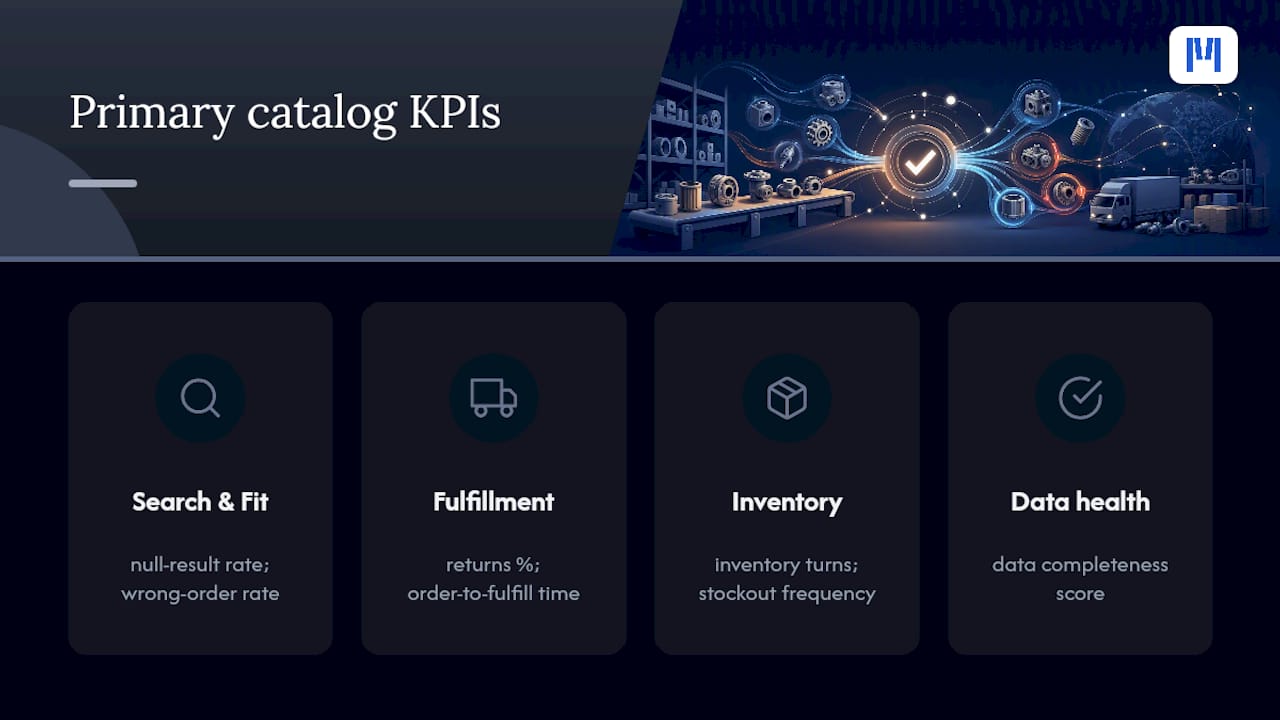
The primary KPIs worth tracking are: null-result rate (searches returning no matching part), wrong-order rate (orders placed against incorrect fitment), returns percentage, order-to-fulfill time, inventory turns, stockout frequency for critical parts, and a data completeness score measuring what percentage of records have all required core fields populated.
Case studies across automotive and adjacent industries report maintenance cost reductions as high as 30% after structured spare-parts management is implemented, though your own results will depend heavily on your starting data quality and how aggressively you pursue point-of-entry governance. Treat any published range as a directional target rather than a guarantee.
Sample your KPIs monthly during the first two quarters of a remediation project, then move to quarterly dashboarding once the numbers stabilize. Reviewing too infrequently early on means you won’t catch a validation rule that’s letting bad data back through until months of records are already affected.
How MDMS Applies These Catalog Principles for Equipment Dealers
Everything covered so far, fitment-aware search, supersession management, governed data entry, integration with existing systems, maps directly onto what a dealer-focused DMS needs to deliver in its parts module. MDMS builds its parts and warehouse management around exactly these requirements rather than treating parts as an afterthought bolted onto a sales or accounting system.
The platform supports VIN and registration-based lookup so counter staff and technicians search by unit configuration instead of guessing at a generic model match, which directly addresses the null-result problem that plagues catalogs relying only on YMM filtering. Open APIs let the parts catalog sync in real time with inventory, pricing, and the finance module, so a part status update doesn’t sit in a batch queue overnight. Because MDMS is built with complete data ownership and no lock-in, dealerships migrating from a legacy system keep control of their historical consumption data instead of losing it in a forced conversion.
- Parts module supports fitment-aware search tied to unit records, not just generic model tags
- Real-time API integration keeps pricing, stock, and service data synchronized across departments
- Role-based access and audit trails support the governance structure described earlier in this guide
- Modular rollout means a dealership can start with the parts and warehouse module before expanding to service or rental
Teams evaluating a dealer-focused option for their next catalog project should scope a pilot the same way the roadmap above describes: pick one branch or product line, migrate a representative sample of parts data, and measure null-result rate and order accuracy before committing to a full rollout.
What Should a Catalog Project Actually Cost?
Budgeting for parts catalog management depends heavily on how much of the work is data remediation versus new software licensing, and most teams underestimate the first cost while overestimating the second. A software subscription is a predictable, recurring line item. The data cleanup effort behind it, especially for a catalog with years of duplicate records and broken supersession chains, is the variable that actually determines project timeline and total cost.
Three cost categories deserve a line item in any catalog project budget. Software licensing covers the ongoing subscription for your catalog or DMS platform, typically scaled by team size or module selection rather than a flat enterprise fee. Data engineering effort covers the audit, normalization, and enrichment work, whether that’s internal staff time, contracted data specialists, or a combination of both, and this is usually the largest and least predictable line in the budget. Reference data subscriptions, if your parts mix requires ACES/PIES compliance, add an annual cost on top of your software platform, separate from your DMS or catalog tool licensing.
Budget conservatively for the data engineering phase specifically. Teams that treat cleanup as a quick pre-launch task rather than a proper phase of the project routinely underestimate the hours required to resolve duplicate records and rebuild broken supersession chains, which pushes the timeline and cost past initial estimates. Building in a review buffer for the human-in-the-loop step described earlier prevents that phase from becoming the surprise that blows the budget.
What Practitioners Get Wrong About Catalog Cleanup
Most catalog projects fail not because the technology is inadequate but because teams treat cleanup as a one-time event instead of a governance discipline. You can spend six months and a real budget scrubbing duplicate records and rebuilding supersession chains, and within a year you’re back where you started if nobody owns validation at the point of entry. The technical fix is the easy part. The organizational discipline to keep enforcing it is where most projects quietly die.
The priority that actually moves the needle isn’t the fanciest AI enrichment pipeline, it’s governing data at the moment it enters the system and being ruthless about which parts get full-field treatment versus a lighter touch. A low-cost fastener doesn’t need the same scrutiny as a critical drivetrain component, and pretending otherwise just burns review capacity you’ll need elsewhere. Start by putting your service manager and your parts data steward in the same conversation this week. If those two roles aren’t already talking regularly about what’s breaking at the counter, no amount of downstream tooling will fix the upstream problem.
Ready to Fix Your Catalog? Here’s the Practical Next Step
If you’ve read this far, you already know your catalog needs more than a one-off cleanup, it needs a system built around fitment-aware search, supersession management, and governed data entry from day one. That’s the gap MDMS was built to close for equipment dealerships specifically, rather than adapting a generic inventory tool that treats parts as just another SKU list.
The parts and warehouse module handles the fitment logic, supersession tracking, and real-time sync with your service and finance workflows described throughout this guide, and because setup takes under an hour, you’re not signing up for a months-long implementation before seeing results. If your dealership operates in industrial equipment, construction and earthmoving, or a related heavy-equipment vertical, MDMS is purpose-built for exactly that operating environment rather than retrofitted from a generic platform.
The practical next step is a pilot: request a demo, bring a sample of your messiest supplier data, and see how the migration and fitment-matching actually perform against your own catalog before committing to a full rollout. Visit the heavy equipment dealer software page to see how the parts module fits alongside sales, service, and rental in one platform.
Sources
- ACES — Auto Care Association
- Your data will never be perfectly ready. What to do instead - COSOL
- Parts classification | PTC
- Parts Catalog Management: Why OEMs Struggle with Outdated Data – Intellinet Systems Private Ltd.
FAQ
How Do You Organize a Parts Inventory?
Group parts by a controlled taxonomy such as commodity code, then layer ABC/XYZ value classification with VED criticality tagging so high-consequence parts get tighter stock controls regardless of their cost.
What Is Catalog Management?
Catalog management is the ongoing practice of organizing, governing, and publishing accurate part records, including numbers, fitment data, supersessions, and technical attributes, so staff and customers find the correct part on the first search.
What Is the Best Electronic Parts Catalog Software?
The right choice depends on your fitment complexity and existing systems, but any strong option needs fitment-aware search, supersession management, open APIs, and real-time sync with your ERP or DMS. For equipment dealerships specifically, MDMS’s parts module is built around VIN and registration-based lookup rather than adapted from a generic inventory tool.
What Is Parts Inventory Management?
Parts inventory management is the process of tracking stock levels, consumption patterns, and reorder points for individual parts, using classification and forecasting to keep critical items available without overstocking slow-moving ones.
How Long Does a Catalog Remediation Project Typically Take?
A phased rollout following an audit, schema design, pipeline build, integration, and pilot sequence typically shows measurable improvement in null-result and wrong-order rates within a 90-day pilot window, with full rollout timing depending on catalog size and data quality at the start.