4x Weekly Rule: Rental Rate Cards for Equipment Operators
By MDMS Team · 12 September 2026

4x Weekly Rule: Rental Rate Cards for Equipment Operators
A rental rate card only works when it shows daily, weekly, and monthly rates side by side, plus inclusions, delivery terms, deposits, and waiver options in plain language. The single best starting rule: build your daily rate from all-in ownership cost, then derive week and month tiers by fixed multipliers instead of guessing. Set the daily rate from true ownership cost, then derive the week and month tiers by multipliers that reflect the value of longer commitments and calendar certainty, adjusting by equipment class, and publish that ladder openly.
TL;DR:
- Weekly and monthly rates should be set as fixed multiples of the daily rate, with the weekly being around four to five times the daily, and the monthly about three times the weekly rate.
- All rate card fields must specify detailed inclusions, delivery terms, deposits, and insurance notes clearly to prevent assumptions and disputes.
- The daily rate must be based on true ownership cost divided by realistic usage days, not just market guesses, with adjustments for equipment class and utilization.
- Use software that enforces your rate rules and tracks utilization automatically to ensure consistent quoting and prevent rate drift.
- Review rates regularly, especially if costs change or utilization exceeds 70 percent, and update schedules to keep your pricing competitive and profitable.
Table of Contents
- What Belongs on a Rental Rate Card?
- How Do You Calculate a Defensible Daily Rate?
- What Multipliers Should Set Your Week and Month Rates?
- Add-Ons, Deposits, and Waivers: Getting the Wording Right
- Structuring and Publishing the Rate Card
- When Should You Review Your Rates?
- How Software Keeps Your Rate Ladder Honest
- A Publisher’s Take on Pricing Discipline
- Put Your Rate Ladder on Autopilot
- Sources
- FAQ
What Belongs on a Rental Rate Card?
A rate card is a contract in miniature. If a field is missing, customers fill the gap with assumptions, and assumptions are where disputes start. Every rental rate card should carry these fields, labeled consistently:
- Item and class name — model, size class, and condition or age band, since a five-year-old excavator and a new one don’t belong on the same line.
- Time-based rates — hourly or half-day, daily, weekly, and monthly, each with the unit stated (“per day,” not just a number).
- Inclusions — operator time, fuel, standard attachments, and consumables, clearly split from what costs extra.
- Delivery and pickup terms — flat fee, mileage-based, or included within a radius.
- Deposits and authorizations — the amount and whether it’s a hold or a charge.
- Damage-waiver options — cost and what it does and doesn’t cover.
- Insurance notes, cancellation policy, and standby fees.
- Tax indication — whether GST applies and how it’s shown, which matters given the tax-invoice formatting rules that apply to commercial rental billing in Australia.
The most common pitfall is burying delivery or admin fees below the fold, or writing vague language like “fuel included” without specifying a tank level. Inconsistent units (hourly on one line, “per use” on another) are the second most common complaint driver. Fix the labels before you fix the numbers.
How Do You Calculate a Defensible Daily Rate?
Most operators price by copying a competitor’s number. That’s a guess wearing a decimal point. A defensible rate starts from your all-in ownership cost divided by realistic billable days, not the calendar.
Start with these inputs: purchase price minus expected resale value, spread over the recovery period; annual maintenance allowance; insurance; cost of capital or financing; and a per-unit share of yard overhead. Add those up for an annual ownership cost, then divide by the number of days you realistically expect that unit to be out earning money, not 365.
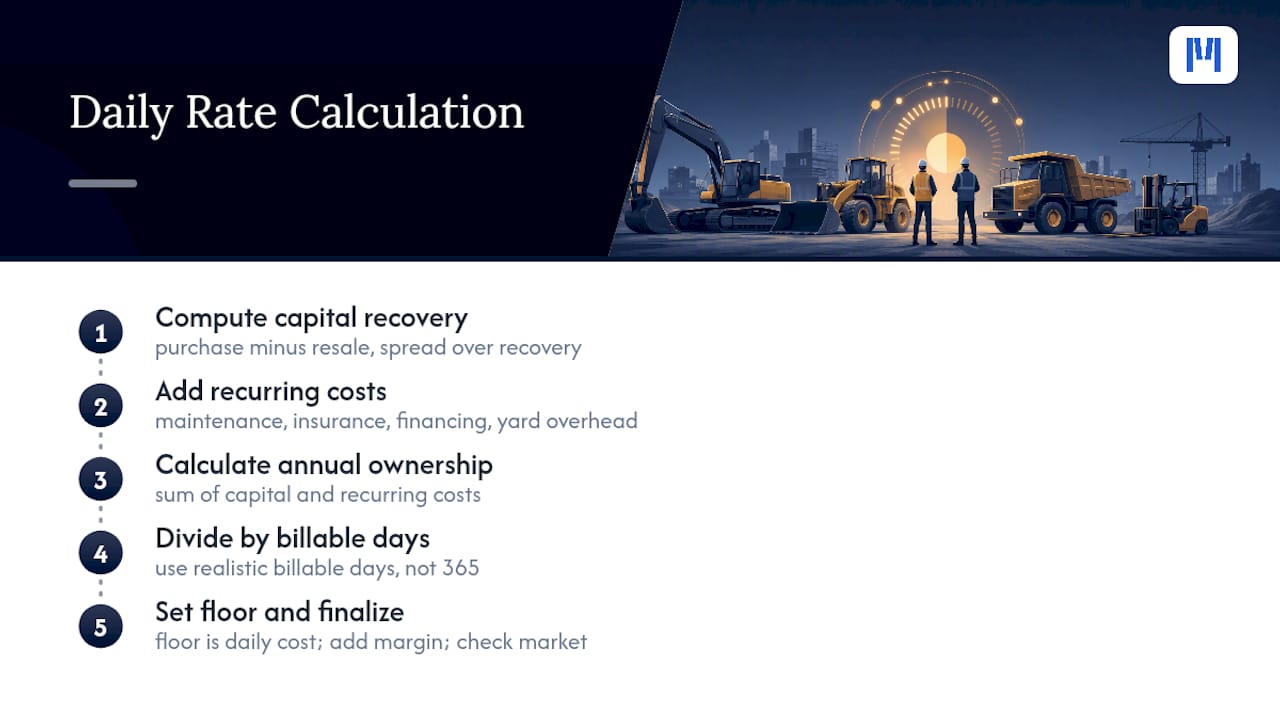
That $80 is your floor, not your price. Add your target margin, then check the result against local market rates for the same class. If your floor sits well above what the market charges, either your utilization assumption is too conservative or the class doesn’t belong in your fleet.
Pro Tip: New operators without booking history should model utilization conservatively, closer to 40 to 50 percent, and revisit the number once you have a real season of data behind you, a practice echoed in equipment rental rate guidance.
What Multipliers Should Set Your Week and Month Rates?
Duration tiers exist because a guaranteed week of use is worth more to you than five separate one-day bookings you have to chase, clean, and re-inspect between each turn. The weekly and monthly rates aren’t discounts in the retail sense. They’re payment for calendar certainty, and treating them that way makes the spread easier to defend to both staff and customers.
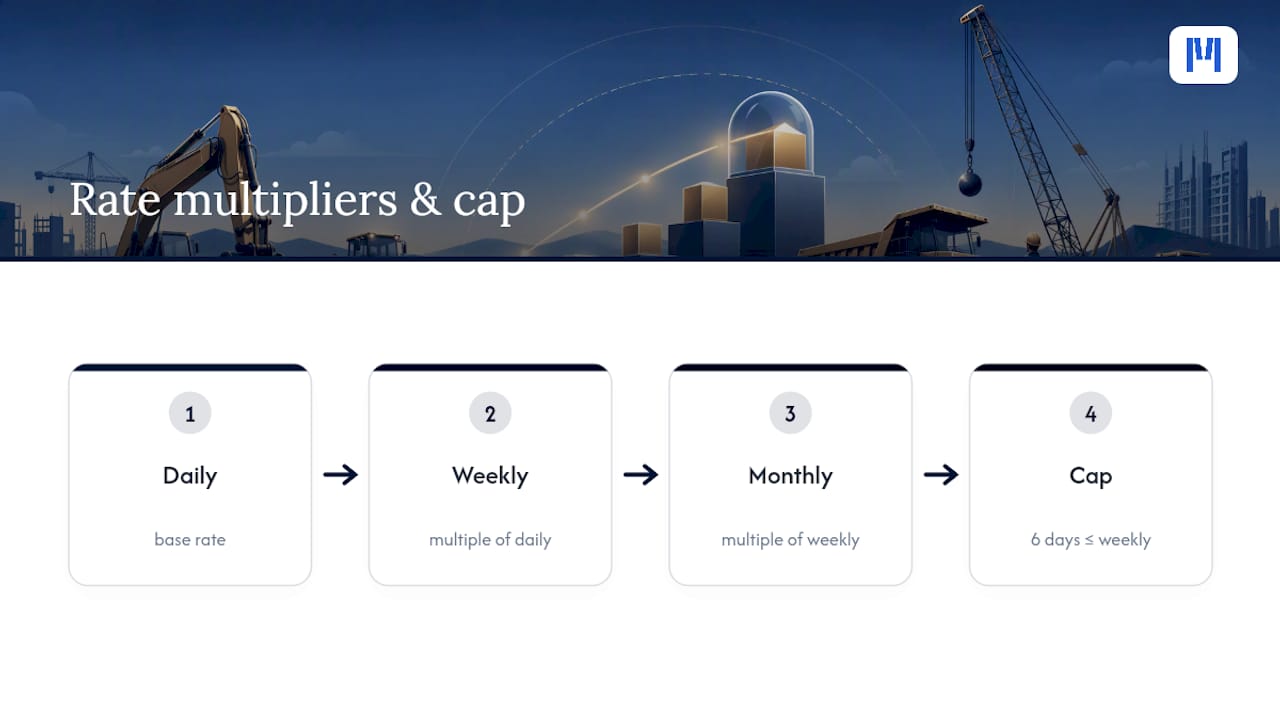
Common practice suggests weekly rates are multiple times the daily rate, often reflecting reduced turnover and administrative costs. Monthly rates are set as further multiples of the weekly rate, adjusted by equipment class and utilization patterns to balance between holding the unit and encouraging bookings.
Build in a hard cap: a customer renting for six days should never pay more than the published weekly rate. That single rule, enforced automatically rather than left to a counter clerk’s math, is what keeps your ladder trustworthy.
Add-Ons, Deposits, and Waivers: Getting the Wording Right
Extra charges are where most disputes are born, usually because the wording was vague, not because the fee itself was unfair. Separating variable costs from your base rate and spelling out exclusions in advance fixes most of it.
- List variable costs separately — delivery, fuel, consumables, and operator time should never be folded silently into the “rate.”
- Write waiver coverage as a short, specific list — a damage waiver is not insurance, and customers need to know exactly what it excludes (tire damage, hydraulic hose failure, theft) before they sign.
- Set deposit and authorization amounts as a fixed percentage or flat figure by class, published upfront rather than negotiated at the counter.
- Pre-agree standby and hold-fee triggers in writing. Ambiguity about when a “standby” charge kicks in is the root cause of most billing disputes, not the fee itself.
Pro Tip: Price the damage waiver around the actual damage patterns your fleet sees, not a flat percentage borrowed from another dealer’s price sheet.
Structuring and Publishing the Rate Card
The best rate cards read like a menu, not a legal document. Lead with a single-page ladder showing daily, weekly, and monthly rates side by side for each class, then link out to a detail page for full terms.
- Publish all three duration tiers together, with the multiplier rule stated plainly (“weekly = 4x daily; days beyond seven bill at the weekly rate”).
- Use consistent currency, unit, and time-basis labels across every row so nothing needs a phone call to interpret.
- Lock your ratios in rental fleet management software rather than a spreadsheet anyone can override, which keeps every quote, whether from the counter, phone, or website, consistent with the published sheet.
- Offer a downloadable or copyable sample template so new staff can apply the same structure to a new equipment class without reinventing it.
When Should You Review Your Rates?
Set a scheduled annual review, but don’t wait a full year if a real cost shifts underneath you: an insurance renewal that jumps 15 percent or a parts-cost spike on your top-earning class both justify an off-cycle look.
Track utilization percentage, average booking length, and repair frequency by class. A unit consistently booked above 70 percent utilization can usually absorb a rate increase; one sitting idle needs a pricing or fleet-composition rethink instead. When you do raise rates, decide upfront whether existing contracts get grandfathered or the new rate applies at next renewal, and say so in writing before the question comes up.
How Software Keeps Your Rate Ladder Honest
Manual rate sheets drift. A counter clerk under pressure grants an “exception” and next month it’s the new normal. Rule-based rental and hire fleet software enforces your week and month multipliers automatically, tracks utilization by unit, and keeps GST-compliant invoicing consistent with what’s published. A dealer management system can set up quickly and keep your data yours, with no lock-in if you move on.
A Publisher’s Take on Pricing Discipline
Published, rule-based rate ladders do something a discretionary pricing habit never can: they make your cash flow predictable and your customer relationships boring in the best way. Every hidden fee you add to protect margin quietly erodes the trust that gets a customer to rebook without a comparison shop. The operators who win aren’t the cheapest. They’re the ones whose price sheet never needs an apology attached to it. If you’ve never tested a rate change deliberately, pick one equipment class, adjust one tier, and watch what happens to utilization before you touch anything else.
— ModernDMS
Put Your Rate Ladder on Autopilot
A published rate card only stays honest if every quote actually follows it, and that’s the part spreadsheets and laminated price sheets can’t guarantee once a busy counter gets involved. Rental software modules can lock your daily, weekly, and monthly multipliers into the quoting system itself, so a phone quote, a counter quote, and an online booking all pull the same number, with GST handled correctly on every invoice.

The rental module also tracks utilization by unit automatically, which means the review cadence covered above stops being a manual spreadsheet exercise and starts happening in real time. If you’re still rebuilding your rate card in a spreadsheet every quarter, request a demo of rental contract and fleet software built specifically for equipment dealers, or explore the equipment hire and rental solution to see how the rate rules, invoicing, and utilization reporting fit together.
Sources
- How to price equipment rentals — EquipFlow
- Equipment Rental Pricing Strategy: How to Price for Profit | EquipDash
FAQ
What Is the 30% Rental Rule?
The 30% rule is a household budgeting guideline suggesting renters spend no more than a certain portion of income on housing rent. It applies to residential leasing, not equipment rental rate cards, but the underlying idea, that a rate should stay proportionate to the payer’s budget, carries over when you’re sizing rates for repeat commercial customers.
How Often Should I Update My Equipment Rental Rates?
Review rates on a set annual schedule, with earlier reviews triggered by a major cost jump, a sustained shift in utilization, or a competitor restructuring their tiers. Watching utilization and average booking length by class tells you which categories need a change sooner.
What’s a Reasonable Weekly-to-Daily Rate Ratio?
A weekly rate around four to five times the daily rate is a common starting point, adjusted up or down by how much demand and turnover cost a given equipment class carries. The month typically runs about three times the weekly rate, or roughly ten to twelve times the daily rate.
How Big Should a Security Deposit Be?
Deposit sizing should be published as a fixed amount or percentage per equipment class rather than negotiated per customer, and set high enough to cover realistic damage exposure without discouraging legitimate bookings. Pairing a clear deposit policy with a well-defined damage waiver reduces disputes at return time.
Can Software Really Prevent Rate Drift at the Counter?
Yes. Locking your multipliers and discount floors into rental management software, rather than leaving them to staff judgment, keeps every quote consistent with your published rate card regardless of who takes the booking.