Cycle Counting Parts: A Practical SOP for Warehouses
By MDMS Team · 8 August 2026

Cycle Counting Parts: A Practical SOP for Warehouses
Cycle counting for parts means running planned, targeted counts of small inventory subsets on a rolling schedule, keeping your perpetual records current without shutting down the warehouse for a full annual stocktake. The immediate recommendation: classify your parts into A, B, and C tiers using ABC/Pareto analysis, then run daily or weekly counts for A items using a tablet or scanner, fortnightly to monthly for B items, and quarterly for C items. Your first action today: identify the highest-value or fastest-moving bin in your parts area and schedule a blind tablet count for tomorrow morning before the service bay opens. Industry bodies such as APICS and Australian practitioners like Associated Stocktaking Services both validate this stratified approach as the most efficient way to maintain accuracy without excessive labor.
Key Takeaways
A well-run parts cycle-count program maintains inventory accuracy year-round by combining stratified counting frequency, investigation-first discipline, and paperless tablet workflows that feed directly into your perpetual record.
| Point | Details |
|---|---|
| Stratify by ABC tier | Count A items daily or weekly, B items fortnightly to monthly, and C items quarterly. |
| Close transactions first | Always freeze open invoices and work orders before counting to avoid timing discrepancies. |
| Investigate before adjusting | Find the root cause of every variance before posting an adjustment to fix the process, not just the number. |
| Use tablet-based workflows | Paperless, scan-based counting during low-activity windows removes manual entry errors and speeds reconciliation. |
| Moderndms for implementation | Moderndms’s parts and stocktake modules support mobile counting, serial/batch tracking, and Xero integration for Australian dealers. |
Table of Contents
- What is cycle counting and how does it differ from a full stocktake?
- Which cycle-counting methods work best for parts inventory?
- How do you implement cycle counting for parts step by step?
- How often should you count parts and what does a sample schedule look like?
- What tools and systems do you need for reliable parts cycle counting?
- What KPIs tell you whether your cycle-count program is working?
- What causes parts discrepancies and how do you fix them?
- What does a cycle-count sheet look like in practice?
- Why investigating before adjusting is the right approach — Australian practice notes
- An operations manager’s perspective on rolling out cycle counts at a dealership
- Moderndms supports your parts cycle-count program from day one
- Sources
- FAQ
What is cycle counting and how does it differ from a full stocktake?
Cycle counting is a perpetual inventory method: instead of counting everything at once, you divide your parts inventory into manageable subsets and count each subset on a planned schedule throughout the year. The result is a continuously updated picture of stock levels rather than a single annual snapshot that is already aging the moment it is taken.
The contrast with a full physical stocktake is significant for parts operations.
| Dimension | Cycle counting | Full annual stocktake |
|---|---|---|
| Operational disruption | Minimal — counts run during quiet windows | High — often requires warehouse shutdown |
| Accuracy over time | Continuously maintained | Accurate on count day, drifts until next count |
| Discrepancy detection | Ongoing; repeat issues surface quickly | Once per year |
| Audit readiness | Year-round | Concentrated at year-end |
| Labor demand | Spread across the year | Concentrated, high-intensity burst |
For parts operations specifically, the benefits compound quickly:
- Shrinkage and picking errors surface within days rather than months, giving you time to act before losses compound.
- Replenishment decisions stay grounded in accurate on-hand quantities, reducing both stockouts and overstock.
- FIFO integrity is easier to maintain when bin locations are verified regularly rather than left unchecked for eleven months.
- Regular stocktakes help detect damaged or obsolete stock and keep inventory data aligned with sales records, which matters for GST reporting under Australian Taxation Office requirements.
Two special cases deserve attention from the start. Serialized parts — engines, hydraulic pumps, control modules — require the count sheet to capture each individual serial number, not just a quantity. Batch-controlled parts such as fluids, filters, or consumables with expiry dates need reconciliation at the batch level so FIFO rotation can be verified. Both cases are manageable within a well-configured cycle-count program, and both are far harder to handle accurately in a once-a-year stocktake.
Which cycle-counting methods work best for parts inventory?
The main methods are ABC/Pareto, location-based, statistical (random sample), control-group, and opportunity-based counting. Choosing the right one depends on your parts mix, warehouse layout, and the risk profile of your SKUs.
ABC/Pareto counting
This is the foundation of any parts cycle-count program. Count A items daily or weekly, B items fortnightly to monthly, and C items quarterly or annually. The stratified approach is validated by practitioner guides as the most efficient way to keep parts inventory accurate without excessive labor.
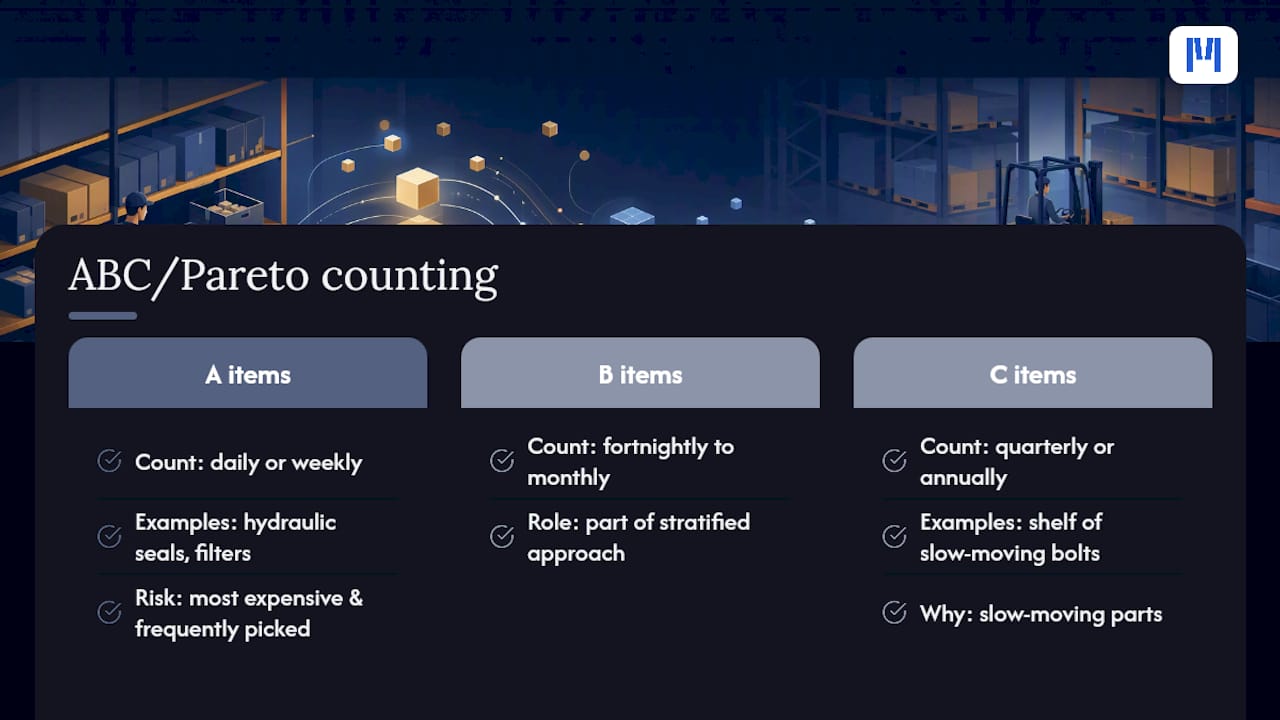
The practical advantage for equipment dealerships is that your most expensive and most frequently picked parts — hydraulic seals, filters, wear components — get the most scrutiny, while a shelf of slow-moving bolts gets a quarterly check. That allocation of effort matches where the financial risk actually sits.
Location-based counting
Rather than counting by SKU, you count everything in a defined bin or aisle during a single session. This works well in multi-location warehouses and kitting environments where parts from multiple SKUs share a zone. It also catches labeling and bin-assignment errors that a SKU-based count would miss entirely. The trade-off is that a location sweep may not align neatly with your ABC cadence, so most operations use location-based counting as a secondary method alongside ABC.
Statistical and control-group methods
A random-sample count selects SKUs statistically to give a confidence-level estimate of overall accuracy. This is useful for benchmarking your program’s health rather than managing day-to-day accuracy. A control-group count repeatedly counts the same small set of SKUs to isolate whether a process change (a new label format, a revised receiving procedure) actually improved accuracy. Both methods are more common in larger distribution centers than in dealership parts rooms, but they are worth knowing when you need to validate a process fix.
Opportunity-based counting
Count a location or SKU immediately after a triggering event: a receiving delivery, a return from a technician, a warranty claim, or a discrepancy flagged by a service job. This catches errors at the point they are most likely to have occurred and requires no additional scheduling. It pairs naturally with ABC counting as a reactive layer.
Pro Tip: Combine ABC counting as your scheduled backbone with opportunity-based counting as your reactive layer. When a technician returns a part to the shelf, that bin gets a quick recount before the transaction closes. You catch the error in real time rather than at the next scheduled count.
How do you implement cycle counting for parts step by step?
The following SOP gives your team a repeatable process from planning through investigation.
- Classify your SKUs. Apply ABC/Pareto rules to your parts master. Sort by annual usage value, assign tiers, and record the classification in your DMS or WMS. Review classifications quarterly or when a part’s movement pattern changes significantly.
- Map locations and bins. Every SKU needs a primary bin location recorded in the system. Unlabeled or dual-location parts are the single biggest source of phantom discrepancies. Walk the warehouse and reconcile the physical layout against the system before your first count.
- Close open transactions. Before counting any zone, confirm that all pending invoices, service work orders, and purchase receipts for parts in that zone are posted. Counting while transactions are in flight guarantees a discrepancy that has nothing to do with physical stock.
- Assign responsibilities. The person counting should not be the same person who normally picks or receives in that zone. Separation of duties is a basic control that catches errors a single handler would perpetuate.
- Choose blind or open counting. In a blind count, the counter receives only the SKU and bin location, not the system quantity. They record what they physically find. The system then compares. Blind counting is more accurate because counters cannot unconsciously round to the expected number.
- Execute the count. Use a tablet or handheld scanner loaded with the count task. Scan the bin label, scan each part’s barcode, and record the quantity. For serialized parts, scan each serial number individually. For batch parts, record the batch number and quantity per batch. Count during low-activity windows — early morning before the service bay opens, or during a lunch break — to reduce interference from active picks.
- Reconcile against the system. Compare the physical count to the system quantity. Apply your variance threshold: for A items, a common target is less than 1% variance; for C items, a wider tolerance may be acceptable. Quantities within threshold are confirmed. Quantities outside threshold trigger investigation before any adjustment is posted.
- Investigate discrepancies. Do not post an adjustment until you understand why the variance exists. Check the receiving log, recent service jobs, returns, and transfer records for that SKU. The goal is to find the process failure, not just correct the number.
- Post adjustments and document. Once the root cause is identified and corrected (or confirmed as unexplained after a thorough search), post the inventory adjustment with a reason code and a note. This audit trail is essential for year-end reconciliation and ATO compliance.
- Review and improve. Track which SKUs generate repeated discrepancies. A part that shows a variance every count cycle has a process problem, not a counting problem.
Pro Tip: Rotate counting staff across zones every quarter. A counter who always counts the same shelf develops unconscious assumptions about what should be there. Rotation keeps counts genuinely independent and surfaces errors that familiarity hides.
How often should you count parts and what does a sample schedule look like?
Frequency should match the financial and operational risk of each tier. The table below gives a starting point your team can adapt based on historical variance data and supplier lead times.
| Tier | Cadence | Example part types | Notes |
|---|---|---|---|
| A — high value / fast-moving | Daily or weekly | Hydraulic seals, filters, wear components, high-cost electronics | Close open transactions before each count session to avoid timing discrepancies. |
| B — mid-value / moderate movement | Fortnightly or monthly | Belts, hoses, standard fasteners, common gaskets | Monthly reconciliation recommended |
| C — low value / slow-moving | Quarterly or annually | Obsolete accessories, rarely ordered consumables, display parts | Align with tax-year end for ATO reporting |
| Critical / regulated | Per event or monthly | Serialized components, warranty-tracked parts, hazmat items | Count after every receipt or return regardless of tier |
Adjust cadence upward when a SKU’s variance history shows repeated discrepancies, when a supplier changes packaging or labeling, or when seasonal demand spikes increase pick frequency. A part that moves from C to A behavior during a peak service season should be reclassified and recounted accordingly.
This is especially relevant for equipment dealerships where a single missing hydraulic pump can delay a machine return and cost a customer a day of production.
What tools and systems do you need for reliable parts cycle counting?
Getting the hardware and software right removes the two biggest sources of count error: manual transcription and timing conflicts with live transactions.
Essential hardware
- Handheld barcode scanners or tablets with a warehouse-grade case and long battery life. Tablets running a mobile stocktake app give counters a larger screen for serial number verification without sacrificing portability.
- Barcode printers for producing durable bin labels and part labels. Thermal-transfer labels on polypropylene stock survive the grease, moisture, and UV exposure common in parts rooms and outdoor storage areas.
- Wireless access points covering all storage zones, including mezzanine levels and external racking. A dead zone forces manual recording, which reintroduces transcription errors.
- Charging stations positioned at the start of each counting zone so devices are always ready at shift start.
Software features to require
- Perpetual inventory tracking that updates on-hand quantities in real time as transactions post.
- Mobile stocktake module that pushes count tasks to a tablet, captures scanned quantities, and feeds results directly to the reconciliation queue without manual re-entry.
- Batch and serial number tracking at the transaction level, so counts can be reconciled at the batch or serial level for regulated and high-value parts.
- Automated reconciliation with configurable variance thresholds and reason codes, so the system flags exceptions rather than requiring manual comparison.
- Audit logs that record who counted, when, what the system quantity was, and what adjustment was posted. This is non-negotiable for ATO audit readiness.
- Xero or MYOB integration so inventory adjustments flow through to your accounts without a second data entry step, keeping GST calculations and cost-of-goods figures accurate.
Australian practice favors paperless, tablet-based auditing during low-activity periods precisely because it removes manual entry errors and provides real-time updates to the perpetual record. A spreadsheet-based count sheet, by contrast, creates a gap between the physical count and the system update that can span hours or days, during which live transactions corrupt the comparison.
Moderndms’s parts and warehouse management module covers perpetual inventory, mobile stocktake, serial and batch tracking, and automated reconciliation in a single platform built for Australian equipment dealerships. The stocktake feature pushes count tasks to a tablet, captures results on the floor, and feeds the reconciliation queue directly, with Xero integration keeping your accounts current without duplicate entry.
For Australian dealers, GST reporting requires that your inventory valuation is defensible at any point in the financial year, not just at June 30. A perpetual system with a complete audit log satisfies that requirement continuously.
What KPIs tell you whether your cycle-count program is working?
Four metrics give a complete picture of program health. Calculate each on a monthly basis and assign ownership so someone is accountable for each number.
Inventory accuracy (%) is the primary metric. Calculate it as: (number of SKUs counted with zero variance ÷ total SKUs counted) × 100. A target around the mid-90s percentile range for accuracy is a reasonable starting point for a mixed parts operation; for A items specifically, aim for very low variance per count. Aligning physical counting with barcode scanning and ERP reconciliation and targeting monthly reconciliation supports this threshold.
Count variance (%) measures the magnitude of discrepancies, not just their presence. Calculate it as: (absolute value of quantity difference ÷ system quantity) × 100 for each SKU, then average across the count batch. A single large variance on a high-value part matters more than ten small variances on C-tier consumables, so review this metric by tier.
Shrinkage rate tracks unaccounted losses as a percentage of total inventory value over a period. Rising shrinkage on a specific SKU or location points to theft, damage, or a receiving process failure. Assign this metric to the parts manager and review it monthly.
Cycle count coverage measures what proportion of your SKU catalog has been counted at least once in the current period. For C items, quarterly coverage is the target. Gaps in coverage are where undetected drift accumulates.
Days between discrepancies for a given SKU is a useful diagnostic. A part that generates a discrepancy every three weeks has a process problem that needs a root-cause fix, not just a recount.
Ownership: the warehouse supervisor owns daily count execution and variance reporting; the parts manager owns shrinkage and coverage; finance owns the reconciliation sign-off and audit log review.
What causes parts discrepancies and how do you fix them?
Most discrepancies trace back to a small set of repeatable process failures. Identifying the cause before posting an adjustment is what separates a cycle-count program that improves over time from one that just corrects numbers indefinitely.
The primary objective of cycle counting is to identify and eliminate root causes of inventory drift, not simply to fix ledger balances. Here are the most common cause-and-fix pairs for parts operations:
- Receiving errors: Supplier ships 10 units, receiver posts 12. Fix: implement a two-step receiving process where the physical count is recorded before the purchase order quantity is visible on screen. Retrain receiving staff on blind receiving procedures.
- Mislabeling or bin misassignment: Part is stored in bin A3 but the system shows bin A5. Fix: conduct a location audit, reprint labels, and update the bin master. Add a bin-verification step to the put-away workflow.
- Picking mistakes: Technician picks the wrong part, returns it to the wrong bin. Fix: add a barcode scan confirmation at the point of pick and at the point of return. Investigate any return that does not match an open work order.
- Unrecorded returns: Technician returns a part to the shelf without processing a return transaction. Fix: require a system transaction for every return, even partial ones. A physical return without a system record is invisible to the perpetual count.
- Damaged or scrapped stock: Part is damaged in storage but not written off. Fix: create a formal scrap/damage process with a reason code and immediate system adjustment. Hold damaged parts in a quarantine bin until the write-off is posted.
- Theft or unauthorized removal: Consistent negative variance on high-value parts in a specific location. Fix: escalate to management, review access logs, and consider relocating high-value parts to a secured cage. Involve finance when the value is material.
Escalation rules: pause replenishment for a SKU when its variance exceeds your A-item threshold on two consecutive counts. Audit all related SKUs in the same bin or product family when a discrepancy suggests a labeling or receiving error that could affect multiple lines. Involve the supplier when the variance pattern aligns with a specific delivery batch.
For recurring problems, the fix is always a process change, not a recount. Retraining, label redesign, workflow adjustments, and system configuration changes are the tools. A recount without a process fix produces the same discrepancy next cycle.
What does a cycle-count sheet look like in practice?
The fields below are the minimum required for a defensible count record. Configure these in your WMS or DMS stocktake module, or use them to build a spreadsheet template for smaller operations.
| Field | Purpose |
|---|---|
| SKU / Part number | Unique identifier for the part being counted |
| Part description | Human-readable name to verify the counter is at the right bin |
| Bin / Location code | Physical location being counted |
| System quantity (on-hand) | Hidden from counter in a blind count; revealed after physical count is recorded |
| Counted quantity | Physical count recorded by the counter |
| Variance (counted minus system) | Calculated automatically; triggers investigation if outside threshold |
| Serial numbers (if applicable) | Individual serial numbers scanned for serialized parts |
| Batch number and quantity (if applicable) | Batch ID and quantity per batch for batch-controlled parts |
| Counted by | Name or employee ID of the counter |
| Verified by | Second person for independent verification on high-value counts |
| Date and time | Timestamp of the physical count |
| Investigation notes | Root cause identified and corrective action taken |
| Adjustment posted | Yes/No confirmation that the system record has been updated |
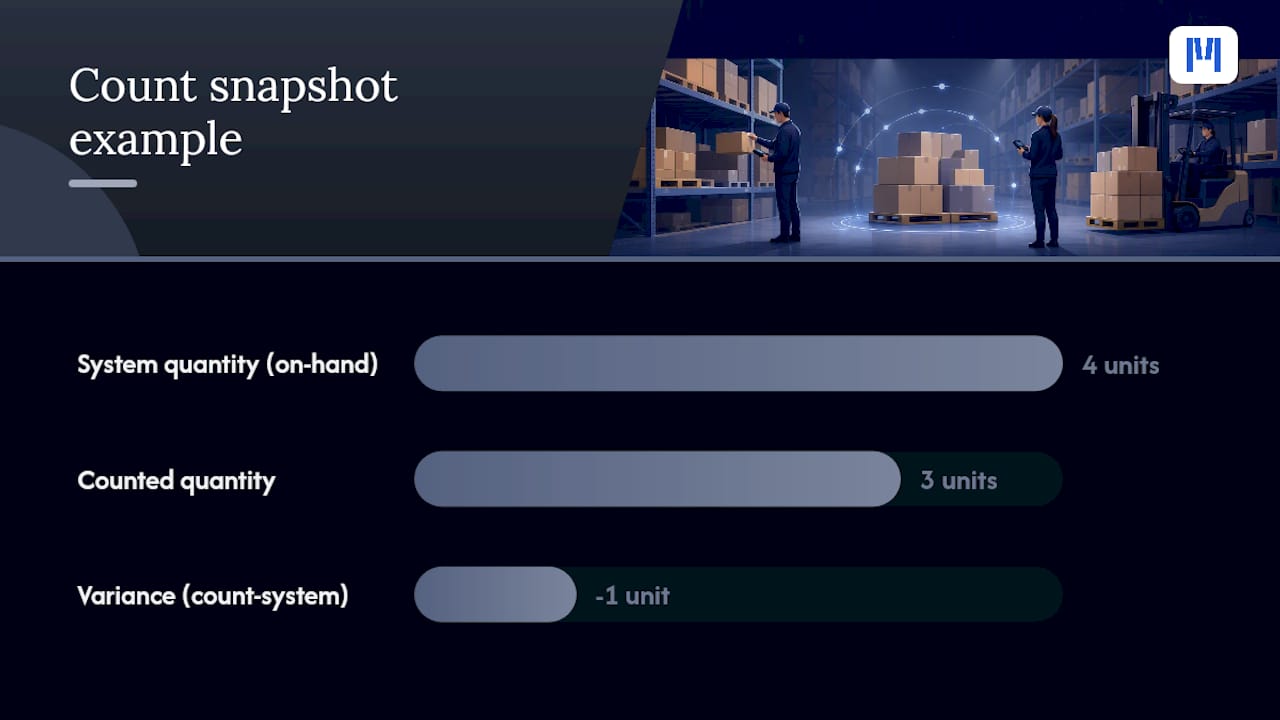
Worked example: Your parts manager schedules a blind count of bin C7, which holds hydraulic pump assemblies (A-item, serialized). The counter scans the bin label, then scans three serial numbers: HYD-00421, HYD-00422, and HYD-00424. The system shows four units on hand. The counter records three. After the count is submitted, the system flags a variance of minus one unit. The parts manager checks the service work order log and finds that HYD-00423 was fitted to a machine that morning but the work order was not yet closed. The transaction is completed, the system quantity updates to three, and the variance resolves to zero. No adjustment is needed. The investigation note records the root cause as an open work order at time of count, and the SOP is updated to require work order closure before the daily A-item count session.
For serialized inventory tracking, reconciling at the individual serial level is the only way to confirm that the right unit is in the right location, particularly for warranty-tracked components.
Why investigating before adjusting is the right approach — Australian practice notes
The instinct when a count shows a discrepancy is to post the adjustment and move on. That instinct is wrong, and Australian practitioners are clear about it.
Cycle counting should identify and eliminate root causes of inventory drift rather than only adjusting numbers. Separating counting duties and investigating repeated discrepancies are both part of the standard. An adjustment without an investigation is a missed opportunity to fix the process that created the error.
Counting during low-activity windows and using independent verification improves count reliability and reduces operational disruption. Close open transactions before counting, and separate the counting role from the daily handling role to maintain the integrity of the count.
Australian practice notes add two specific requirements. First, close or freeze open transactions in your DMS before any count session. A count taken while invoices or service jobs are in flight will produce a discrepancy that reflects timing, not a real stock problem. Second, align your rolling counts with the tax-year reconciliation cycle. The ATO expects that your inventory valuation at June 30 is supported by a defensible count record. A perpetual system with monthly reconciliation and a complete audit log satisfies that requirement far more convincingly than a single annual stocktake conducted under time pressure.
FIFO valuation is the preferred accounting approach for most Australian wholesalers and dealers. Barcode scanning at receiving and monthly ERP reconciliation keep the physical flow and the accounting record aligned, reducing the risk of costly valuation errors at year-end.
An operations manager’s perspective on rolling out cycle counts at a dealership
Rolling out a cycle-count program at an equipment dealership is less about the counting itself and more about changing the habits that let inventory drift in the first place. The counting reveals the problems; the discipline to investigate and fix them is what delivers lasting accuracy.
The most common resistance comes from the service bay. Technicians are focused on getting machines back to customers, and a parts process that requires them to scan a return or close a work order before leaving for the day feels like friction. The solution is not to make the process optional. It is to make it fast enough that compliance is easier than workarounds. A tablet scan at the parts counter takes ten seconds. A missing serial number discovered three weeks later during a warranty claim takes an hour to resolve.
One concrete change that consistently reduces stock variance is moving the daily A-item count to the first fifteen minutes of the shift, before any picks are processed. Counts taken at the start of the day, before the warehouse is active, are cleaner and faster than counts squeezed into a busy afternoon. Staff who own that daily routine also tend to notice bin labeling problems and misplaced stock as a matter of course, which reduces discrepancies before they even reach the count sheet.
Staff training matters, but change management matters more. The team needs to understand why the count program exists, what happens when discrepancies are found, and that the goal is process improvement, not blame. When a technician’s workflow change resolves a recurring variance, acknowledge it. That feedback loop is what turns a compliance exercise into a genuine operational improvement.
Moderndms supports your parts cycle-count program from day one
Equipment dealerships running parts cycle counts on spreadsheets or disconnected systems spend more time managing the counting process than improving it. Moderndms gives your team a purpose-built alternative: a dealer management system for equipment dealers with integrated parts, stocktake, and warehouse modules that map directly to the SOP above.

The mobile stocktake module pushes count tasks to a tablet on the floor, captures scanned quantities and serial numbers in real time, and feeds results to the reconciliation queue without manual re-entry. Variance thresholds are configurable by tier, so A-item exceptions surface immediately while C-item tolerances are applied automatically. Audit logs record every count, every adjustment, and every investigation note, giving your finance team a defensible record for ATO reporting. Xero integration means inventory adjustments flow through to your accounts the same day, keeping GST calculations current without a second data entry step.
Setup takes under an hour. There is no lock-in, and you own your data. Start with the parts and stocktake modules, then add service, rental, or finance as your team is ready. Book a demo at Moderndms for industrial equipment dealers to see how a daily A-item count is configured and how discrepancy investigations are documented inside the platform.
Sources
- Mastering Inventory Control: The Definitive Guide for Australian SMBs in 2026
- The Importance of Cycle Counting in Inventory Management - Associated Stocktaking Services
- RGIS — cycle count stocktaking guidance
- Business
- Inventory Cycle Counting: Methods, Benefits, & Best Practices
FAQ
What are the steps involved in cycle counting?
The core steps are: classify SKUs by tier, close open transactions, assign a counter, execute a blind scan-based count, compare to the system quantity, investigate any variance above your threshold, post an adjustment with a reason code, and document the root cause. The investigation step is what most operations skip, and it is the step that actually improves accuracy over time.
What is the 80/20 rule for cycle counting?
In a cycle-count program, those A-tier SKUs get counted most frequently, daily or weekly, because errors on high-value parts carry the greatest financial and operational risk.
What are the different types of cycle counting?
The main methods are ABC/Pareto (frequency tied to value and movement), location-based (count everything in a defined bin or zone), random sample (statistical confidence check), control-group (repeated counts of the same SKUs to validate a process change), and opportunity-based (count triggered by a receiving event, return, or discrepancy). Most parts operations use ABC as the primary method and opportunity-based counting as a reactive layer.
What are the 4 types of inventory?
The four standard inventory types are raw materials, work-in-progress (WIP), finished goods, and maintenance, repair, and operations (MRO) supplies. For equipment dealerships, parts inventory spans finished goods (parts ready to sell) and MRO (consumables and supplies used in the service workshop), both of which benefit from regular cycle counting to maintain accurate on-hand records.