Serialized Inventory Tracking: A Practical Guide for Dealers
By MDMS Team · 2 August 2026
Serialized Inventory Tracking: A Practical Guide for Dealers
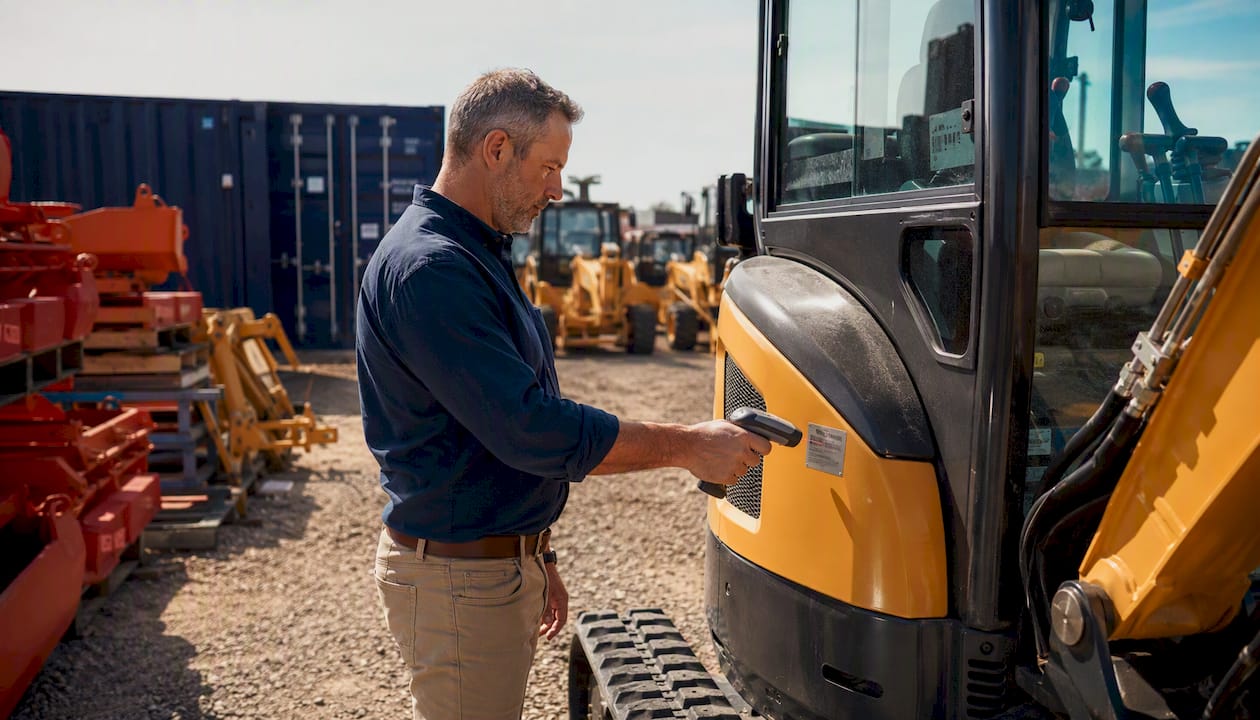
Serialized inventory tracking records each individual unit with a unique serial number so you can trace ownership, warranty, service history, and location throughout its entire lifecycle. For equipment dealers and asset-heavy businesses, that single capability changes how you handle warranty claims, recall events, PPSR registrations, and parts orders — because every transaction ties back to one specific physical unit, not just a SKU count.
The operational payoff is immediate:
- Warranty and recovery speed: Pull the original purchase date, customer record, and service history from a single serial lookup instead of a scavenger hunt across paper files.
- Recall handling: Identify exactly which units are affected and where they are, rather than notifying every customer who ever bought that model.
- Accurate unit-level valuation: Know the precise cost, margin, and depreciation of each machine, not an average across a batch.
- Theft and loss reduction: Asset tracking research shows GPS-enabled serial tracking can cut equipment theft by up to 85% and resolves insurance claims 40–60% faster.
The implementation steps, technology stack, and dealer-specific workflows are covered in detail below.
Table of Contents
- What serialized inventory tracking actually records and how it flows
- How serialized tracking compares to lot tracking and non-serialized inventory
- When does your business actually need serialized tracking?
- Primary benefits of serialized inventory tracking
- Technology that supports serialized tracking in your operations
- How to implement serialized inventory tracking step by step
- Common pitfalls and how to avoid them
- What equipment dealers should actually expect from their DMS
- Key Takeaways
- The case for treating serialization as infrastructure, not a feature
- Moderndms supports your serialized inventory workflow
- Useful sources and further reading
- FAQ
What serialized inventory tracking actually records and how it flows
A serial record is more than a number on a label. Each serialized unit in your system carries a linked set of fields: the serial number itself, the parent SKU, current bin or warehouse location, supplier and purchase order reference, customer or owner record (once sold or assigned), and links to every work order and warranty claim ever raised against it.
For heavy equipment, that record should also capture the engine number and running hours at every interaction. Linking machine serial numbers to engine numbers and running hours lets dealers identify the correct parts diagrams and reduces downtime caused by incorrect parts shipments — a real cost when a wrong filter or seal holds up a machine for days.
The lifecycle flow looks like this:
- Receive and register: The serial is captured at goods receipt, the unit is assigned to a bin or yard location, and the purchase cost is recorded against that specific serial.
- Store and locate: Bin location management keeps the unit findable. A parts bin location system ties each serialized part to a physical slot, reducing pick errors.
- Sell or assign: At point of sale or rental dispatch, the serial links to the customer record and deal sheet. Ownership transfers in the system at the same moment it transfers physically.
- Post-sale service and warranty: Every work order raised against the machine references the serial. Parts consumed in the repair are deducted from serialized or non-serialized stock and logged against that unit’s history.
- Retire or transfer: When the unit is traded in, scrapped, or sold on, the serial record closes or transfers, preserving the full history for audit and PPSR purposes.
A concrete example: a dealer receives a compact excavator, captures the serial and engine number at the dock, assigns it to yard bay C-14, and records the landed cost. Six months later, the customer calls with a hydraulic fault. The service advisor pulls the serial, sees the original invoice date, confirms warranty eligibility in seconds, raises a work order, and orders the correct seal kit using the engine number to match the right parts diagram. No phone calls to the supplier to confirm the build spec. No guessing.
How serialized tracking compares to lot tracking and non-serialized inventory
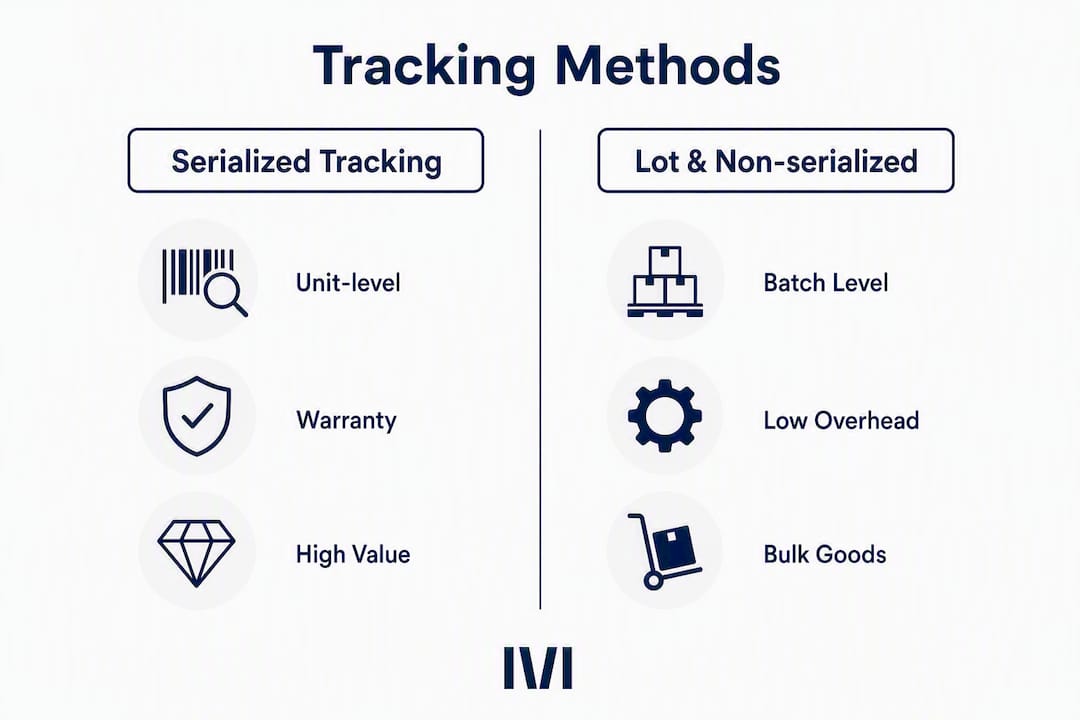
Choosing the wrong tracking method creates either unnecessary overhead or dangerous blind spots. The three methods serve different purposes.
| Tracking method | Granularity | Recall / warranty suitability | Typical use case | Overhead |
|---|---|---|---|---|
| Serialized | Individual unit | Excellent — pinpoint affected units | High-value equipment, vehicles, medical devices, electronics | High — one record per unit |
| Lot / batch | Group of units from one production run | Good — isolate affected batches | Perishables, chemicals, pharmaceuticals, bulk fasteners | Medium |
| Non-serialized (quantity) | SKU count only | Poor — cannot isolate units | Commodity consumables, low-value bulk parts | Low |
Serialized tracking is the right choice when each unit has a distinct value, a warranty obligation, or a regulatory identity. Lot tracking suits goods where the production batch is the relevant unit of risk — a batch of hydraulic fluid or a run of O-rings. Non-serialized quantity tracking works for nuts, bolts, filters, and other consumables where individual identity is irrelevant and the cost of serializing would exceed any benefit.
Most equipment dealerships run all three methods simultaneously: serialized for whole machines and major assemblies, lot tracking for lubricants and chemicals, and quantity-only for consumable parts. The key is configuring your inventory management software to enforce the right method per SKU class rather than leaving it to staff discretion.
When does your business actually need serialized tracking?
The clearest trigger is a warranty obligation. If you are contractually required to prove when a unit was sold, to whom, and what service it has received, serialization is not optional — it is the evidence base.
Industry signals in the Australian market:
- Equipment dealerships: Tractors, excavators, mowers, generators, and forklifts all carry manufacturer serial numbers and warranty terms that require unit-level records. Dealers in the forklifts and material handling and heavy equipment sectors face this daily.
- Automotive and commercial vehicles: VIN-based tracking is legally embedded in registration and PPSR workflows.
- Medical devices: The Therapeutic Goods Administration (TGA) requires unique device identification for Class IIb and Class III devices.
- Telecom and high-value electronics: Devices with IMEI numbers, network equipment, and enterprise hardware all benefit from serial-level tracking for warranty and theft recovery.
- Rental fleets: Every asset on hire needs a serial record to support inspection logs, maintenance scheduling, and damage attribution.
Business-trigger checklist — serialization is warranted when:
- Units carry individual warranty terms from the manufacturer or your dealership.
- Your business sells on retention-of-title terms and needs PPSR registration by serial number to protect security interests.
- You have experienced a product recall in the past three years.
- Unit replacement cost exceeds a threshold where a single untracked loss is material to your P&L.
- Regulatory inspection or certification is tied to the individual unit (e.g., pressure vessels, lifting equipment).
- Your service department generates significant revenue from post-sale work orders.
- Theft or unexplained shrinkage is a recurring problem.
If three or more of those signals apply to a SKU class, serialization will pay for itself.
Primary benefits of serialized inventory tracking
Serialized records are the foundation for demonstrating maintenance history and handling warranty claims and product recalls efficiently in Australian operations. The benefits below are ranked by the frequency with which dealers report them as the primary driver for adoption.
-
Faster warranty validation and claims recovery. A service advisor can confirm warranty eligibility in under a minute by pulling the serial record. No cross-referencing paper invoices, no calls to the manufacturer to verify the build date. For dealers recovering warranty costs from OEMs, accurate serial records are the difference between a paid claim and a rejected one.
-
Precise recall management. When a manufacturer issues a recall, a serialized system lets you filter the exact affected units in your stock and in customers’ hands. Without serial-level data, you notify everyone who bought that model — a much larger, more expensive exercise.
-
Accurate unit-level valuation and margin tracking. Knowing the landed cost, any pre-delivery work, and the final sale price for each individual machine gives you real margin data per unit. Averaged SKU costs hide the outliers that erode profitability.
-
Reduced parts errors and workshop downtime. Capturing engine numbers and running hours alongside the serial number means your parts team orders against the correct build specification every time. Incorrect parts shipments are one of the most common causes of extended workshop turnaround.
-
PPSR compliance and security interest protection. Under the Personal Property Securities Act, serial-numbered collateral should be registered by serial number to protect your security interest and priority. A small error in the serial format can invalidate that protection entirely.
-
Audit-ready records. Serialized records give auditors a complete chain of custody for each unit. For GST purposes, the serial ties the tax invoice to a specific asset, which matters when the ATO reviews high-value transactions.
Australian compliance note: PPSR registration by exact serial number is the primary mechanism for protecting retention-of-title interests on equipment sold on credit terms. Dealers who skip this step risk losing priority to a subsequent secured party or a buyer’s trustee in bankruptcy.
Technology that supports serialized tracking in your operations
Identification methods
Barcodes and QR codes are the most widely adopted identification method in Australian equipment operations. Research shows 83% of Australian businesses use QR or barcode as their primary digital identification method. For most dealerships, a QR label on the machine and a matching label on the bin location is sufficient.
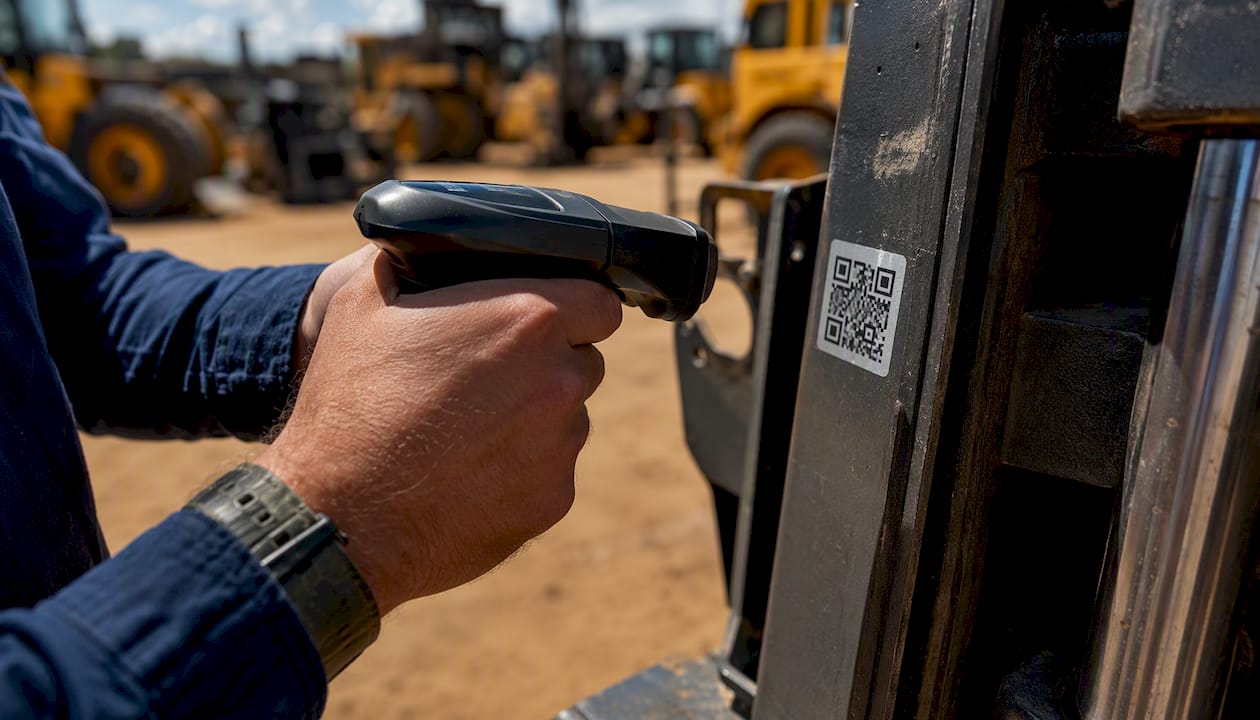
RFID adds hands-free scanning capability — useful in high-throughput receiving docks or rental yards where scanning each unit manually creates a bottleneck. The trade-off is cost: RFID readers and tags are significantly more expensive than barcode infrastructure, and the ROI depends on volume.
For outdoor equipment in harsh environments, label durability matters. Polyester or metal-plate labels outlast paper in workshop and yard conditions. A label that fails after six months defeats the purpose of the system.
Software components
Your inventory management software needs a native serialized inventory module, not a workaround using notes fields. The core requirements are:
- Serial capture enforcement: The system must block receipt or sale completion unless a valid serial is entered.
- Duplicate detection: The system should reject a serial that already exists in the database.
- Format validation: Configurable rules that reject serials that don’t match the expected format for a given SKU class.
- Workshop reconciliation: Parts used in work orders should reconcile against serialized stock in real time so valuation and margins stay accurate.
- Accounting integration: Xero or MYOB integration ensures that the serial-level cost flows through to your financial records without manual re-entry.
A DMS that automates PPSR and warranty logging while connecting sales, service, and procurement reduces administrative overhead and supports GST-compliant workflows — it functions as core infrastructure, not a bolt-on feature.
Adoption and ROI data

According to Australian market research, 46% of Australian small and medium enterprises still track assets on spreadsheets or paper. That gap is the baseline against which serialized software investment is measured.
| Metric | Reported range |
|---|---|
| Reduction in equipment theft (GPS-enabled tracking) | Up to 85% |
| Insurance claim resolution speed improvement | 40–60% faster |
| Businesses still using spreadsheets or paper (AU SMEs) | 46% |
Pro Tip: Before selecting hardware, walk your receiving dock and workshop with a phone. If your team can scan a QR code with a mobile app in those conditions, you don’t need dedicated scanners. Save the RFID budget for the rental yard where hands-free scanning genuinely saves time.
Integration checklist
- API connection between your DMS and accounting platform (Xero/MYOB) for real-time cost sync.
- Duplicate serial detection active at both receiving and point of sale.
- System-enforced blocking: no receipt or sale line completes without a valid serial entry.
- Mobile scanning capability for yard and field use.
- Scheduled reconciliation reports that flag serials in the system with no matching physical location.
How to implement serialized inventory tracking step by step
A phased rollout reduces risk and gives your team time to build the habits that make serialization stick. Trying to serialize every SKU on day one is the fastest way to create a backlog of phantom units and frustrated staff.
-
Scope your serialized SKUs. Identify the SKU classes where serialization delivers the most value: whole machines, major assemblies, and any item with a warranty obligation or PPSR exposure. Leave consumables and bulk parts on quantity tracking for now.
-
Design your numbering scheme. Choose a format that is human-readable, machine-scannable, and consistent across departments. Naming drift — departments creating local tag numbers — causes compliance problems and audit failures. Assign one person or team as the owner of the numbering policy.
-
Configure your DMS or inventory system. Flag serialized SKUs in the system, set up format validation rules, activate duplicate detection, and configure the blocking rule: no receipt or sale line completes without a valid serial. This single configuration step prevents the majority of data-quality problems.
-
Update receiving workflows. Train receiving staff to capture the serial (and engine number and running hours for heavy equipment) at the dock before the unit moves to the yard or warehouse. Pair the serial with the bin or yard location at the same time.
-
Update POS and workshop workflows. Equipment dealers must capture serial numbers at receiving and again at point of sale to avoid phantom units that break warranty and ownership records. Workshop job cards should reference the serial so parts consumption reconciles against the correct unit.
-
Run a pilot on high-value, high-risk SKUs. A 2–6 week pilot on a narrow set of machines gives you real data on label durability, staff compliance, and system configuration gaps before you scale. Fix what breaks at small volume, not large.
-
Train staff and document SOPs. A one-page SOP for receiving, one for sales, and one for workshop is enough. The goal is that every team member knows exactly when and how to capture a serial, and knows the system will not let them skip it.
-
Set an audit and reconciliation schedule. Monthly physical counts against serialized records for high-value stock, quarterly for everything else. Use the reconciliation to catch label failures, location drift, and any serials that exist in the system but not on the floor.
-
Phase in remaining SKU classes. Once the pilot is stable, extend serialization to the next tier of SKUs. A full rollout typically takes 1–6 months depending on the number of SKU classes and the complexity of your supplier integrations.
Typical cost drivers: hardware (scanners, labels, printers), software licensing or DMS module fees, integration development between your DMS and accounting platform, and staff time for data migration and training. Cleaning historical inventory records before migration is often the most time-consuming step — the LedgerOne CFO guide to cleaning up inventory records is a practical starting point for that exercise.
Pro Tip: Configure your DMS to block transaction completion unless a valid serial number is entered. This one rule eliminates phantom units and avoids the large reconciliation effort that builds up when receiving teams bypass serial entry during busy periods.
Common pitfalls and how to avoid them
Most serialization projects don’t fail because of technology. They fail because of process gaps that accumulate quietly until an audit or a warranty dispute makes them visible.
Common pitfalls:
- Receiving shortcuts. When the dock is busy, staff skip serial entry and plan to “add it later.” Later rarely comes. The result is units in stock with no serial record — phantom units that break warranty and PPSR workflows.
- Naming drift. The service department starts using its own shorthand for serial formats, the parts team uses another. Within six months, the same physical unit may have three different identifiers across three systems.
- Duplicate serials and typos. Manual entry without format validation creates duplicates and transposition errors. A serial entered as “1O23” instead of “1023” is effectively a new, unmatched record.
- Label durability failures. Paper labels in workshop or outdoor environments degrade within weeks. A unit with an unreadable label is functionally untracked.
- Integration reconciliation gaps. If your DMS and accounting platform don’t sync in real time, serialized cost records drift from financial records, creating valuation errors that compound over time.
Mitigations:
- Enforce serial capture at the system level — no overrides, no “add later” workarounds.
- Standardize the numbering scheme in writing and assign one owner. Review it quarterly for drift.
- Activate duplicate detection and format validation in your DMS configuration.
- Specify durable polyester or metal-plate labels for any unit that will spend time outdoors or in a workshop.
- Schedule monthly cross-system reconciliation between your DMS and Xero/MYOB to catch cost drift early.
Audit readiness checklist:
- Verify physical serial plates against system records before each scheduled audit.
- Confirm PPSR registrations reference the exact serial format used in your DMS.
- Keep purchase invoices, work orders, and sale records linked to each serial for a minimum of seven years (consistent with ATO record-keeping requirements for GST purposes).
- Document the numbering policy and any changes to it with effective dates.
What equipment dealers should actually expect from their DMS
The dealer workflow where serialization delivers the most value is the one that runs from sale through workshop and back to warranty recovery. When those three stages share a single serial record, the data travels once. When they don’t, your team spends time reconciling instead of working.
A practical example: a customer buys a skid steer loader. The deal sheet captures the serial and engine number. Three months later, the loader comes in for a warranty repair. The service advisor opens the work order, pulls the serial, confirms warranty eligibility, and orders the correct parts using the engine number to match the build spec. The parts are deducted from serialized warehouse stock in real time. When the warranty claim goes to the manufacturer, the serial record provides the purchase date, the work order, and the parts list — everything the OEM needs to approve the claim. No manual assembly of evidence.
What dealers should require from their DMS:
- Native serialized SKU flagging with configurable fields for engine number, running hours, and custom attributes.
- POS and receiving enforcement that blocks transaction completion without a valid serial.
- Workshop reconciliation that deducts parts against serialized stock in real time and links consumption to the work order.
- PPSR-ready serial records with export capability for registration submissions.
- GST-compliant finance flows and Xero or MYOB integration so serial-level costs flow to your accounts without re-entry.
- Mobile scanning and offline capability for field service and remote yard operations.
The inventory tracking system guide for equipment dealers covers how these capabilities connect across a dealership’s full operational stack.
Dealerships that implement serialization properly report fewer incorrect parts orders, faster warranty claim approvals, and cleaner audit outcomes. The administrative time savings are real: Moderndms users report recovering up to 10 hours per week in administrative tasks once workflows are properly configured and enforced.
Key Takeaways
Serialized inventory tracking is the operational foundation that connects a dealer’s sales, workshop, and warranty workflows through a single, unit-level record — without it, phantom units, naming drift, and PPSR exposure accumulate silently.
| Point | Details |
|---|---|
| Enforce serial capture at the system level | Configure your DMS to block receipt and sale completion without a valid serial — this single rule prevents phantom units. |
| PPSR registration requires exact serial format | Under Australian law, security interests on serial-numbered collateral must be registered by exact serial number to hold priority. |
| Pilot on high-value SKUs first | A 2–6 week pilot on machines and major assemblies surfaces label, process, and integration gaps before full rollout. |
| A notable share of Australian SMEs still use spreadsheets for asset tracking. | Moving to a serialized DMS module delivers first-year ROI of 200–500% against that baseline, per Australian market research. |
| Moderndms covers the full serialization stack | Moderndms includes native serialized SKU flagging, POS enforcement, workshop reconciliation, PPSR-ready records, and Xero integration for Australian equipment dealers. |
The case for treating serialization as infrastructure, not a feature
Most dealerships approach serialized tracking as a compliance checkbox — something to implement when a manufacturer demands it or an audit flags a gap. That framing undersells what the data actually does for your business.
The real value of a serial record is not the number itself. It is the chain of events attached to it: the purchase order, the landed cost, the pre-delivery inspection, the sale, the warranty claims, the parts consumed in every repair, and the final disposal or trade-in. When that chain is intact and queryable, your service department stops guessing about build specs, your finance team has defensible unit-level margins, and your warranty recovery rate improves because you can produce the evidence an OEM needs in minutes rather than days.
The businesses that treat serialization as infrastructure — configuring it into every receiving, sales, and workshop workflow from day one — are the ones that find it pays for itself quickly. The ones that treat it as optional tend to discover its value only after a recall event, a PPSR dispute, or an audit that exposes years of phantom units.
For Australian equipment dealers specifically, the PPSR dimension makes this non-negotiable. Selling on retention-of-title terms without a clean serial record in your PPSR registration is a legal exposure that no amount of good faith can fix after the fact. The serial is the registration. Get it right at receiving, enforce it at every transaction, and the compliance benefit follows automatically.
Moderndms supports your serialized inventory workflow
Equipment dealers running serialized inventory on spreadsheets or disconnected systems face a specific problem: the data exists somewhere, but it doesn’t travel with the unit. A sale happens in one system, a work order in another, and a warranty claim gets assembled manually from both. That gap costs time and money on every transaction.
Moderndms is purpose-built for Australian equipment dealerships and includes the full serialization stack in a single platform. Native serialized SKU flagging, POS and receiving enforcement that blocks transactions without a valid serial, real-time workshop reconciliation against parts and warehouse stock, PPSR-ready serial records, Xero and MYOB integration, and an offline-capable mobile app for field and yard scanning. For industrial capital equipment dealers, the platform covers the entire workflow from deal sheet through warranty recovery without requiring a separate system for any stage.
Dealers using Moderndms report recovering up to 10 hours per week in administrative tasks once serial capture, workshop reconciliation, and warranty workflows are configured and enforced. Setup takes under an hour, contracts are monthly with no lock-in, and you retain full ownership of your data.
Request a free trial or book a demo at moderndms.com.au to see how the serialized inventory module maps to your current workflows.
Useful sources and further reading
- Personal Property Securities Register (PPSR) — Australian Financial Security Authority: The official PPSR portal for registering and searching security interests on serial-numbered collateral in Australia.
- Serial-numbered goods under the PPSA | Sprintlaw: Plain-language explanation of how the Personal Property Securities Act applies to serial-numbered goods and what dealers must do to protect security interests.
- State of Equipment Tracking in Australia 2026 | MapTrack: Australian market research on asset tracking adoption, spreadsheet reliance, and ROI benchmarks for tracking software.
- Mastering equipment tag numbers: A 2026 guide | Evright Industrial: Practical guidance on numbering schemes, naming conventions, and governance controls to prevent naming drift.
- Inventory tracking for Australian businesses | Moderndms: Overview of inventory tracking methods and compliance considerations for Australian businesses, with notes on serialized and lot tracking.
- Clean up inventory records before migration | LedgerOne CFO: Step-by-step guidance for cleaning historical inventory data before moving to a serialized tracking system.
FAQ
What is the difference between serialized and non-serialized inventory?
Serialized inventory assigns a unique identifier to each individual unit, enabling unit-level traceability for warranty, ownership, and service history. Non-serialized inventory tracks quantity only — you know how many units you have, but not which specific unit is which.
What is the easiest way to track serial numbers in a dealership?
Configure your DMS to enforce serial capture at receiving and point of sale, so the number is recorded the moment the unit enters or leaves your system. Pairing that with QR or barcode labels and a mobile scanning app removes the need for manual entry in most workflows.
Does standard accounting software handle serialized inventory?
Most general-purpose accounting platforms handle quantity-based inventory but lack native serialized modules with POS enforcement, duplicate detection, and workshop reconciliation. A purpose-built DMS like Moderndms includes these capabilities and integrates with Xero or MYOB for financial reporting.
How does PPSR registration relate to serial number management?
Under the Personal Property Securities Act, security interests on serial-numbered goods must be registered using the exact serial number and correct collateral class. Errors in the serial format can invalidate the registration, so your DMS serial records and your PPSR submissions must match character-for-character.
How long does a serialized inventory rollout typically take?
A pilot on high-value SKUs runs 2–6 weeks. A full phased rollout across all serialized SKU classes typically takes 1–6 months, depending on the number of SKU classes, integration complexity, and the volume of historical data that needs cleaning before migration.