Top 3 Dealer Management System Alternatives 2026
By MDMS Team · 17 July 2026
Top 3 Dealer Management System Alternatives 2026
Managing sales, rentals, service, and inventory across separate systems causes delays and information gaps for equipment dealerships. Many dealer management systems force a long vendor-led implementation or demand a bundled pricing model that does not fit staged adoption. This comparison shows pricing, customization, and workflow coverage for three dealer management system alternatives, so dealerships can align software choice to their operation size and team structure.
Table of Contents
- Modern Dealer Management System (MDMS)
- Dealer Information Systems Corporation (DIS)
- DealerCloud
- Comparison of alternatives
Modern Dealer Management System (MDMS)
At a Glance
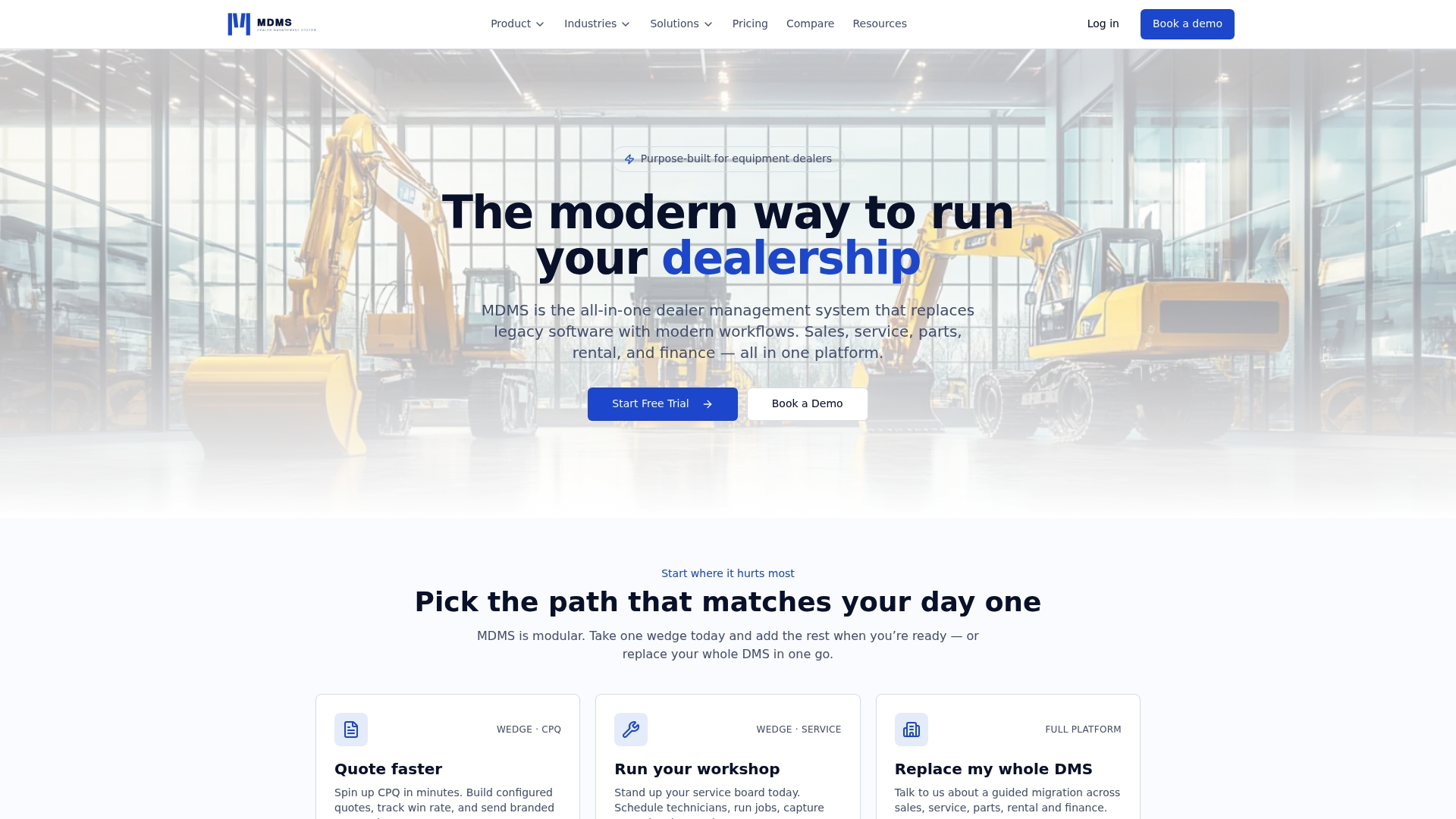
The vendor advertises quick setup under an hour for self-service deployments. MDMS also claims dealers can reclaim administrative time, reporting up to 10 hours per week saved in testimonials. The platform targets Australian and New Zealand equipment dealers with native compliance and offline-capable mobile apps.
Core Features
MDMS consolidates CRM and customer lifecycle management with sales quoting and CPQ, serial-tracked equipment inventory, and pre-delivery build workflows. The platform includes rental fleet management with contract billing and meter tracking, plus offline-capable mobile apps for field service and workshop teams. A modular architecture lets dealers enable modules on demand and operate without lengthy vendor-led implementations.
Key Differentiator
MDMS centers on Australian dealer workflows with built-in GST invoicing, ABA payment files, and a Xero sync option as native features. The product emphasizes self-configuration and field-ready mobile apps that work offline for remote job sites. Those elements reduce dependency on long implementation projects and on-premise legacy systems.
Pros
Self-service setup and transparent module pricing let dealerships pilot core functions without a large upfront project. Native Australian data hosting and compliance features remove extra configuration work for GST, ABA files, and accounting integration. Offline mobile apps keep service and commissioning work moving at remote sites. Modular pricing and clear packages allow staged adoption by sales, parts, rental, and service teams, and that setup claim shortens the time to operational use.
Cons
- Onboarding and customization can feel less intuitive without vendor support for complex workflows.
Notable Integrations
MDMS lists Xero accounting as a built-in integration for bank reconciliation and GST reporting. The platform supports ABA payment file generation for Australian banking workflows.
Who It’s For
Dealership owners and managers running heavy equipment, machinery, or capital goods operations in Australia or New Zealand. Teams that need serial number tracking, pre-delivery build orders, and rental contract management will benefit most. Large OEMs or enterprise dealer groups requiring extensive factory EDI connections may need a different platform.
Unique Value Proposition
Complete data ownership without vendor lock-in lets you migrate or export records on your terms. Modular licensing means you buy only the modules you need and scale functionality as workflows grow. That approach lowers initial risk and keeps monthly costs aligned to immediate operational priorities.
Real World Use Case
A heavy equipment dealer replaced legacy software with MDMS to combine sales, service, parts, and rental workflows in one system. Field technicians used offline apps for site commissioning, while accounting reconciled with Xero. The dealer reported faster rollout and clearer operational handoffs between departments.
Pricing
The vendor states pricing starts from A$59/month per module, with packages for sales and rental, service and parts, and dealer suite bundles. The vendor states the full platform with all modules is approximately A$451/month billed annually, and individual module pricing is published on the website.
Website: https://moderndms.com.au
Dealer Information Systems Corporation (DIS)
At a Glance
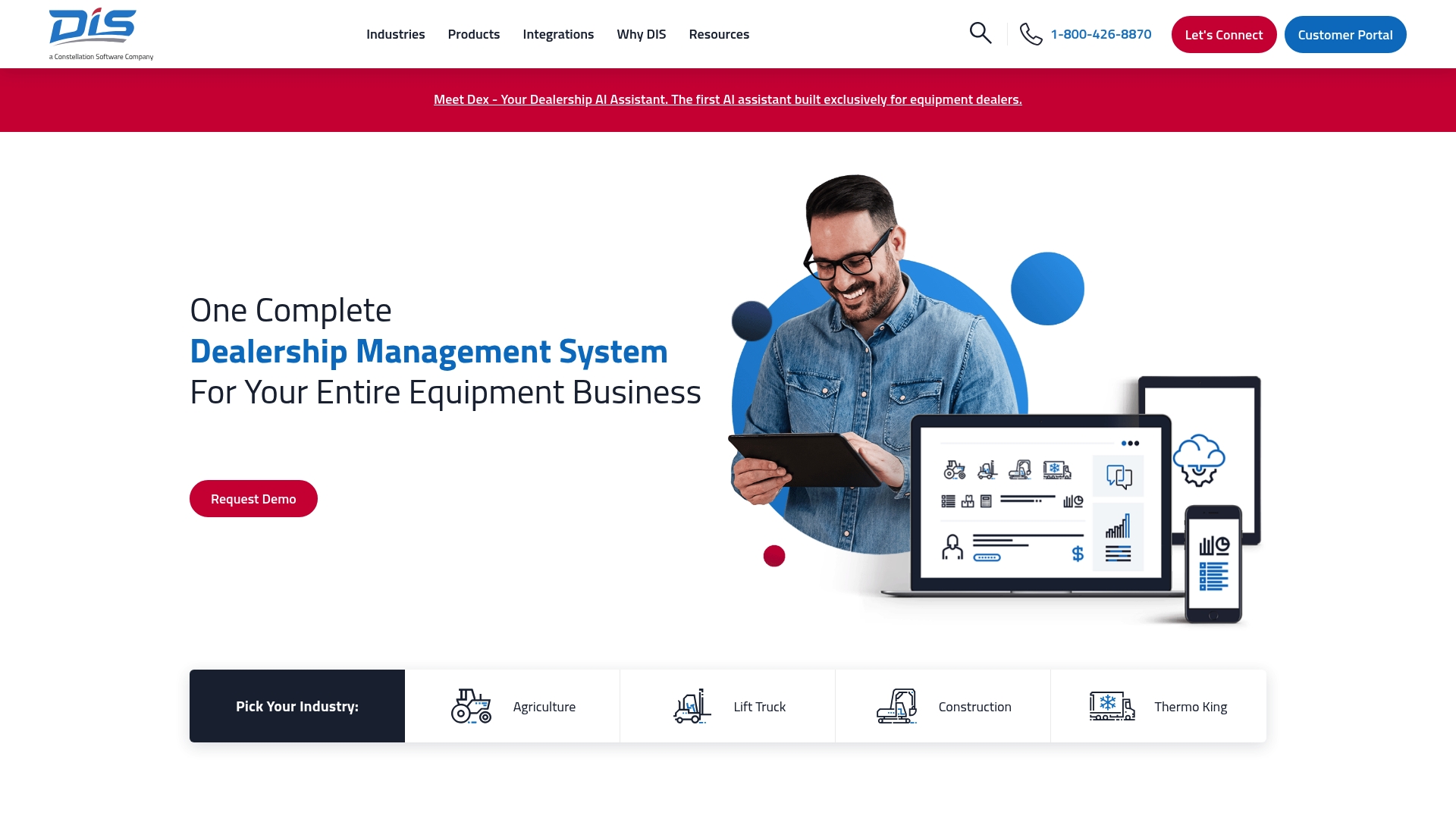
The vendor says the product was developed with direct input from thousands of dealers. DIS has been backed by Constellation Software since 2017, which supports ongoing development and stability. The system targets equipment dealerships and runs as a cloud based platform with mobile and browser access.
Core Features
DIS combines sales, service, parts, inventory, accounting, and CRM into a single offering, with manufacturer parts and warranty integration. The platform supports multiple locations and mobile access so field teams and branch staff can view the same records. Automated parts ordering and manufacturer interface bundles are included for parts accuracy and faster ordering.
Key Differentiator
DIS claims its feature set reflects direct input from thousands of dealers, which the vendor says results in workflows aligned to equipment businesses. That vendor claim suggests the product focuses on dealer-specific needs rather than generic retail or automotive workflows. The result is a solution shaped around parts catalogs, warranty flows, and dealer sales processes.
Pros
DIS delivers an integrated feature set that maps to the main dealer functions: sales, service, parts, inventory, accounting, and CRM. The platform supports operations across multiple locations and departments, which reduces duplicate data entry for regional chains. Being part of Constellation Software since 2017 adds a layer of financial backing and product continuity that many dealers value.
Cons
- No substantive third party user reviews exist, which makes it hard to verify daily user experience.
- Several specific product pages return 404 errors, limiting independent feature verification.
- Implementation can be complex and costly for dealers with bespoke legacy systems or heavy on premises infrastructure.
When It May Not Fit
If your dealership is a small single-branch operator, DIS may be more scope and budget than required. Dealers with heavily customized legacy databases could face long migration work and higher integration costs. Teams that require extensive public user reviews before purchase will find little independent feedback to read.
Notable Integrations
- Kubota Interface Bundle for manufacturer parts and data.
- CNH Interface Bundle to connect CNH parts and warranty systems.
- Activate OS ASIP Integration for standardized manufacturer messaging.
Who It’s For
This product fits large equipment dealerships and regional chains that manage multiple locations and departments. IT teams planning a centralized back office will benefit from the built in accounting and manufacturer interfaces. Dealers seeking an industry focused package rather than a generic retail system should evaluate DIS closely.
Real World Use Case
A regional construction equipment dealer uses DIS to centralize sales, parts, service, and accounting across several branches. Branch managers access common inventory and parts pricing, which shortens order cycles and reduces stockouts. Central finance reconciles branch activity without manual spreadsheets.
Pricing
Not applicable. The vendor lists the product for informational purposes and does not publish standard pricing. Expect pricing to be quoted based on dealership size, module selection, and integration scope.
Website: https://dis-corp.com
DealerCloud
At a Glance
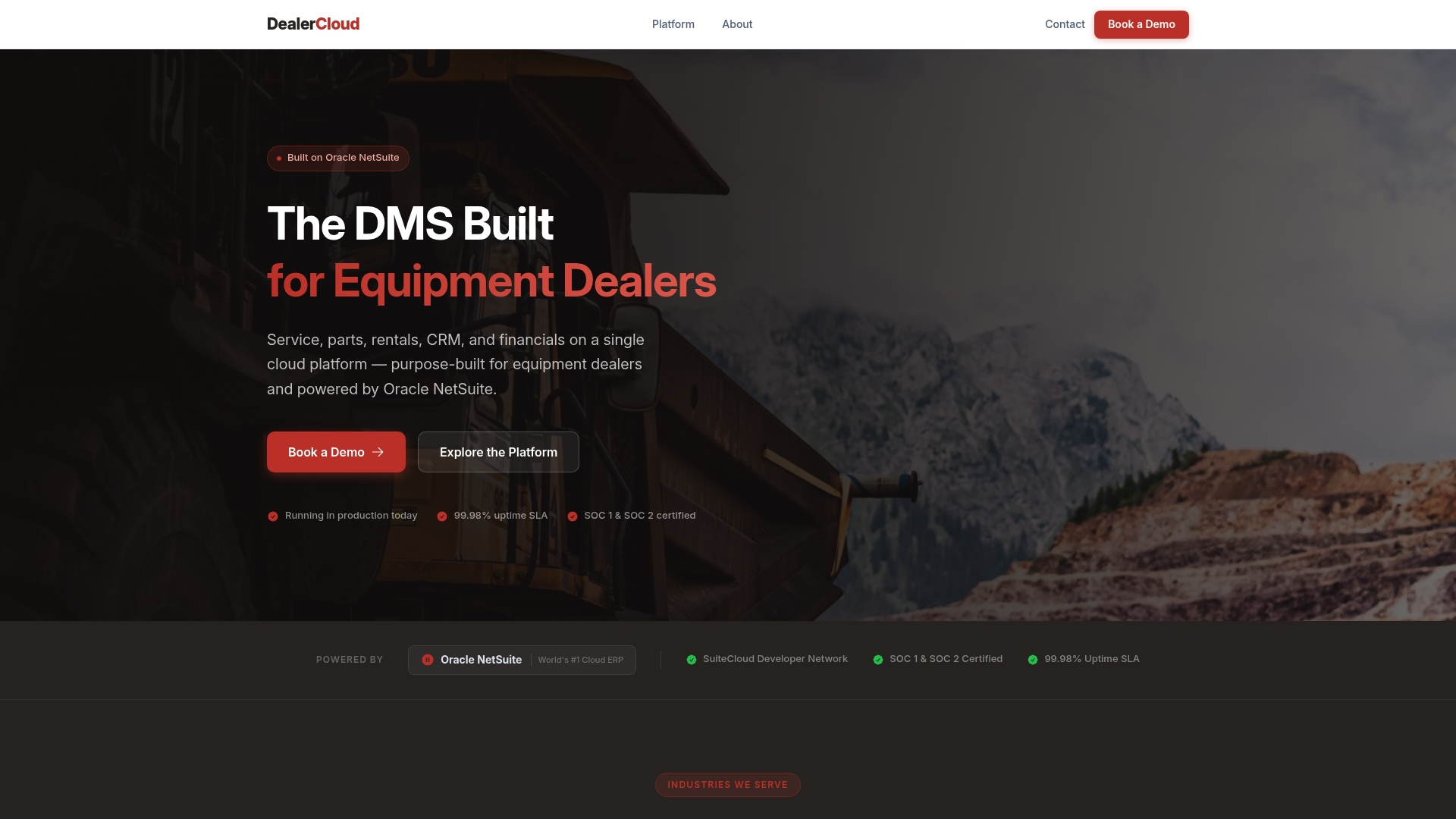
Built natively on Oracle NetSuite, DealerCloud centralizes service, parts, rentals, CRM, and finance on a single cloud database. The platform targets equipment dealers that need unified operational data and NetSuite ERP capabilities across multiple locations. It emphasizes real time dashboards and continuous updates from NetSuite.
Core Features
DealerCloud delivers a cloud native architecture with a unified database that removes manual reconciliation between systems. The platform includes built in ERP and accounting based on NetSuite and full modules for service, parts, rentals, CRM, and financials. Real time dashboards and reporting provide visibility into dealership performance across locations and product lines.
Key Differentiator
Being built on Oracle NetSuite gives DealerCloud enterprise ERP depth and native accounting inside the same database. That design suits dealers who need large scale transaction handling, OEM integrations, and consolidated financial reporting. Compared with Moderndms, DealerCloud leans toward ERP scale and heavy integration rather than ultra-fast modular onboarding.
Pros
DealerCloud delivers a single platform that reduces system silos and cuts repeated data entry between sales, service, parts, and rentals. The vendor emphasizes enterprise grade security and lists SOC certifications as part of its compliance posture. Integrations with OEMs, ecommerce catalogs, telematics, and SSO reduce custom integration work. The platform is implemented by NetSuite specialists, which helps when a dealership requires deep ERP configuration or complex accounting flows.
Cons
- Insufficient detailed user reviews to confirm practical strengths or weaknesses. The public feedback picture is thin.
- The comprehensive feature set can add complexity for very small dealerships with simple needs. Training and configuration may extend project timelines.
- Users unfamiliar with cloud ERP integrations may face a learning curve during rollout and change management.
When It May Not Fit
DealerCloud may be overkill for single location dealers with minimal inventory and simple service workflows. The solution requires reliable internet access and familiarity with cloud based ERP concepts. Small operations seeking a lightweight, quick setup may find the implementation scope and NetSuite licensing model more than they need.
Notable Integrations
- OEM supplier EDI and data feeds.
- eCommerce parts catalog integration.
- Telematics and IoT equipment data.
- Single sign on with Microsoft Entra ID.
Who It’s For
Mid sized to large equipment dealerships that need unified financials and operational data across locations. Dealers selling heavy machinery, agriculture, mining, material handling, transportation, or refrigeration equipment will get the most value. Teams that plan significant OEM or telematics integrations benefit from the native NetSuite foundation.
Real World Use Case
A heavy machinery dealer replaces several legacy systems with DealerCloud to run service, parts, and rental workflows on one database. The dealer uses integrated telematics feeds and OEM parts data to reduce parts errors and shorten repair cycle times. Consolidated ledgers let the finance team close month end with fewer reconciliations.
Pricing
DealerCloud does not publish standard list pricing. Pricing depends on NetSuite licensing, selected modules, and implementation scope handled by Inscio. The vendor issues custom quotes based on locations, integrations, and configuration needs. Contact DealerCloud for a tailored proposal and implementation estimate.
Website: https://dealerclouddms.com
Comparison of alternatives
MDMS, DIS, and DealerCloud offer distinct benefits that cater to specific dealership needs. MDMS shines in providing localized configurations for Australian requirements, DIS excels in streamlined multi-branch operations, and DealerCloud delivers deep enterprise-level integrations.
Compliance and Workflow Localization
MDMS uniquely addresses Australian compliance with built-in GST invoicing and ABA payment file support. This localized focus simplifies financial reporting tasks for dealers in Australia and New Zealand, reducing administrative overhead. Competitors such as DIS and DealerCloud target larger, disparate operations and global workflows rather than emphasizing local compliance focus.
Integration Depth
DealerCloud distinguishes itself with its Oracle NetSuite backend, which facilitates advanced integration capabilities aligned with ERP-level requirements. Dealerships with demands for complex OEM data synchronization and parts catalog connectivity will find these features valuable. In comparison, MDMS provides modular integration targeting lightweight deployments, while DIS offers manufacturer interface bundles tailored to industry-standard operations.
Best fit
- Dealerships located in Australia or New Zealand requiring fast setup and adherence to local compliance standards should consider MDMS.
- Enterprises seeking OEM-level data synchronization and ERP integration capabilities can turn to DealerCloud.
- Dealers with multi-branch operations demanding centralized record systems and workflow standardization should evaluate DIS.
Our pick
MDMS stands out for dealerships prioritizing native compliance and localized configurations for Australian workflows while minimizing upfront commitment. If a large-scale enterprise integration is required, DealerCloud could be a better fit due to its extensive NetSuite-driven feature set.
Choosing the right dealer management system ensures streamlined workflows and optimal operations tailored to your dealership’s needs.
| Product | Core Feature | Key Differentiator | Pricing | Limitation |
|---|---|---|---|---|
| Moderndms | Modular CRM, sales quoting, rental management | Self-setup design, Xero integration, offline-capable | A$59/module/month | Onboarding less intuitive for complex workflows |
| DIS | Integrated sales, service, parts, and inventory | Features shaped by feedback from thousands of dealers | Price not published | Limited public reviews for detailed daily use insights |
| DealerCloud | Unified ERP on Oracle NetSuite | Enterprise-scale ERP capabilities | Price not published | Setup complexity for small dealerships |
Choosing the Right Dealer Management System for Your Equipment Dealership
Your team faces key challenges when comparing dealer management system alternatives: fast setup, data ownership, and fitting the system to your exact workflows. Moderndms meets these needs by offering a modular, self-service platform tailored for Australian and New Zealand equipment dealerships. With quick setup under an hour and deep features for sales, service, parts, and rentals, Moderndms cuts administrative time by up to 10 hours weekly.
Moderndms also supports integration with platforms like Xero to simplify accounting and GST compliance. If your dealership seeks a system that respects your data control and scales with your teams, consider how Moderndms can replace outdated software without long implementation delays. Learn more about this solution and explore how it fits your operational priorities at Moderndms.
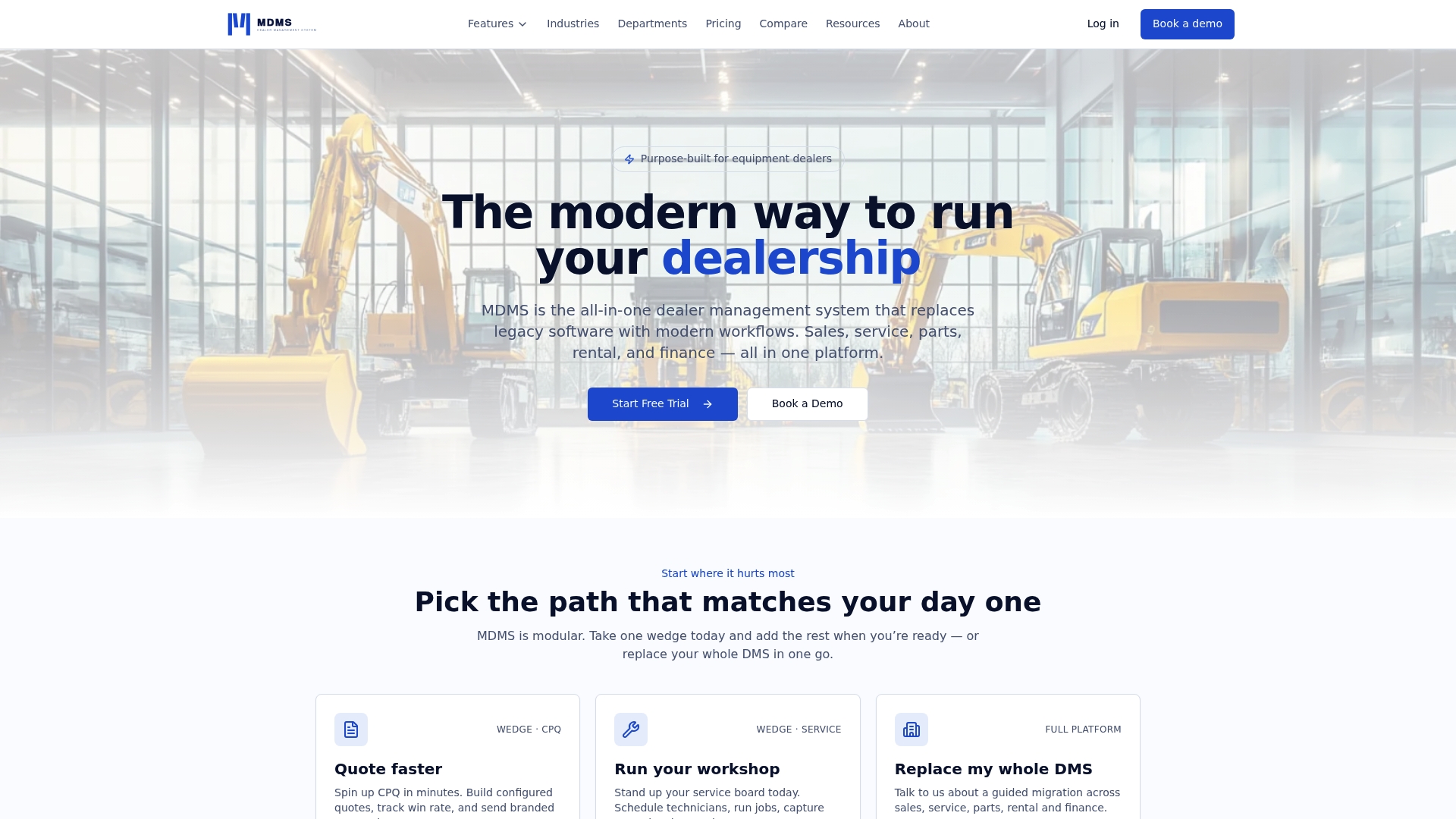
Take the next step by assessing how Moderndms’s modular design helps your managers and technicians reduce workflow complexity and reclaim valuable time.
FAQ
How does Moderndms help dealers save administrative time?
Moderndms can save dealers up to 10 hours per week in administrative tasks. According to testimonials, this time savings allows teams to focus more on core business activities. Consider using Moderndms to enhance operational efficiency in your dealership.
What is the difference between DIS and Moderndms?
DIS provides an integrated feature set developed from direct input by thousands of dealers, allowing for workflows specifically tailored to equipment businesses. In contrast, Moderndms focuses on fast self-service setup without extensive vendor-led implementations, making it ideal for dealers who value quick deployment. Evaluate your team’s needs to choose the right solution.
Which platform supports offline capabilities for field service workers?
Moderndms includes offline-capable mobile apps for field service and workshop teams. This feature lets service personnel work efficiently at remote job sites without requiring constant internet access. If your team frequently operates in areas with limited connectivity, Moderndms is a solid choice.
Can I manage rental contracts with Moderndms?
Yes, Moderndms supports rental fleet management with contract billing and meter tracking. This capability allows your dealership to efficiently manage all aspects of rental operations. Consider leveraging this functionality to streamline your rental processes.
How does the pricing of Moderndms compare to its competitors?
Moderndms pricing starts at A$59 per month per module, allowing dealerships to scale functionality based on their needs. This transparent pricing model enables budget-conscious dealerships to pilot core functions without a major financial commitment. If you’re looking for a flexible, modular pricing structure, Moderndms might be the right fit.