Stop BAS Surprises: 10% GST on Equipment Rentals for Aussie Dealers
By MDMS Team · 17 September 2026

Stop BAS Surprises: 10% GST on Equipment Rentals for Aussie Dealers
Most commercial equipment rentals in Australia carry 10% GST, and if you’re GST-registered, you can generally claim input tax credits on each taxable rental payment, roughly one-eleventh of the invoice total. The exact timing of that claim, and whether you get it upfront or spread across the lease, depends on whether your contract is a genuine lease or a hire purchase arrangement, and whether your business reports GST on a cash or accruals basis.
TL;DR:
- Most commercial equipment rentals in Australia attract 10% GST, which can generally be claimed as input tax credits if conditions are met.
- Proper tax invoices must clearly show GST charges and meet documentation standards, especially when dealing with bundled supplies or residual payments.
- The contract’s substance determines whether GST is claimed upfront, gradually, or if the arrangement is considered a sale, especially for hire purchase or residual payments.
- International leases and cross-border rentals are likely taxable if connected with Australia, but exemptions exist if the equipment leaves the country and proper export documentation is maintained.
- Accurate recordkeeping, checking supplier registration, and understanding contract types are essential to avoid common GST claim errors and compliance issues.
Table of Contents
- How GST Applies to Equipment Rentals and Leases
- Claiming Input Tax Credits on Rental Payments: Timing and Calculation
- Hire Purchase, Chattel Mortgages and Leases: Why the Contract Type Matters
- End-of-Lease Purchases and Residual Payments
- Bundled Invoices, Apportionment and Mixed Supplies
- Recordkeeping and BAS Reporting Essentials
- Common Mistakes and a Practical Compliance Checklist
- GST on Cross-Border Equipment Rentals and International Leasing
- Special Rules for Agricultural, Medical and Other Equipment Categories
- How GST Applies to Short-Term vs Long-Term Rental Agreements
- Author Perspective: What Actually Trips Up Equipment Managers
- A Practical Way to Reduce GST Errors on Rental Fleets
- Primary Sources and Official Guidance
- Sources
- FAQ
How GST Applies to Equipment Rentals and Leases
GST law splits supplies into two camps: taxable supplies and input-taxed supplies. Input-taxed supplies, like most residential rent, carry no GST and generate no credits for related costs. Commercial equipment rental doesn’t fall into that category.
A forklift lease, an excavator hire, or a scissor lift rental to a construction site is a standard taxable supply. GST sits at 10% on the full value of that supply, and the lessor charges it.
Your supplier, the equipment owner or rental company, is responsible for adding GST to the rental invoice and remitting it to the Australian Taxation Office (ATO). That amount should appear as a clearly itemized line on a proper tax invoice, not buried into a round-number total. If you’re leasing out equipment yourself, this is your obligation too: charge the 10%, show it plainly, and report it on your BAS.
Claiming Input Tax Credits on Rental Payments: Timing and Calculation
You can claim a GST credit if three conditions line up: you’re GST-registered, the equipment serves a creditable business purpose, and you hold a valid tax invoice. Miss any one of those, and the ATO can disallow the claim outright.
The math itself is simple. Input tax credits on lease instalments are generally one-eleventh of the amount paid or invoiced in that tax period, since GST is 10% of the pre-tax value baked into a total.
Timing depends on your BAS accounting method:
- On accruals: claim the credit when the invoice is issued, or when part of the payment becomes due, whichever comes first.
- On cash: claim the credit only when you actually pay the invoice.
Worked example: Say your dealership pays $1,100 a month for an excavator lease, GST included. That instalment breaks down to $1,000 for the rental plus $100 GST. Under accruals accounting, you claim that $100 credit in the BAS period covering the invoice date. Under cash accounting, you claim it in the period you actually transfer the $1,100, even if the invoice landed a month earlier.
Hire Purchase, Chattel Mortgages and Leases: Why the Contract Type Matters
The label on your contract changes when and how much GST you can claim. For hire purchase agreements signed on or after July 1, 2012, the entire supply, including the credit component, is treated as a taxable supply. That means an eligible business can often claim the full GST on the purchase price upfront, rather than dribbling it out over the term.
Genuine operating and finance leases work differently. GST shows up in each rental instalment, and you claim the credit progressively as instalments fall due, following the one-eleventh calculation above.
The ATO doesn’t just take the contract’s title at face value. It looks at substance: if the lessee carries the residual value risk, or the contract includes a bargain purchase option that all but guarantees ownership transfer, the arrangement may be recharacterized as a sale rather than a lease. That shifts both GST timing and income tax treatment, swapping rental deductions for depreciation claims. Industry finance guides echo this: chattel mortgages and hire purchases can produce very different cashflow patterns than a straightforward operating lease, so check the substance of the deal before assuming a label tells you the tax answer.
End-of-Lease Purchases and Residual Payments
Buying the equipment when the lease ends is its own taxable event, separate from the rental payments that came before it. If you exercise a purchase option or pay out a residual, that transaction generates a fresh GST liability on the residual or purchase price.
If you’re GST-registered and the asset will keep serving a creditable business purpose, you can generally claim an input tax credit on that purchase, subject to the same tax invoice and BAS attribution rules that applied to your rental instalments.
The practical risk here is cashflow, not compliance. A $40,000 residual due at month 36 is easy to forget when you’re focused on monthly rental payments. Build residual and balloon amounts into your forecasting well before the lease matures, so the GST and the principal don’t ambush your finance team in the same BAS period.
Bundled Invoices, Apportionment and Mixed Supplies
Rental invoices rarely arrive as a single clean line. Maintenance packages, insurance, delivery fees, and the rental charge itself often land on one document, and not every component earns the same GST treatment.
You’re only entitled to claim the creditable portion, and mixed-use or partly input-taxed supplies require apportionment before you claim anything.
- Ask suppliers for separate line items for rental, maintenance, and insurance rather than one bundled figure.
- Apportion the GST credit when equipment sees mixed business and private use, or supports an input-taxed activity.
- Keep a note of the apportionment method you used, in case the ATO asks later.
Pro Tip: If a supplier won’t break out the components on your tax invoice, ask in writing before the first payment is due. It’s far easier to fix an invoice template at the start of a contract than to reconstruct apportionment records eighteen months into a lease.
Recordkeeping and BAS Reporting Essentials
Weak paperwork is the single most common reason GST credits get knocked back. The fix is straightforward.
- Keep a valid tax invoice for every rental payment, showing the supplier’s Australian Business Number (ABN) and the GST amount charged.
- File the lease contract itself alongside payment records, since the ATO may need both to confirm creditable purpose.
- Attribute each credit to the correct BAS period: invoice date under accruals, payment date under cash accounting.
- Flag and correct any invoice missing an ABN or GST breakdown before it goes into your BAS, not after.
Sloppy end-of-lease records are a repeat offender too. Filing the residual invoice separately from the original lease paperwork makes it easy to lose track of what you actually claimed.
Common Mistakes and a Practical Compliance Checklist
Most GST errors on rentals trace back to a handful of preventable slip-ups.
- Confirm the supplier’s GST registration and ABN before the first invoice arrives.
- Secure a proper tax invoice for every payment, not a receipt or a statement.
- Check whether your BAS runs on cash or accruals, and attribute credits accordingly.
- Apportion any bundled invoice covering maintenance, insurance, or private use.
- Forecast residual or purchase payments so the GST hit doesn’t surprise your finance team.
- Retain records for at least five years, as the ATO can request them well after the BAS is lodged.
Pro Tip: If a supplier disputes an invoice or a document goes missing, don’t wait for BAS lodgment day to sort it out. Request a reissued tax invoice immediately. Once the deadline passes, you’re negotiating with the ATO instead of your supplier, and that’s a much harder conversation. When the numbers get genuinely messy, a registered tax agent is worth the fee before you lodge, not after you’re audited.
GST on Cross-Border Equipment Rentals and International Leasing
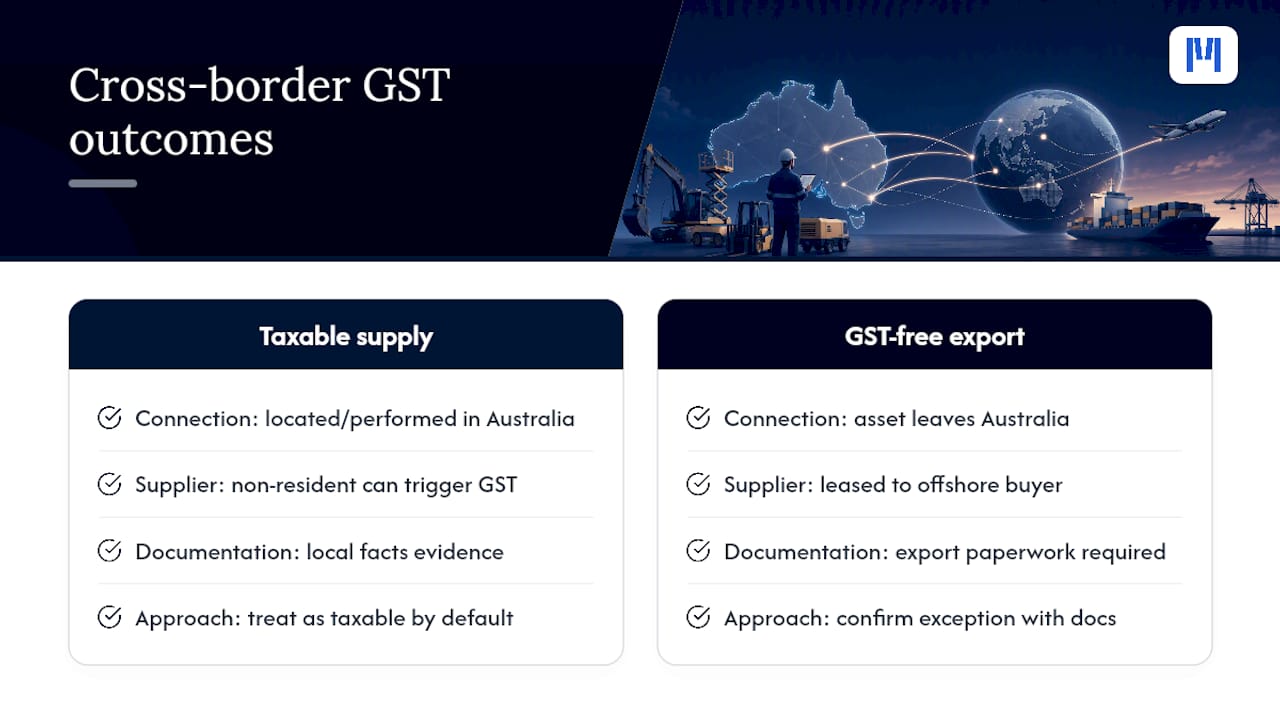
Renting equipment from an overseas supplier, or leasing your own fleet to an offshore operator, adds a layer most domestic guidance skips entirely. Australian GST generally applies to supplies connected with Australia, which usually means the equipment is located here, or the lease is negotiated and performed here, regardless of where the invoicing entity is based.
A non-resident supplier renting a crane into an Australian job site can still trigger Australian GST obligations if that supplier meets the registration turnover threshold, even without a local office. Conversely, if your dealership leases equipment to an offshore buyer and the asset leaves Australian territory, the supply may qualify as GST-free as an export, though the paperwork proving that export matters enormously.
The safest approach for any cross-border arrangement is to treat it as a taxable domestic supply by default and confirm the exception with documentation, rather than assuming GST-free treatment and discovering otherwise at audit. International leasing arrangements also frequently trigger withholding tax and different depreciation rules in the counterparty’s home jurisdiction, which is a separate conversation from GST but tends to surface in the same contract review. If your dealership regularly leases equipment across borders, get a registered tax agent to review the specific supply chain before you finalize pricing, because the connected-with-Australia test turns on facts specific to each deal, not a blanket rule you can apply from one contract to the next.
Special Rules for Agricultural, Medical and Other Equipment Categories
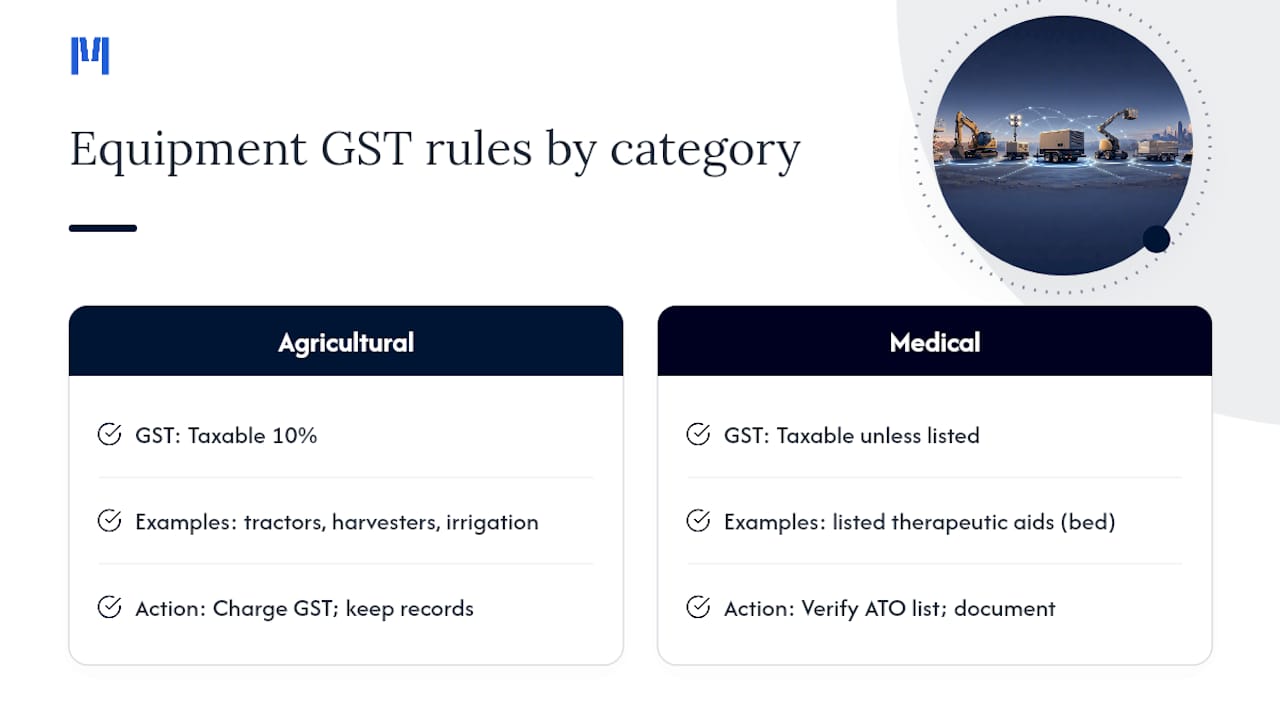
Equipment category rarely changes the core GST mechanics, but it does shift what documentation and use tests apply. Agricultural machinery rented to a primary producer follows the same standard 10% taxable supply rules as any other commercial equipment lease. There’s no blanket GST exemption for tractors, harvesters, or irrigation gear simply because the end use is farming.
Where things get more nuanced is medical equipment. Some medical aids and appliances qualify as GST-free supplies under specific categories the ATO lists, but that GST-free status typically attaches to defined items sold or hired for a particular therapeutic use, not to “medical equipment” as a broad label. A hospital bed rented for home care might qualify under a specific listed category; a general-purpose piece of diagnostic equipment leased to a clinic for everyday operations usually won’t, and instead falls back to the standard taxable treatment.
The practical lesson for dealership managers handling either category is the same: don’t assume an exemption applies just because the equipment serves a sensitive or essential purpose. Check the specific item against the ATO’s GST-free goods and services rules before you invoice, and keep documentation showing why a particular rental qualifies if you do treat it as GST-free. Getting this wrong in either direction, charging GST on a genuinely exempt supply or failing to charge it on a standard taxable one, creates BAS corrections that are far more painful to fix retroactively than to get right on the first invoice.
How GST Applies to Short-Term vs Long-Term Rental Agreements
The GST rate and mechanics don’t change based on rental duration; a weekend excavator hire and a five-year equipment lease both carry the same 10% GST on taxable supplies. What changes is the administrative rhythm and the practical risk of getting the timing wrong.
Short-term rentals, day hires, weekly plant hire, one-off equipment loans, usually involve a single invoice and a single BAS attribution point. There’s little room for error because the whole transaction lives inside one reporting period. The main risk is volume: a rental business processing dozens of short-term hires a week needs a system that captures a valid tax invoice for every single transaction, not just the big-ticket ones.
Long-term leases spread GST obligations across many BAS periods, sometimes years. This is where hire purchase versus genuine lease treatment actually matters, since it determines whether you’re claiming one large upfront credit or a string of smaller ones tied to each instalment. Long-term agreements are also more likely to include bundled maintenance and insurance charges that need apportionment, and they’re the ones most likely to end in a residual purchase that generates a fresh taxable supply. If your dealership manages a mix of both, the discipline that works for short-term hire, invoice everything, claim it immediately, doesn’t automatically scale to a five-year lease with a balloon payment at the end. Different rental durations call for different tracking habits, even though the underlying GST rate never moves.
Author Perspective: What Actually Trips Up Equipment Managers
The biggest risk we see isn’t the GST rate. It’s teams trusting a contract’s label over its substance. A “lease” with a bargain purchase option can behave like a sale for GST purposes, and nobody notices until the BAS doesn’t reconcile.
Clean invoicing habits and a shared paper trail between finance, operations, and procurement fix most of this before it becomes a problem. Get those three functions looking at the same lease documents, and the credits take care of themselves.
— ModernDMS
A Practical Way to Reduce GST Errors on Rental Fleets
Manual spreadsheets are where most of the mistakes in this article actually happen: a missing tax invoice, a bundled charge nobody split out, a residual payment nobody flagged until it was due. Moderndms is built as an alternative to that manual process for dealerships running rental fleets in Australia, with a rental and contract module that centralizes tax invoices, tracks apportionment on bundled charges, and flags residual and end-of-lease payments before they surprise your finance team.

Because it connects natively with Xero, GST figures captured at the point of invoicing flow straight into your BAS reporting without a rekeying step, which is usually where attribution errors creep in. The Rental module runs $59 AUD per month, and setup typically takes under an hour, so you can see whether it fits your current lease volume without committing to a long project. If your dealership is juggling short-term hires and long-term leases across different contract types, start with the rental and hire fleet solution page to see how the workflow maps to your own fleet.
Primary Sources and Official Guidance
For formal rulings, always go to the source. The ATO’s pages on hire purchase and leasing and claiming GST credits cover the detailed rules, and Business fills in the practical decision-making side.
Sources
FAQ
Do I Pay GST on Rental Payments?
Yes, most commercial equipment rentals in Australia are taxable supplies, so GST applies to each rental payment. If you’re GST-registered and use the equipment for a creditable business purpose, you can generally claim an input tax credit of about one-eleventh of the invoice amount.
Is GST 5% or 6%?
Neither. GST in Australia is a flat 10% on taxable supplies, including standard commercial equipment rentals and leases. Rates of 5% or 6% apply in other countries’ consumption tax systems, not Australia’s GST.
Do You Charge GST on the Sale of Used Equipment?
Generally yes, selling used equipment is a taxable supply if the seller is GST-registered and the sale happens in the course of running a business.
What Items Are Exempt From GST?
Certain categories are GST-free, including specific listed medical aids and appliances, some basic food items, and particular exports, while residential rent is input-taxed rather than exempt.
How Do I Know Whether My Lease Is Really a Hire Purchase?
Look at the substance of the contract, not just its title. If there’s a bargain purchase option or the lessee carries the residual value risk, the ATO may treat it as a sale rather than a genuine lease, which changes both GST timing and how you claim credits.