Consignment Stock Management: Australian Dealer Guide
By MDMS Team · 4 August 2026

Consignment Stock Management: Australian Dealer Guide
Consignment stock management is the process of holding supplier-owned inventory at a buyer’s location while title stays with the supplier until a sale occurs. The consignee holds, displays, and sells the stock; the consignor retains ownership and carries the asset on their books until that sale event triggers revenue recognition and payment. If your team is setting up or reviewing a consignment arrangement, three actions come first:
- Sign a clear consignment agreement that defines ownership, the sale trigger, payment terms, commission, reporting obligations, and what happens to unsold stock.
- Confirm PPSR registration requirements under the Personal Property Securities Act 2009 (Cth) — a commercial consignment may qualify as a security interest, and failing to register can expose the consignor to the consignee’s creditors in an insolvency.
- Enable consigned inventory tracking in your systems with a separate consigned status, SKU/serial-level tagging, and a scheduled reconciliation cadence (weekly, fortnightly, or monthly depending on volume).
Get those three foundations right and the rest of the process — accounting, audits, settlement, and dispute resolution — becomes manageable.
Table of Contents
- What is consignment stock, and when does it make sense?
- How does a consignment arrangement work from delivery to settlement?
- What are the real benefits and drawbacks for each party?
- What Australian legal requirements apply to consignment stock?
- What clauses does every Australian consignment agreement need?
- How do you manage consigned stock day to day?
- How should you account for consignment stock in Australia?
- What software features does consignment tracking actually require?
- How does Moderndms implement consignment workflows for Australian dealers?
- Key Takeaways
- Why consignment strategy matters more than most dealers realize
- Moderndms handles consignment from receipt to settlement
- Authoritative Australian sources and further reading
- FAQ
What is consignment stock, and when does it make sense?
In a consignment arrangement, the consignor (typically the manufacturer or supplier) ships goods to the consignee (a dealer, distributor, or retailer) who holds them for sale. Ownership does not transfer at delivery. It transfers at the point of sale to an end customer, which is also the moment the consignor’s revenue clock starts.
That distinction matters operationally. Until a sale occurs, the consignee is essentially a custodian. The stock sits on the consignor’s balance sheet, not the consignee’s. The consignee carries no purchase liability for unsold units, but they do carry responsibility for care, security, and accurate reporting.
Typical use cases in Australian equipment and industrial supply:
- A parts supplier places slow-moving or high-value components at a dealer’s warehouse; the dealer only pays when a part is consumed in a work order.
- A machinery manufacturer places demonstration units at a regional dealer to test market demand before committing to a full distribution agreement.
- An industrial supplier places consumables at a mine site or workshop under a vendor-managed inventory arrangement, with monthly account-sales reporting.
Consignment differs from sale-or-return (where title passes at delivery and reverses on return) and from vendor-managed inventory (where the supplier manages replenishment but the buyer may own the stock). Understanding which model applies determines your accounting treatment, your PPSR obligations, and your contract structure.
How does a consignment arrangement work from delivery to settlement?
The operational flow follows a predictable sequence. Each step generates data that must travel cleanly between the consignee’s systems and the consignor’s records.
- Account-sales report — At the agreed reporting interval (weekly, fortnightly, or monthly), the consignee sends the consignor a consolidated account-sales report covering all units sold, prices achieved, discounts, and returns since the last settlement.
Timing examples: A high-volume parts consignment typically runs weekly reporting. A capital equipment demonstration unit might settle monthly. Whatever the cadence, the key rule is consistency: missed reporting cycles are the single most common source of consignment disputes.
What are the real benefits and drawbacks for each party?
Consignment is not a free lunch for either side. The strategic upside is real, but so are the operational and financial trade-offs.
| Dimension | Consignor | Consignee |
|---|---|---|
| Capital exposure | Retains inventory on balance sheet; cash tied up longer | No upfront purchase cost; frees working capital |
| Market access | Gains shelf presence without requiring distributor purchase commitment | Broader product range without capital outlay |
| Product testing | Can trial new lines with lower trade friction | Can test demand before committing to stock purchases |
| Cash conversion | Slower: revenue waits for end-customer sale | Faster: no purchase payment until goods are sold |
| Obsolescence risk | Carries full obsolescence risk on unsold stock | Minimal; unsold stock returns to consignor |
| Reporting burden | Depends on consignee’s accuracy and timeliness | Must maintain accurate records and submit account-sales reports |
| Shrinkage/loss | Risk depends on contract; often consignee’s liability once received | Responsible for care and security of goods held |
| Accounting complexity | Must track consigned inventory separately; revenue recognition delayed | Must track consigned stock off-balance-sheet; GST timing requires care |
Consignment stock helps distributors reduce upfront capital requirements and expand product lines while requiring accurate system-level tracking to avoid operational chaos. For a seasonal product launch or a new product trial in a regional market, the consignor’s slower cash conversion is often worth the shelf exposure. For a consignee managing thin margins, the working capital benefit is the primary draw.
The risks that catch teams off guard are usually on the reporting side. Disputes over discounts applied, units returned without documentation, or settlement delays caused by incomplete account-sales reports are far more common than outright fraud. Treating consignment as a strategic partnership with transparent reporting and audit rights built into the agreement is the most effective way to prevent those disputes from escalating.
What Australian legal requirements apply to consignment stock?
There is no single “Consignment Act” in Australia. Consignment arrangements are governed by contract law, commercial law, and the Australian Consumer Law, which means the written agreement carries most of the legal weight. Two areas require specific attention: the PPSA/PPSR and the ACL.
PPSA and PPSR registration
The Personal Property Securities Act 2009 (Cth) (PPSA) can treat a commercial consignment as a security interest. Under PPSA section 12(3), commercial consignments may be classified as security interests requiring registration on the Personal Property Securities Register (PPSR). If the consignee becomes insolvent and the consignor has not registered, the consignor’s goods can be claimed by the consignee’s secured creditors — the consignor loses priority and may lose the stock entirely.
A consignment qualifies as a “commercial consignment” under the PPSA when the consignor does not ordinarily sell goods of that kind, the goods are delivered for the purpose of sale or lease, and the consignee deals in goods of that description in the ordinary course of business. If your arrangement meets those criteria, register.
PPSR action checklist:
- Determine whether the arrangement meets the commercial consignment definition under the PPSA.
- Register a financing statement on the PPSR before delivering goods (or as soon as practicable).
- List the collateral accurately: serial numbers for serialized goods, description for non-serialized.
- Set a registration period that covers the full consignment term plus a buffer.
- Review and renew registrations before expiry.
- Keep evidence of registration as part of the consignment file.
Australian Consumer Law obligations
Section 18 of the ACL prohibits misleading or deceptive conduct in trade or commerce. Both consignors and consignees must represent goods accurately — pricing, condition, origin, and warranty status. Consumer guarantees under the ACL apply regardless of whether the consignee or consignor is the “supplier” in a given transaction; the practical allocation of ACL liability should be addressed explicitly in the consignment agreement.
What clauses does every Australian consignment agreement need?
A well-drafted consignment agreement is the single most important document in the arrangement. Core clauses must define ownership and title, payment triggers, reporting obligations, and risk allocation. For high-value or serialized stock, the agreement should attach a formal inventory schedule.
Essential clause checklist:
- Reporting obligations: — List the required fields in each account-sales report (SKU, serial, sale date, sale price, discounts, returns, current on-hand quantity).
A consignment form should record SKU/serial details, pricing rules, commission, return handling, and insurance details to prevent disputes and establish a clear evidentiary record.
Pro Tip: For high-value capital equipment or serialized parts, negotiate a clause requiring the consignee to update the inventory schedule within 24 hours of any movement — sale, return, damage, or transfer. A stale schedule is the root cause of most reconciliation disputes.
How do you manage consigned stock day to day?
Operational discipline is what separates a consignment arrangement that runs smoothly from one that generates constant disputes. The controls below apply whether you are managing 20 SKUs or 2,000.
Stock segregation and labeling
Consigned stock must be physically and systemically separate from owned stock. In a warehouse, that means dedicated bins or zones labeled “CONSIGNMENT — [Consignor Name].” In your inventory system, every consigned SKU carries a “consigned” status flag that prevents it from being allocated, consumed, or sold without triggering the correct reporting workflow. Mixing consigned and owned stock is the fastest path to a reconciliation nightmare.
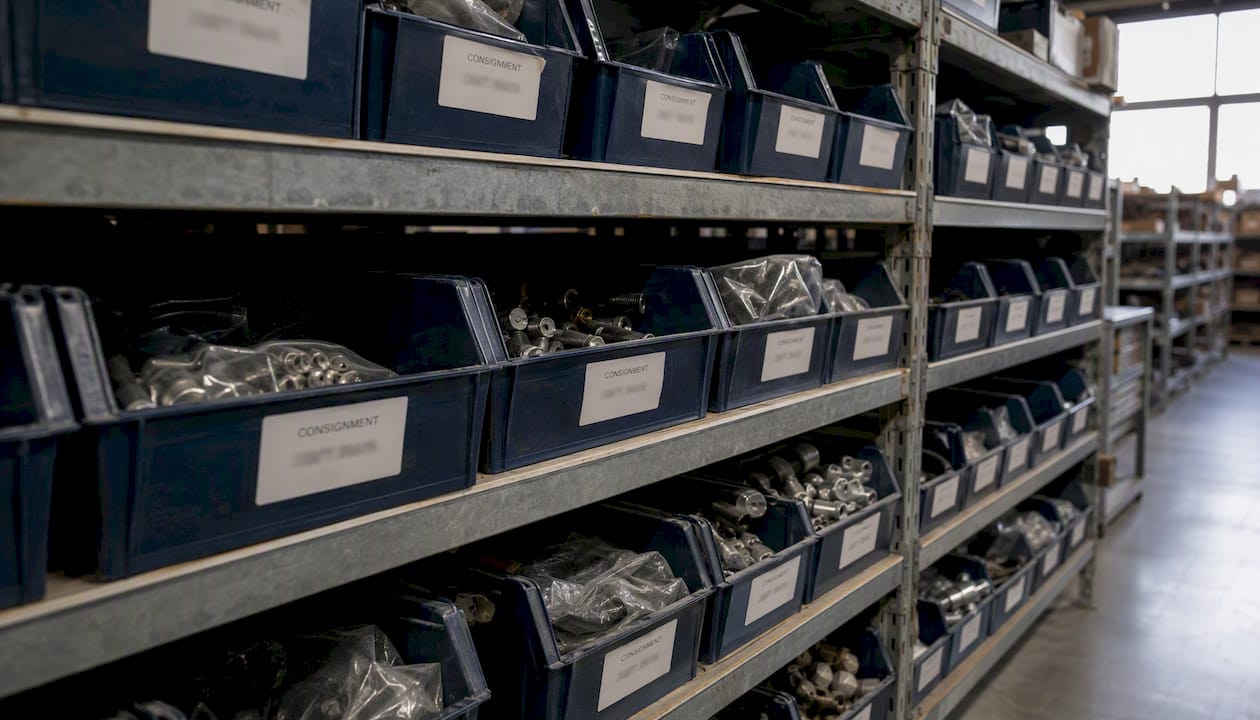
For serialized inventory, each unit’s serial number should be captured at receipt and tracked through every movement — sale, return, transfer, or write-off. Serial-level tracking is the only reliable way to reconcile high-value consignment arrangements at audit.
Cycle counts and reconciliation cadence
Physical counts of consigned stock should occur at least as frequently as the reporting cycle. For monthly reporting, run a full physical count of consigned bins in the week before the account-sales report is due. For weekly reporting, a rolling cycle count covering consigned locations works well.
The reconciliation process compares three numbers: the consignor’s records (what they shipped minus what they’ve been paid for), the consignee’s system (current on-hand consigned quantity), and the physical count. Any discrepancy triggers a corrective-action workflow — investigate, document, and resolve before the next settlement.
How should you account for consignment stock in Australia?
The accounting treatment for consignment stock is governed by two Australian Accounting Standards. Under AASB 15, revenue recognition is delayed until the end customer obtains control of the goods — shipping to a consignee does not trigger revenue for the consignor. Under AASB 102, consigned inventory must be valued at the lower of cost and net realizable value, and obsolescence remains the consignor’s responsibility.
The table below summarizes the key accounting entries and GST treatment for both parties.
| Event | Consignor treatment | Consignee treatment | GST |
|---|---|---|---|
| Goods delivered to consignee | Inventory remains on consignor’s balance sheet; no revenue entry; memo note of goods out on consignment | Record receipt in off-balance-sheet consignment register; no purchase liability | No tax invoice issued; no GST event |
| Sale to end customer | Derecognize inventory (Dr Cost of Goods Sold, Cr Inventory); recognize revenue (Dr Receivable/Cash, Cr Revenue) | Record sale proceeds; pay commission to consignor per agreement | Consignee issues tax invoice to end customer and remits GST; consignor invoices consignee for goods sold |
| Account-sales report submitted | Issue tax invoice to consignee for goods sold in the period | Record payable to consignor; reduce consignment register | Tax invoice triggers GST liability for consignor; consignee claims input tax credit |
| Unsold stock returned | Reinstate inventory on balance sheet; update consignment register | Remove from consignment register | No GST event on return of unsold goods |
| End-of-period valuation | Write down inventory to net realizable value if lower than cost | No balance-sheet impact | No GST event |
GST agency note: Where the consignee acts as agent for the consignor (rather than buying and reselling), the GST treatment differs. In a true agency arrangement, the consignor is the supplier for GST purposes and issues the tax invoice directly. Most Australian consignment arrangements are structured as principal-to-principal (the consignee buys at the point of sale), which is simpler to administer. Confirm the structure with your accountant before configuring your system.
For Xero users, the practical approach is to use a dedicated inventory management integration that tags consigned quantities separately and creates a vendor bill only when the account-sales report confirms units sold. This prevents premature COGS recognition and keeps consigned balances visible without inflating the consignee’s balance sheet.
This section provides general information, not accounting or tax advice. Confirm your specific treatment with a registered tax agent or accountant.
What software features does consignment tracking actually require?
Most general-purpose inventory systems were not built with consignment workflows in mind. ERP systems with dedicated consignment modules add separate consigned inventory statuses and accounting flows so organizations only pay for consumed or sold items and can track consigned quantities independently from owned stock.
Must-have system features:
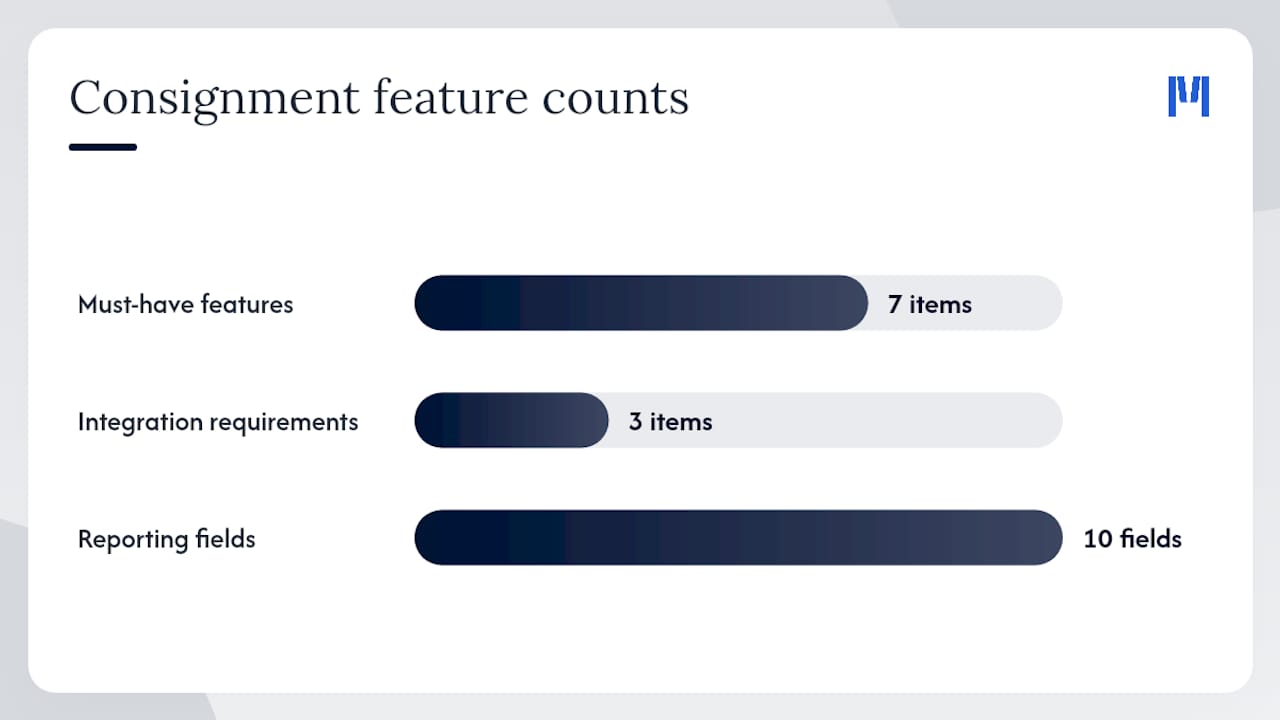
- Consigned inventory status: A distinct stock status (separate from “available,” “reserved,” or “on order”) that prevents consigned units from being allocated or consumed without triggering the correct workflow.
- Consigned COGS and asset accounts: Separate general ledger accounts for consigned inventory value and consigned cost of goods sold, so consigned transactions never contaminate owned-stock financials.
- SKU and serial-level tagging: Every consigned unit tracked by SKU and, for serialized goods, by individual serial number from receipt through sale or return.
- Inventory schedules: System-generated consignment schedules listing all goods on consignment by consignor, contract, SKU, serial, date received, and current status.
- Consumption receipts: Automated workflow that converts a consigned unit to “sold” status when a sale is confirmed, triggering the account-sales report entry.
- Account-sales reporting: Automated generation of account-sales reports at the configured reporting interval, with all required fields pre-populated from transaction data.
- Audit trail and reconciliation exports: Full movement history exportable for physical count reconciliation and dispute resolution.
- Mobile stocktake support: A mobile app for cycle counts in warehouse or field locations, with offline capability for sites with poor connectivity.
Integration requirements:
- POS or warehouse management system integration to capture sale events in real time.
- Xero or MYOB general ledger integration to post consigned COGS and revenue entries automatically on settlement.
- Consignor portal access (or automated report delivery) so consignors can view their stock on hand and sales data without calling your team.
Recommended reporting fields per transaction: consignor ID, consignment contract ID, SKU, serial number, date received, date sold, sale price, discount flag, commission calculation, and settlement reference number. For parts and warehouse operations, these fields should be captured at the point of sale, not reconstructed at month-end.
How does Moderndms implement consignment workflows for Australian dealers?
Moderndms (MDMS) is built specifically for Australian equipment dealerships and includes consignment workflow support as part of its parts and inventory management module. The implementation follows a structured 4–6 week rollout that mirrors the operational steps described in this guide.
Implementation plan:
- Week 1: Contract capture and consignor onboarding. Load consignment agreement details into MDMS — consignor ID, contract terms, commission rates, reporting cadence, and settlement rules. Attach the inventory schedule as a document record.
- Week 2: Consigned SKU and serial onboarding. Configure consigned inventory statuses in MDMS. Import or manually enter all consigned SKUs with serial numbers, agreed prices, and consignor references. Run a PPSR checklist and attach registration evidence to the consignor record.
- Week 3: Account configuration and parallel run. Configure consigned COGS and consigned asset accounts in MDMS and map them to the Xero general ledger. Run a parallel reconciliation alongside your existing process to verify that system records match physical stock and consignor records.
- Week 4: Cycle count and mobile stocktake setup. Configure cycle count schedules for consigned bin locations. Train warehouse staff on the MDMS mobile app for physical counts, including offline mode for sites without reliable connectivity.
- Week 5–6: Go live and settlement automation. Activate automated account-sales report generation and Xero integration for settlement posting. Process the first live settlement cycle and verify GL entries against the consignor’s invoice.
MDMS feature callouts for consignment:
- Consigned inventory status with separate bin/location tracking.
- Consigned COGS and asset accounts with direct Xero integration.
- Serial number tracking from receipt through sale or return.
- Automated account-sales report generation at configured intervals.
- Mobile cycle count app with offline capability.
- Data ownership with no lock-in: your consignment records stay with you.
Dealers report saving up to 10 hours per week in administrative tasks after moving from spreadsheets and disconnected systems to MDMS — time that was previously spent on manual reconciliations, chasing account-sales data, and rebuilding settlement calculations from scratch.
Key Takeaways
Effective consignment stock management in Australia requires a written agreement, PPSR registration where applicable, system-level consigned inventory tracking, and accounting treatment that delays revenue recognition until end-customer sale under AASB 15.
| Point | Details |
|---|---|
| Written agreement is foundational | Every consignment needs clauses covering title, sale trigger, commission, reporting, audit rights, and termination. |
| PPSR registration protects consignors | Register before delivery if the arrangement meets the commercial consignment definition under the PPSA. |
| Segregate and tag consigned stock | Use separate bin locations and a consigned inventory status in your system to prevent mixing and enable accurate reconciliation. |
| Delay revenue recognition | Under AASB 15, consignors keep inventory on their balance sheet until end-customer sale; premature recognition breaches the standard. |
| Moderndms supports the full workflow | MDMS provides consigned inventory status, serial tracking, Xero integration, and automated account-sales reporting for Australian equipment dealers. |
Why consignment strategy matters more than most dealers realize
The conventional wisdom treats consignment as a supplier-friendly arrangement that dealers accept reluctantly to win a product line. That framing misses the real opportunity.
For Australian equipment dealers operating with thin margins and uneven seasonal demand, consignment is one of the few levers that lets you expand your parts and product range without tying up working capital. A dealer who can offer a broader selection of slow-moving or high-value components — without carrying the purchase cost — is a more competitive dealer. The supplier gets shelf presence in markets they could not otherwise reach economically. Done well, it is genuinely mutual.
What most teams underestimate is the operational overhead. Consignment only delivers its financial benefits if the reporting, reconciliation, and settlement processes run cleanly. A missed account-sales report or a reconciliation that runs three months behind does not just create a dispute — it erodes the supplier relationship that makes the arrangement worth having. The dealers who get the most value from consignment are the ones who treat it like a financial product: documented, tracked, and settled on schedule.
The PPSR piece is the most consistently overlooked risk. Consignors who rely on contract language alone, without registering on the PPSR, are exposed in a way that most do not discover until an insolvency event makes it too late. Register early, register accurately, and review registrations before they expire.
For dealers evaluating whether to adopt or expand consignment arrangements, the internal readiness question is straightforward: do your systems support a separate consigned inventory status, and can you generate an accurate account-sales report on demand? If the answer is no, fix the systems before you sign the next consignment agreement.
Moderndms handles consignment from receipt to settlement
Equipment dealers who have outgrown spreadsheets and disconnected accounting systems need a platform where consignment data travels once — from receipt through sale, reconciliation, and Xero posting — without manual re-entry at each step. That is exactly what Moderndms delivers.
MDMS is purpose-built for Australian equipment dealerships and includes native support for consigned inventory statuses, serialized tracking, consigned COGS accounts, automated account-sales reporting, and direct Xero integration. Setup takes under an hour for the core module, rollout is modular so your team adopts at their own pace, and your data stays yours with no lock-in. Australian GST compliance is built in, not bolted on.
Whether you manage consigned parts, capital equipment on demonstration, or consumables at customer sites, MDMS gives your team the controls and reporting visibility to run consignment arrangements with confidence.
Start with a free trial or book a demo to see how MDMS handles consignment workflows for Australian dealers.
Authoritative Australian sources and further reading
The resources below were used in preparing this guide. Each covers a distinct aspect of consignment stock management in Australia.
- Consignment stock legal essentials for Australian businesses
- What Is A Consignment Agreement? | Sprintlaw Australia
- Commercial consignments and the PPSA
- Stock consignment: 6 best practices (MYOB)
- Consignment Stock Management Guide | Triumph ERP
- How Consignment Affects Your Accounting Records
- Consignment form: key clauses for Australian small businesses
- Consigned inventory and how to manage it effectively
This guide provides general information only and does not constitute legal, accounting, or tax advice. Consult a qualified Australian legal practitioner or registered tax agent for advice specific to your arrangements.
FAQ
Who owns consignment stock before it is sold?
The consignor (supplier) retains ownership of consigned goods until a sale to an end customer is completed. The consignee holds the stock as custodian, not as owner.
What commission rates does consignment usually take?
Commission rates vary by industry, product category, and negotiation. There is no standard rate set by law in Australia; rates are agreed in the consignment contract and should be specified alongside discount rules and settlement timing.
What are the main disadvantages of consignment stock?
For consignors, the primary disadvantages are slower cash conversion, retained obsolescence risk, and dependence on the consignee’s reporting accuracy. For consignees, the main burden is the administrative overhead of accurate tracking, reconciliation, and timely account-sales reporting.
How should consignment stock be accounted for in Australia?
Under AASB 15, consignors keep consigned goods on their balance sheet until end-customer sale and delay revenue recognition until that point. Consignees track consigned stock off-balance-sheet in a consignment register and record no purchase liability until a sale occurs. GST treatment depends on whether the arrangement is structured as principal-to-principal or agency.
Does consignment stock need to be registered on the PPSR?
If the arrangement meets the definition of a “commercial consignment” under the Personal Property Securities Act 2009 (Cth), registration on the PPSR is strongly recommended. Without it, a consignor can lose priority to the consignee’s secured creditors in an insolvency event.