Close a Dealership Month End in 3 Days Without Extra Headcount
By MDMS Team · 30 August 2026

Close a Dealership Month End in 3 Days Without Extra Headcount
To close this month accurately and on time, enforce a hard posting cutoff, work through your reconciliations in priority order, and get preparer and reviewer sign-offs locked in within the first three business days. That sequence, applied consistently, is what separates a controller who reports clean numbers by the fifth of the month from one still chasing variances on the fifteenth. Everything below builds out that discipline into a checklist you can run department by department.
TL;DR:
- Automating general ledger posting and inventory synchronization significantly reduces manual data entry and errors, cutting month-end close time by several hours.
- Focusing on key accounts like bank, inventory, and warranty receivables prevents hidden variances that can distort financial reports.
- Enforcing strict cutoff dates, assigning clear ownership, and building exception workflows ensure the close stays on schedule and minimizes late postings.
- Conducting a pre-year-end trial close in November helps identify systemic issues and avoids last-minute year-end scramble.
- Implementing a consistent sign-off, archiving process, and lock period procedures creates an audit-ready record and enhances report accuracy.
Table of Contents
- What Does a Month-End Close for Dealerships Actually Involve?
- Which Reconciliations Matter Most at Month-End?
- How Can a DMS Speed Up the Month-End Close?
- Why Does Month-End Always Run Late, and How Do You Fix It?
- How Should Dealerships Prepare for Year-End and 13th-Month Entries?
- What Sign-Off and Archiving Practices Keep a Close Audit-Ready?
- How Do You Account for Trade-Ins in the Month-End Close?
- How Do Warranty Claims and Repairs Affect Month-End Financials?
- What Tax Considerations Apply to Dealership Month-End Accounting?
- How Should Dealerships Report and Analyze Month-End Performance?
- ModernDMS Perspective: What Rollout Actually Looks Like
- How MDMS Supports a Faster, More Reliable Close
- Sources
- FAQ
What Does a Month-End Close for Dealerships Actually Involve?
A dealership month-end close is the process of verifying every deal, repair order, parts sale, and cash movement posted during the month, then reconciling those transactions against the general ledger before management reports go out. It’s not bookkeeping cleanup. It’s a control function, and it works best as a structured, day-by-day sequence rather than an open-ended scramble.
Most dealership accounting teams run some version of a three-day or four-day close. The exact number of days matters less than whether each day has a defined owner and a defined deliverable.
- Day 1: Cutoff and physical verification. Enforce a hard posting cutoff so no new deal, repair order (RO), or parts slip lands in the closing month after the deadline. Close out open ROs and parts tickets that should have billed during the month, and perform physical counts on high-value inventory. This is also when you run your sales log against the DMS to confirm every unit that funded actually posted.
- Day 2: Posting and reconciliation prep. Finish posting all sales, F&I chargebacks, and parts invoices. Pull the balance sheet reconciliation schedules together (bank, floorplan, inventory, AR, AP, payroll accruals) so the reviewer has a complete package, not a partial one, the following morning.
- Day 3: Controller review and variance investigation. The controller or reviewer walks each reconciliation, flags variances against prior-month baselines, and sends anything outside tolerance back to the preparer with a specific question, not a vague “check this.” Finalize the income statement once variances clear.
- Day 4 (if you run a four-day model): Sign-off and distribution. Reserve this day for final sign-offs, factory reporting submission, and archiving. Some dealer groups add this fourth day specifically to avoid rushing the reviewer’s sign-off on Day 3.
Late postings still happen. Build an exception workflow now: anything trying to post after cutoff needs written approval from the controller, and it gets logged separately so it doesn’t quietly distort next month’s baseline. Industry guidance consistently points to firm deadlines and named owners as the difference between a close that runs on schedule and one that turns into a fire drill every single month.
Which Reconciliations Matter Most at Month-End?
Not every account needs the same scrutiny every month. Dealership balance sheets have a handful of accounts that move real money and hide real problems if left unchecked.
- Bank and cash, including F&I reserve accounts and manufacturer receivable accounts, since these often lag the deal date by weeks.
- Inventory subledger versus physical count, with a sanity check on used-vehicle valuations against current market data, not last quarter’s numbers.
- Floorplan payoffs, confirmed directly against lender statements rather than assumed from the DMS balance.
- AR aging, with particular attention to warranty receivables that are aging past the point of realistic collectability.
- Payroll accruals, including any commission or bonus accrual, verified by someone other than whoever calculated it.
That last point is worth repeating in a different form: the person who built the number should never be the only person who checks it. A second set of eyes on payroll and commission accruals catches the kind of error that a preparer, deep in their own spreadsheet, simply won’t see.
Pro Tip: Reconcile floorplan and bank accounts weekly, not just at month-end. A five-minute weekly check turns a potential forensic project into a two-line note on your close checklist.
Reconciling weekly rather than waiting for month-end is one of the most repeated recommendations in dealership accounting best-practice guidance, and it’s the single habit that shrinks the Day 2 reconciliation package from overwhelming to routine.
How Can a DMS Speed Up the Month-End Close?
Your dealer management system should be doing more than storing deal jackets. A DMS that posts directly to the general ledger, or that exports clean feeds to your accounting software, removes the manual re-entry that eats hours every close cycle.
- Automated GL posting or export feeds to platforms like Xero or MYOB cut down duplicate data entry and reduce mapping errors between systems.
- Inventory sync between the DMS and accounting records surfaces mis-posts as exceptions instead of leaving them buried until month-end.
- Close-status dashboards let the controller see which department, sales, service, parts, or rental, still has outstanding tasks, instead of chasing status updates by phone.
Dealer groups using ModernDMS report saving up to 10 hours a week in administrative work once reconciliation and reporting tasks stop requiring manual re-keying. That time doesn’t come from working faster. It comes from removing steps that never needed a human in the first place, like matching an inventory line item by hand when the system can flag the mismatch automatically.
Why Does Month-End Always Run Late, and How Do You Fix It?
Certain problems show up in almost every dealership close, and they’re diagnosable fast if you know where to look first.
- Late or mis-posted deals. Check your posting date filters and cross-reference the sales log before assuming a deal simply hasn’t been booked.
- Open repair orders and parts slips. Run an exception report for ROs still open past their expected close date, and escalate stragglers to the department manager directly, not through email.
- Suspense and clearing accounts. These should hit zero every month. If they don’t, that’s a signal something upstream isn’t being coded correctly.
- GL mapping errors. A mismatch between how the DMS categorizes a transaction and how your accounting package expects it will quietly distort multiple line items until someone traces it back.
Most of these trace to the same root cause: a gap between when a transaction happens on the shop floor or the sales lot and when it gets recorded in the system that talks to your books.
How Should Dealerships Prepare for Year-End and 13th-Month Entries?
Run a pre-year-end trial close, typically in November, specifically to surface problems while there’s still time to fix them calmly. Waiting until December to discover a systemic reconciliation gap turns a fixable issue into a year-end scramble.
- Treat 13th-month adjustments as a separate, restricted category. Label them clearly and post them to a distinct journal or period rather than blending them into December’s regular activity.
- Restrict who can post 13th-month entries. This isn’t a task for anyone outside the controller and the reviewer.
- Coordinate depreciation schedules, fixed-asset disposals, and warranty liability estimates with what your CPA firm will expect to see during the audit.
A pre-year-end trial close gives you room to correct systemic issues before the audit clock starts running, rather than discovering them under deadline pressure.
What Sign-Off and Archiving Practices Keep a Close Audit-Ready?
Auditors don’t just want the right numbers. They want proof that someone checked them and that the records haven’t been altered after the fact.
- Require a preparer sign-off and a separate, independent reviewer sign-off on every reconciliation, timestamped at the point of completion.
- Archive each month’s package in a consistent folder structure and naming convention, so a reviewer three years from now can find the March close in seconds, not minutes.
- Lock the accounting period once it’s closed. Reopening a locked period should require controller-level approval and a documented reason, never a casual edit.
These three habits, more than any single reconciliation, are what an auditor checks first.
How Do You Account for Trade-Ins in the Month-End Close?
A trade-in isn’t a discount. It’s a separate transaction that has to be booked at fair market value, then reconciled against your used inventory subledger before month-end closes. Get this wrong and your gross profit on the new-unit sale looks distorted in one direction while your used inventory valuation looks distorted in the other.
The process starts at the deal desk: the trade-in’s appraised value gets recorded as inventory acquisition cost, separate from the allowance shown to the customer on the deal sheet. Those two figures often differ, since dealerships sometimes offer a trade allowance above true market value to close the deal, with the difference absorbed into the front-end gross on the new unit. Your month-end reconciliation needs to catch any case where that gap wasn’t coded correctly, because it directly affects both the reported gross on the sale and the carrying value of the trade-in once it lands in inventory.
Reconcile the trade-in’s booked cost against its actual appraisal sheet and any inspection notes before the vehicle moves to retail-ready status. If the unit needs reconditioning work, that cost should accumulate against the specific inventory line, not get absorbed into a general shop expense account, or your per-unit valuation will be wrong at the next physical count. For units that go straight to wholesale instead of retail, confirm the wholesale proceeds get matched against the original trade-in cost in the same reconciliation cycle, so you’re not carrying a phantom asset on the books for a vehicle that’s already left the lot.
How Do Warranty Claims and Repairs Affect Month-End Financials?
Warranty work creates a timing mismatch that trips up more closes than almost any other single item: the repair happens and gets billed in one month, but the manufacturer reimbursement often lands weeks or months later. If your AR aging isn’t tracking warranty receivables separately from customer-pay receivables, that gap becomes invisible until it’s a real collectability problem.
Every open warranty claim at month-end should sit in its own aging category, reviewed specifically for claims that are aging past what’s realistic for manufacturer processing timelines. A claim sitting unpaid for 90 days isn’t necessarily bad debt, but it needs a note and a follow-up owner, not silence. Claims that get denied or partially paid need to be written down promptly rather than carried at full value on the AR schedule, since an inflated warranty receivable balance overstates your current assets and can mask a real cash flow issue in service department reporting.
The labor and parts cost side needs equal attention. Warranty repair orders should flow through the same RO-closing discipline as customer-pay work, with parts pulled at standard cost and labor booked at the warranty rate the manufacturer actually reimburses, not the customer-pay rate. Mixing those rates up is a common source of service department gross profit distortion that only surfaces when someone finally reconciles the warranty receivable against actual manufacturer payments received.
What Tax Considerations Apply to Dealership Month-End Accounting?
Dealership accounting carries a few tax wrinkles that don’t show up in most general small-business guidance, and month-end is when they need to get caught, not April.
Floorplan interest, manufacturer incentive income, and holdback payments each have specific treatment that affects taxable income differently than ordinary revenue. Holdback, in particular, often gets received on a lag relative to when the units it relates to were sold, so your month-end accrual needs to estimate holdback earned during the period even before the manufacturer payment lands. Booking it only when cash arrives understates income in the sale month and overstates it in the payment month, which distorts month-to-month performance comparisons even if the annual total eventually evens out.
Sales tax and use tax on trade-ins and fleet transactions also deserve a month-end look, since misapplied tax treatment on a trade-in allowance or a multi-unit fleet deal can compound across several transactions before anyone notices. Depreciation on your rental fleet or loaner vehicles needs to be posted consistently each month rather than caught up in a lump at year-end, both for accurate monthly gross profit and for a smoother year-end tax filing conversation with your CPA. None of this replaces a tax professional’s review, but catching these items at month-end rather than at year-end close gives your accountant cleaner data to work with and fewer surprises to explain.
How Should Dealerships Report and Analyze Month-End Performance?
A finalized close is only useful if the reporting that comes out of it actually helps someone make a decision. That starts with comparing this month’s numbers against a trailing baseline, not just against last year’s same month, since seasonality alone can mask a real operational problem or flatter a weak one.
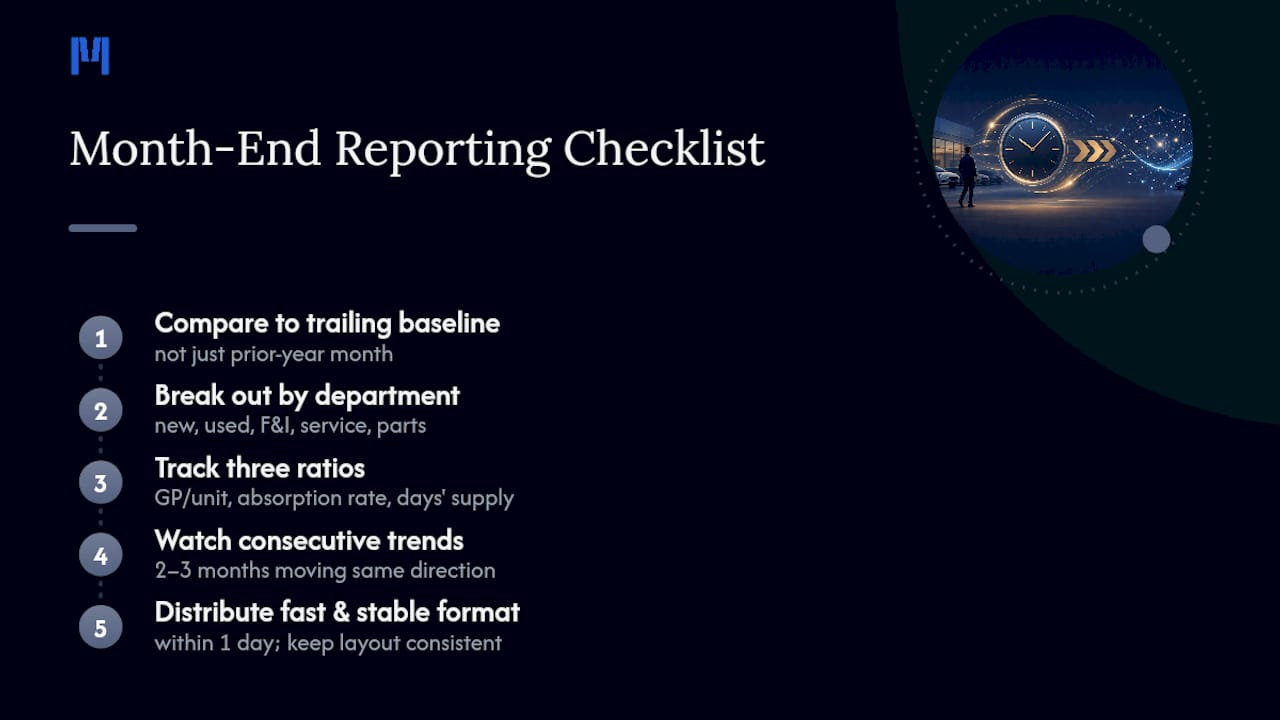
Break performance out by department (new, used, F&I, service, parts) rather than reporting a single consolidated gross, since a strong F&I month can hide a service department that’s quietly losing ground. Track key ratios month over month: gross profit per unit, absorption rate, and days’ supply on used inventory are the three numbers that catch a drifting dealership before it becomes a crisis. A single bad month on any of these rarely means much on its own, but two or three consecutive months moving the same direction is worth a real conversation with department managers before the next close cycle even starts.
Distribute the finished reports quickly, ideally within a day of sign-off, since a report reviewed a week late is a report used to explain the past instead of adjust the present. Keep the format consistent from month to month too. Changing report layouts or metric definitions partway through the year makes trend analysis nearly impossible for anyone outside the accounting office.
ModernDMS Perspective: What Rollout Actually Looks Like
Dealerships that modernize their close process rarely do it in one sweeping change, and that’s by design. Modular rollout, adding inventory sync first, then finance reporting integrations, then archive workflows, lets a team absorb new tools without disrupting an active close cycle. The administrative time savings customers report, up to 10 hours a week, tend to show up gradually as manual reconciliation steps get replaced one at a time, not all at once. The lesson we’d underline for controllers evaluating a system change: sequence the rollout around your existing close calendar, not against it.
— ModernDMS
How MDMS Supports a Faster, More Reliable Close
Every checklist and reconciliation habit in this guide gets easier when your system does the matching for you instead of leaving it to a spreadsheet at 9 p.m. on Day 3. MDMS was built specifically for equipment dealerships running the kind of close described above, with inventory sync that flags mismatches before they reach your reconciliation package, finance reporting that ties directly to your close-status dashboard, and native integration with Xero and MYOB so postings don’t need re-entry between systems.

The archive and sign-off workflows built into the platform keep preparer and reviewer approvals timestamped automatically, which matters the moment an auditor asks for proof rather than a promise. Customers running MDMS across inventory, service, and finance modules report saving up to 10 hours a week in administrative work that used to go into manual reconciliation and re-keying. Setup takes under an hour, and you keep full ownership of your data the entire time, no lock-in, no waiting on a vendor to migrate you. If your close is still taking longer than three or four days, book a demo and see which part of that timeline MDMS can shorten first.
Sources
- How a Strong Month-End Close Drives Dealership Financial Success
- How Auto Groups Can Streamline Their Month End Closing (Without Burning Out the Office)
- Top month-end closing tips for dealership accounting teams
FAQ
Can You Walk Me Through a Dealership’s Month-End Closing Process?
It typically runs three to four days: Day 1 covers cutoff and physical counts, Day 2 covers posting and reconciliation prep, and Day 3 (or Day 4) covers controller review, variance resolution, and sign-off before reports go out.
What Is the Process of Month-End Closing?
Month-end closing means posting every transaction from the period, reconciling balance sheet accounts like bank, floorplan, inventory, AR, and AP against the general ledger, then reviewing and signing off on the final financials before they’re distributed.
What Are the Steps for the Month-End Closing?
The core steps are enforcing a posting cutoff, completing balance sheet reconciliations in priority order, investigating variances against prior-month baselines, and securing preparer and reviewer sign-offs before the close is archived.
How Do You Automate the Month-End Closing Process?
Automation comes primarily from a DMS that posts directly to the general ledger or exports clean feeds to accounting software like Xero or MYOB, paired with exception reports that flag mismatches before they reach the reconciliation stage; platforms like MDMS are built around this workflow specifically for equipment dealerships.
How Long Should a Dealership’s Month-End Close Take?
Most well-run dealership accounting teams complete their close in three to four business days once reconciliations are standardized and reviewed weekly rather than saved entirely for month-end.