Three-Way Matching for AP Teams: A Practical Guide
By MDMS Team · 3 August 2026

Three-Way Matching for AP Teams: A Practical Guide
Three-way matching is the accounts payable control that compares a supplier invoice against the original purchase order and the goods received note (GRN) or service confirmation, approving payment only when all three documents align within your configured tolerances. For Australian equipment dealerships, wholesale operations, and any business managing high-value physical inventory, it is the most reliable way to ensure you pay only for what you actually ordered and received.
Three-way matching applies directly to your operation if you deal in physical goods, use formal purchase orders, and have a documented receiving process. If any of those three conditions are present, the control adds material value.
Why it matters at a glance:
- Prevents overpayments and duplicate charges by requiring documented proof of receipt before payment
- Reduces invoice disputes with suppliers by creating a clear, auditable paper trail
- Flags fraudulent or erroneous invoices before they reach your payment run
- Supports Australian GST compliance by tying tax amounts to verified, received goods
Table of Contents
- What Is Three-Way Matching in Australian AP Practice?
- What Documents and Data Points Should AP Check?
- How Does the Three-Way Matching Workflow Actually Run?
- Two-Way vs Three-Way vs Four-Way Matching: Which One Do You Need?
- Who Does What: Roles and Responsibilities in the Matching Process
- What Are the Real Benefits and Drawbacks of Three-Way Matching?
- What Are the Most Common Three-Way Matching Errors?
- Worked Example: A Clean Match and a Partial-Delivery Exception
- How Does Automation Change the Three-Way Matching Process?
- Key Takeaways
- What AP Teams Actually Experience When They Adopt Three-Way Matching
- Moderndms Supports Three-Way Matching for Australian Equipment Dealers
- Useful Sources and Further Reading
- FAQ
What Is Three-Way Matching in Australian AP Practice?
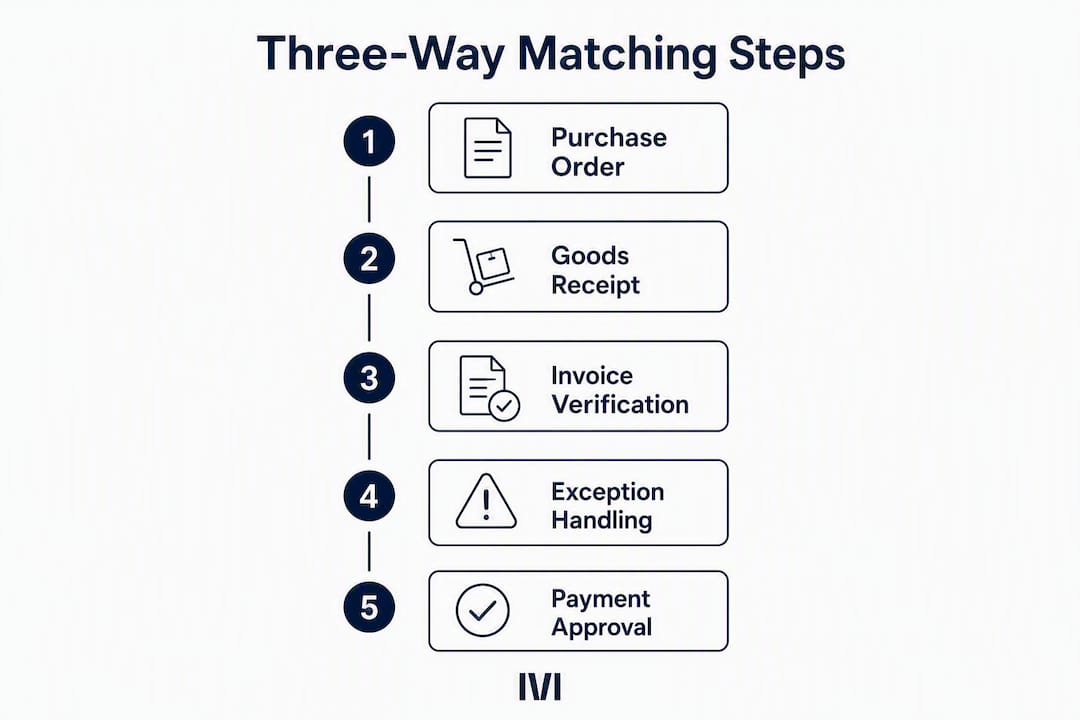
Three-way matching is a formal internal accounting control. Your AP team cross-references three documents: the purchase order (what was ordered and at what price), the goods received note or service confirmation (what was actually delivered or completed), and the supplier invoice (what the supplier is billing you for). Payment is approved only when all three agree within your defined tolerances.

In Australian practice, GST handling adds a layer of complexity that two-way matching often misses. The invoice must show the correct GST amount tied to the actual goods received, not just the ordered quantity. If your GRN records 80 units but the invoice charges GST on 100, the tax line itself becomes an exception. Most Australian AP teams running Xero or MYOB need their matching rules to operate at the tax-line level, not just on net amounts.
Key terms your team needs to know:
- Purchase Order (PO): The authorised document your business raises to commit to buying goods or services at an agreed price and quantity.
- Goods Received Note (GRN) / Receiving Report: The internal record created when goods arrive or services are confirmed as complete. Also called a goods receipt note.
- Invoice: The supplier’s billing document requesting payment.
- Tolerance: The acceptable variance between matched values (e.g., ±2% on price, ±1 unit on quantity) before a discrepancy triggers an exception.
- Exception: Any invoice that fails to match within tolerance and requires human review before payment can proceed.
- Header-level match: Comparing document totals only (total amount, total GST). Faster but misses line-level errors.
- Line-level match: Comparing each individual line item across all three documents. Required for multi-line or high-value POs.
Three-way matching is particularly common in Australian wholesale, manufacturing, and distribution sectors where partial deliveries and invoicing for undelivered goods are genuine operational risks.
What Documents and Data Points Should AP Check?
Precise field-level matching is what separates a control that works from one that looks good on paper. Here is what your team should verify on each document.
Purchase order fields
- PO number (must appear on the invoice for automated matching to work)
- Line item descriptions and item codes
- Authorised quantities per line
- Agreed unit prices
- Delivery location and expected delivery date
- Authorised approver name and approval date
Goods received note fields
- Delivered quantities per line item (not just total units)
- Date and time of receipt
- Receiving location or warehouse bay
- Condition notes (damaged, partial, substituted)
- Receiver identity (name or employee ID)
Invoice fields
- Supplier ABN and legal name
- Invoice number and invoice date
- PO number reference
- Line item descriptions matching PO
- Unit prices and extended line totals
- GST amount per line and total GST
- Net and gross totals
- Supplier bank account details (BSB and account number)
Line-level matching matters most for equipment dealerships. A parts order with 15 line items may balance at the header level while hiding a $2,000 unit-price variance on a single high-value component. Header-only matching misses exactly these discrepancies in complex, multi-line operations.
Pro Tip: Three-way matching does not verify that the supplier’s bank account details are legitimate. Criminals can alter payment destination details on otherwise valid invoices. Run a separate bank-account verification check — especially for new suppliers or any invoice that arrives with updated payment details.
How Does the Three-Way Matching Workflow Actually Run?
A well-designed po approval workflow moves from invoice capture to payment posting without requiring a human to touch every transaction. Here is the operational sequence.
- Invoice capture. The supplier submits an invoice (email PDF, e-invoicing, or supplier portal). Your system extracts key fields via OCR or structured data and links the invoice to the PO number.
- Automated matching. The system compares the invoice against the open PO and the GRN at line level. It checks quantities, unit prices, totals, and GST amounts against your configured tolerances.
- Auto-approval. Invoices that match within tolerance are automatically approved and queued for payment posting. No human review required.
- Exception flagging. Invoices outside tolerance are categorized by exception type: missing PO reference, quantity mismatch, price variance, missing or incomplete GRN, or duplicate invoice number.
- Exception routing. Each exception type routes to the correct owner. A missing GRN goes to the receiving team. A price variance above your threshold goes to the purchasing manager. A duplicate invoice flag goes to AP for investigation.
- Resolution and override. The assigned owner resolves the exception, attaches evidence (packing slip, corrected invoice, approval email), and either approves or rejects the invoice. All overrides are recorded in the audit trail with the approver’s identity and timestamp.
- Payment posting. Approved invoices post to your accounting system (Xero or MYOB) and enter the payment run.
Handling partial deliveries requires a specific approach. When your GRN records 60 units against a PO for 100, the invoice matching process should match only against the portion actually received. You have two options: process a partial payment for the 60 units and leave the remaining 40 on an open PO, or hold the entire invoice until the balance is delivered. For equipment dealerships managing critical parts inventory, partial payment is usually the right default. It keeps supplier relationships intact and avoids blocking your parts operation.
Pro Tip: Set SLA targets for exception resolution — not just for AP, but for receiving teams and purchasing managers. An exception that sits unresolved for five days defeats the purpose of the control. A 48-hour SLA on GRN exceptions is a reasonable starting point for most dealerships.

Two-Way vs Three-Way vs Four-Way Matching: Which One Do You Need?
| Matching type | Documents compared | Best for | Receiving discipline required | Cycle time impact |
|---|---|---|---|---|
| Two-way | Invoice + PO | Services, low-value goods, simple supplier relationships | None | Minimal |
| Three-way | Invoice + PO + GRN | Physical goods, high-value inventory, equipment parts | High | Moderate |
| Four-way | Invoice + PO + GRN + inspection/quality sign-off | Regulated goods, custom equipment, quality-critical components | Very high | Higher |
Two-way matching is often sufficient for service businesses; three-way matching becomes the right standard the moment your operation involves formal receiving and high-value physical goods. Four-way matching adds an inspection or quality acceptance record before payment, which is appropriate for custom-built equipment, regulated components, or any situation where a GRN alone does not confirm the goods meet specification.
Matching strategy by organizational profile:
- Equipment dealerships (parts and inventory): Three-way matching at line level, with four-way for custom or high-value build orders
- Service-only businesses: Two-way matching is adequate; add three-way for any service with a material component
- Mixed operations (service + parts): Apply matching type by transaction category, not as a blanket rule
- Low-value, recurring purchases (office supplies, utilities): Two-way or standing-order matching; three-way adds friction without proportionate control value
Who Does What: Roles and Responsibilities in the Matching Process
Clear ownership at each step is what keeps the three-way match process from becoming a bottleneck. The following table maps responsibilities across the typical AP team structure.
| Role | Responsibility | Key control point |
|---|---|---|
| Requester / Purchasing | Raise and approve the PO; ensure item codes, quantities, and prices are accurate | PO must be authorised before goods are ordered |
| Receiving / Warehouse | Create the GRN at the point of delivery; record quantities, condition, and receiver identity | GRN must be created at delivery, not retrospectively |
| Accounts Payable | Capture invoices, run matching, categorize and route exceptions | AP should not also raise POs or approve GRNs |
| Finance Manager / Approver | Review and approve exceptions above threshold; authorise override payments | Overrides must be documented with reason and evidence |
Segregation of duties is the most commonly overlooked control. The person who raises the PO should not be the same person who approves the matching exception or authorises payment. In smaller dealership teams, this is a real operational challenge. The practical fix is to require a second approver for any exception override, even if both people are in the same department.
Responsibility checklist for designing your approval matrix:
- No single user can raise a PO, confirm receipt, and approve the invoice
- Exception overrides require a named approver at a defined authority level
- All approvals are timestamped and attributed in the audit trail
- Supplier master data changes (including bank account updates) require separate authorisation
Pro Tip: Real-time receiving is the single biggest cultural change most teams need to make. Without GRNs created at delivery, AP spends its time chasing proof of receipt rather than processing payments. A mobile field app that works offline lets your receiving team log deliveries on the spot, even at remote sites.
What Are the Real Benefits and Drawbacks of Three-Way Matching?
The control is not free. Before applying it across your entire payables operation, weigh the genuine trade-offs.
Benefits:
- Prevents overpayments by requiring documented proof of receipt before any payment is approved
- Detects duplicate invoices automatically when your system checks invoice numbers against existing records
- Creates a complete audit trail that supports both internal review and external audit
- Reduces invoice disputes with suppliers because discrepancies are caught early, with evidence attached
- Consistent matching improves vendor relationships by enabling timely, accurate payments, which can translate to better supplier terms over time
Drawbacks:
- Adds process overhead, particularly where receiving discipline is inconsistent
- Can delay payments if GRNs are not created promptly, creating cash-flow friction with suppliers
- Requires investment in receiving systems and training before the control delivers value
- Generates false exceptions when tolerance rules are misconfigured, creating unnecessary work for AP
The cost-versus-benefit calculation tips clearly in favor of three-way matching for any Australian equipment dealership managing significant parts inventory or high-value supplier invoices. For low-value, low-risk transactions, the overhead is rarely justified. A risk-based approach — applying three-way matching selectively by supplier category, transaction value, or risk profile — gives you the control where it matters without slowing down routine payables.
What Are the Most Common Three-Way Matching Errors?
Most matching failures trace back to a small set of repeatable problems. Here is where things break down and how to fix them.
Common failure causes:
- Missing PO numbers on invoices. Suppliers submit invoices without referencing a PO, making automated matching impossible.
- Delayed or absent GRNs. Receiving teams log deliveries days after the fact, or not at all, leaving AP with no third leg to match against.
- Header-only matching. Systems configured to match totals only miss line-level price variances and quantity discrepancies on individual items.
- Vendor data inconsistencies. Supplier names, ABNs, or item codes differ between the PO and the invoice due to supplier system changes or data entry errors.
- Duplicate invoices. The same invoice is submitted twice (different invoice numbers, same amount and date) and passes matching because the duplicate check is not configured.
Remediation steps:
- Make PO number a mandatory field on your supplier onboarding documentation and purchase order template
- Set a receiving SLA: GRNs must be created within 24 hours of delivery
- Configure line-level matching for all POs above your defined value threshold
- Run automated duplicate detection on invoice number, supplier ABN, amount, and date combination
- Train receiving teams on why their GRN is the third leg of the control, not just a warehouse admin task
Operational fixes for pattern abuse:
- Review override logs monthly. If the same approver is routinely overriding the same exception type, that is a process gap, not a one-off judgment call.
- Set escalation paths for exceptions unresolved beyond your SLA. Unresolved exceptions are where fraud hides.
- Document all routine overrides with a reason code so you can distinguish legitimate business decisions from control bypasses.
Worked Example: A Clean Match and a Partial-Delivery Exception
The clean match
Your parts department raises a PO for 100 units of a hydraulic filter at $50.00 per unit. The PO total is $5,000.00 plus $500.00 GST, totalling $5,500.00. The receiving team logs a GRN for 100 units on delivery. The supplier invoices for 100 units at $50.00 each, with $500.00 GST and a gross total of $5,500.00. All three documents align at line level and header level. The system auto-approves and queues the invoice for payment posting to Xero.
The partial-delivery exception
Same PO: 100 units at $50.00. The receiving team logs a GRN for 80 units. The supplier invoices for the full 100 units at $5,500.00 including GST. The system flags a quantity mismatch of 20 units ($1,100.00 including GST) and routes the exception to the purchasing manager.
Resolution path:
- The purchasing manager contacts the supplier to confirm whether the remaining 20 units are on back-order or were not shipped
- AP processes a partial payment for 80 units ($4,400.00 including GST) against the confirmed GRN
- The open PO line for 20 units remains active pending delivery
- When the balance is delivered and a second GRN is created, the remaining invoice amount is matched and approved
Documents to attach for exception resolution:
- Original packing slip or delivery docket
- Signed GRN with receiver identity
- Supplier correspondence confirming back-order status
- Approval email from the purchasing manager authorising partial payment
For equipment dealerships, the recommended default is partial payment rather than hold-until-resolved. Holding the entire invoice when 80% of goods are confirmed received damages supplier relationships and can disrupt your parts supply chain.
How Does Automation Change the Three-Way Matching Process?
Modern automation approves compliant invoices without human intervention and routes only genuine exceptions to your team. That shift, from reviewing every invoice to reviewing only the ones that need attention, is what allows AP to scale without adding headcount.
Core automation features to require:
- OCR or structured e-invoicing for invoice data capture
- Line-level PO/GRN/invoice matching with configurable tolerances per supplier, category, or value band
- Automated duplicate detection across invoice number, ABN, amount, and date
- Exception categorization and routing rules by exception type and value
- Full audit trail with approver identity, timestamp, and attached evidence
- Native integration with Xero or MYOB for payment posting and GST reconciliation
- Integration with your parts and warehouse management system for automatic GRN creation at receiving
Exception-based workflow design:
- Auto-approve all invoices that match within tolerance at line level
- Route price variances above threshold to purchasing; quantity mismatches to receiving; missing POs to AP
- Prioritize exception queues by invoice value and supplier criticality, not just arrival date
Pilot plan for rolling out automated matching:
- Select a cohort of 5–10 high-volume suppliers with consistent PO and invoicing practices
- Define tolerance rules: start conservatively (±1% price, ±1 unit quantity) and adjust based on false-positive rates
- Run parallel matching for 30–60 days, comparing automated results against your existing manual process
- Measure your auto-match rate, exception volume, and mean time to resolution
- Expand to additional supplier cohorts once false-positive rates are below your target threshold
- Conduct integration testing with your receiving team and accounting system before full cutover
KPIs to track from day one:
- Auto-match rate (target: 80%+ of invoices approved without human intervention)
- Exception volume per week
- Mean time to exception resolution
- Payment cycle time (days from invoice receipt to payment posting)
- Reduction in invoice disputes per quarter
Systems that integrate with receiving and accounting packages catch discrepancies before invoices reach approvers, rather than surfacing them during month-end reconciliation when the window for dispute is much narrower.
Key Takeaways
Three-way matching is the most reliable AP control for Australian equipment dealerships: apply it at line level for physical goods, configure tolerances before going live, and automate exception routing so your team reviews only what genuinely needs attention.
| Point | Details |
|---|---|
| Apply it selectively | Use three-way matching for physical goods and high-value POs; two-way is sufficient for services and low-risk transactions. |
| Line-level matching is non-negotiable | Header-only matching misses unit-price variances on individual lines in multi-line POs. |
| Receiving discipline drives everything | Without GRNs created at delivery, every invoice becomes an exception and the control loses its value. |
| Automate exceptions, not approvals | Auto-approve matched invoices and route only flagged discrepancies to people, targeting an 80%+ auto-match rate. |
| Moderndms for equipment dealers | Moderndms supports GRN capture, line-level matching, configurable tolerances, and Xero/MYOB integration for Australian equipment dealerships. |
What AP Teams Actually Experience When They Adopt Three-Way Matching
The process looks clean on a flowchart. The reality is messier, and that gap is worth naming.
The hardest part of any three-way matching implementation is not the software configuration. It is the cultural shift in your receiving team. AP managers consistently find that the first month of a new matching rollout surfaces a backlog of GRNs that were never created, deliveries that were logged days late, and receiving records that don’t match the actual quantities on the packing slip. That is not a technology problem. It is a process discipline problem, and no amount of automation resolves it until the receiving team understands that their GRN is the third leg of a payment control, not just a warehouse admin task.
The second reality is that tolerance rules need tuning. The conservative settings you start with during your pilot will generate more exceptions than your team can resolve efficiently. Plan for a 60-day calibration period where you review false-positive exceptions weekly and adjust tolerances based on real transaction data, not assumptions.
Once those two things are in place, the shift to exception-based workflows genuinely changes how AP operates. Your team stops processing invoices and starts managing exceptions. That is a meaningful difference in how people spend their time, and it tends to surface the real risks in your payables operation rather than burying them in routine processing volume.
The continuous improvement piece is often neglected after go-live. Review your tolerance thresholds quarterly, audit your override logs monthly, and treat a rising exception rate as a signal that something upstream has changed, whether that is a new supplier, a new product category, or a receiving process that has drifted.
Moderndms Supports Three-Way Matching for Australian Equipment Dealers
Equipment dealerships running parts-heavy operations need AP controls that connect directly to their receiving workflows, not a generic invoicing tool bolted onto a separate warehouse system.
Moderndms is purpose-built for Australian equipment dealers, with parts and warehouse management that generates GRNs at the point of receiving, line-level PO matching, configurable tolerance rules, and exception routing built into the same platform your purchasing and service teams already use. GST compliance is native, and the platform integrates directly with Xero and MYOB so matched invoices post without manual re-entry. The offline-capable field app means your receiving team can log deliveries in real time, even at remote sites, preserving the third leg of the match without chasing paperwork.
If your dealership is ready to move from manual invoice checking to exception-based AP workflows, explore the Moderndms platform for equipment dealers or review pricing and module options to see what fits your operation.
Useful Sources and Further Reading
The following resources are worth bookmarking if you are designing or auditing a three-way matching process for an Australian operation.
- Three-Way Matching in Accounts Payable (Sage) — A clear practitioner overview of the control, when to apply it, and how it differs from two-way matching. Good starting point for teams new to the process.
- Three-Way Matching Policies in Dynamics 365 Finance (Microsoft Learn) — Detailed technical reference for how matching policies are configured in enterprise AP systems. Useful when specifying requirements for your AP system vendor.
- Supplier Bank Account Verification Tools (RelishIQ) — Explains why matching alone does not protect against payment redirection fraud and what verification tools to consider alongside your AP controls.
- Accounts Payable Automation Australia: 2026 Guide (Moderndms) — Covers AP automation features, integration requirements, and pilot planning for Australian businesses. Read alongside this guide when scoping your automation project.
When planning technical integration work, consult the developer documentation for your accounting platform (Xero or MYOB) directly. API capabilities and field-mapping requirements change with platform updates, and vendor documentation is the authoritative source for integration specifications.
FAQ
What is three-way matching in accounts payable?
Three-way matching is an AP control that compares a supplier invoice against the original purchase order and the goods received note, approving payment only when all three documents agree within configured tolerances.
What does a three-way match mean for payment approval?
It means payment is only released when the invoice amount, quantities, and prices align with both what was ordered (PO) and what was actually received (GRN). Any discrepancy outside tolerance triggers an exception requiring human review.
Who is responsible for performing the 3-way match?
Accounts payable runs the matching process, but the control depends on purchasing (raising accurate POs) and receiving teams (creating GRNs at delivery). Finance managers or approvers handle exception overrides above defined thresholds.
What are the most common 3-way matching errors?
The most frequent failures are missing PO numbers on supplier invoices, delayed or absent GRNs, header-only matching that hides line-level variances, and duplicate invoices that pass matching because duplicate detection is not configured.
Can Moderndms handle three-way matching for equipment dealerships?
Yes. Moderndms supports GRN capture at receiving, line-level PO and invoice matching, configurable tolerances, exception routing, and direct integration with Xero and MYOB, all within a single platform built for Australian equipment dealers.