Prove Xero Integration for Australian Dealers: Tests for LCT and MVIP
By MDMS Team · 4 October 2026

Prove Xero Integration for Australian Dealers: Tests for LCT and MVIP
The right move is to connect your dealer management system or CRM to Xero through a native or vetted connector rather than relying on manual entry. Purpose-built platforms can meet dealership needs when the integration is checked against two outcomes: accurate GST and Luxury Car Tax reporting, and operational visibility you can act on daily rather than discover at month end.
TL;DR:
- Native or vetted connectors are essential for reliable Xero integration that accurately handles GST, LCT, and inventory updates without manual re-entry.
- Integration must support detailed, line-item transactions, including trade-ins, trade incentives, and motor vehicle incentive payments, to ensure compliance.
- Vendors should provide test exports for MVIP, LCT calculations, and reconciliation checks before committing to deployment, with focus on error logging and audit trails.
- Implementation should proceed through phased testing stages, starting with sandbox setups and small departmental pilots, to avoid data mismatches and reporting errors.
- MDMS offers built-in Xero integration with industry-specific workflows, starting from $59 AUD per module, with a focus on dealership compliance and operational visibility.
Table of Contents
- Why Xero integration matters for dealerships
- Must-have integration features for dealerships
- GST and LCT: what your integration must support
- Implementation checklist and realistic timeline for DMS to Xero integration
- How ModernDMS integrates with Xero: real-world capabilities and proof points
- How to choose the right Xero-integrated system for your dealership
- Author perspective: integration as a capability, not a cost cut
- MDMS as a ready option: what to ask for next
- FAQ
- Sources
Why Xero integration matters for dealerships
Manual reconciliation is where dealership accounting breaks down. When sales, parts, and service data sit in separate systems, someone has to re-key invoices, match payments, and chase discrepancies before an activity statement can go out. A connected system removes that step by posting transactions to Xero as they happen, which cuts the scramble that usually defines the final days of each reporting period.
Real-time sync also changes what your managers can see day to day. Instead of waiting for a monthly close to know whether service margin is holding up or whether parts inventory is turning fast enough, integrated data lets you track those numbers continuously. That shift from retrospective accounting to ongoing visibility is often the real payoff, more than the hours saved on data entry.
Precise recordkeeping carries compliance weight too. Dealers must keep tax invoices, sales contracts, and records that substantiate GST and Luxury Car Tax calculations, and the ATO’s motor vehicle industry guidance treats digitized source records as a practical way to meet audit requirements. A system that posts directly to Xero, rather than relying on batch uploads or spreadsheets, gives you a cleaner audit trail by default.
Integration delivers operational visibility, not just time savings. It lets managers evaluate service profitability and inventory turnover using real-time posting instead of waiting for end-of-month adjustments to reveal the picture.
What this looks like in practice:
- Invoices, payments, and credit notes post to Xero without manual re-entry.
- Inventory cost layers update as vehicles or equipment move through sale, service, or trade-in.
- Reconciliation at period end becomes a review step rather than a rebuild.
Must-have integration features for dealerships
Before you sign anything, sit through a demo with a specific checklist in hand. Vendors will show you the polished parts of their software by default. Your job is to ask for the parts that determine whether the integration actually holds up under dealership-specific transactions.
Start with the connection method itself. A native connector, built and maintained against Xero’s API, tends to handle updates and error states more reliably than middleware that bridges your DMS to Xero through a third-party layer. Middleware can still work, but it adds a point of failure and often lags behind Xero’s own changes. The Xero App Store’s automotive category lists workshop and dealership apps that sync invoices, contacts, payments, and supplier bills, and checking whether a vendor appears there, with a maintained listing, is a fast way to confirm it has gone through Xero’s own vetting process.
Run through this sequence with any vendor:
- Confirm chart of accounts mapping. Ask how account codes in your DMS map to Xero’s chart of accounts, and whether that mapping is editable.
- Request a line-item invoice sample. Line-item detail should transfer, not a single lump total, so you can still see labor, parts, and margin separately in Xero.
- Ask how payments and deposits reconcile. Deposits taken before a sale completes need a clear path to the final invoice without creating duplicate entries.
- Walk through inventory cost layers. Confirm that cost of goods sold updates correctly when a unit sells, including units taken on trade-in.
- Ask specifically about bailment stock, trade-ins, and motor vehicle incentive payments (MVIPs). These transaction types trip up many standard accounting connectors, which often do not model them correctly out of the box.
- Request error logging and audit export samples. You want to see what happens when a sync fails, not just when it succeeds.
Pro Tip: Ask the vendor for a sample journal export covering a trade-in with an MVIP attached. If they cannot produce one, assume the integration has not been tested against that scenario.
Reconciliation automation deserves a close look too. Some integrations only push data one way and leave you to manually confirm it landed correctly in Xero. Others include built-in reconciliation checks that flag mismatches before they become a problem at tax time.
GST and LCT: what your integration must support
Dealership accounting carries compliance weight that generic retail accounting does not, mainly because of GST and Luxury Car Tax. Your integration needs to support the recordkeeping the ATO requires for LCT reporting, which includes tax invoices, sales contracts, LCT calculations, and evidence of ABN checks on counterparties.
Motor vehicle incentive payments add a layer most generic accounting software was never built to handle. Dealers must report GST on the total consideration for a sale, including third-party motor vehicle incentive payments, so your integration needs to expose MVIPs as a distinct, visible line rather than folding them into a generic sales figure. If a connector cannot separate an MVIP from the base sale price, your GST and LCT reporting will be wrong even if every other number looks fine.

For second-hand vehicles purchased from entities that are not registered for GST, input tax credit entitlement equals the lesser of one-eleventh of the purchase consideration or the GST payable on the eventual taxable sale, as set out in the ATO’s motor vehicle partnership guidance. That calculation needs to be traceable back to source records, which means your DMS should retain the original purchase contract alongside the resale invoice.
Before you commit to a vendor, request these exports and confirm they are accurate:
- A completed LCT calculation tied to a specific vehicle sale.
- A trade-in transaction showing how the traded unit’s value flows through to the new sale.
- An MVIP-included sale showing GST calculated on total consideration.
- A GST reconciliation report that matches your Xero activity statement figures.
A sandbox or test-mode demo that reproduces MVIP and LCT scenarios is the most reliable way to confirm a vendor’s compliance claims hold up before real data is on the line.
Implementation checklist and realistic timeline for DMS to Xero integration
Treat the rollout as a series of gates, not a single cutover event. Each gate should confirm something specific before you move to the next stage, so problems surface in testing rather than after go-live.
- Build test cases from real scenarios before the demo. Pull a sample sale with a trade-in, a sale with an MVIP, a refund, and a standard parts invoice, and ask the vendor to process each one.
- Run a sandbox test against your own chart of accounts. Confirm account mapping, tax codes, and inventory cost layers behave the way your finance team expects.
- Reconcile sandbox output against manually calculated figures. If the numbers do not match for GST, LCT, or cost of goods sold, resolve the mapping before migrating real data.
- Prioritize data migration in order: opening balances first, then inventory on hand, then outstanding debtors and creditors. Getting opening balances wrong distorts every report that follows.
- Run a pilot with one department or one location before a full go-live. Service or parts is often the lowest-risk starting point since transaction volume is high but individual values are small.
- Reconcile again after go-live, within the first full reporting cycle, to confirm the live environment matches sandbox behavior under real transaction volume.
Pro Tip: Keep your old system running in read-only mode for at least one full GST reporting period after cutover, so you have a fallback reference if a reconciliation discrepancy appears.
Realistic timelines vary with the number of modules involved, but a pilot department can typically go live within a few weeks of sandbox testing, provided data migration priorities are followed in order rather than attempted all at once. Our inventory management guide for equipment dealers walks through how inventory data specifically should sync once you reach that stage.
How ModernDMS integrates with Xero: real-world capabilities and proof points
There are purpose-built dealer management platforms for equipment dealerships with native integration to Xero included rather than bolted on. Their modular structure means a dealership can roll out the modules it needs most urgently, whether that is service workshop management or parts inventory, and connect those to Xero before expanding further.
Here is what to verify when you see MDMS in a demo:
- Ask to see chart of accounts mapping for your specific account structure, not a generic template.
- Request a sample trade-in and MVIP transaction processed end to end, with the resulting journal entries in Xero.
- Ask for an LCT calculation export tied to a real vehicle or equipment sale.
- Confirm setup time: the system should be designed for a sub-hour initial setup, and you should ask to see that process live rather than take it on description alone.
- Ask about data ownership: the platform should be built so dealerships retain full ownership of their data, with no lock-in if you later decide to move systems.
User-reported administrative time savings with this platform can be significant, reflecting reduced manual entry across sales, service, and parts workflows. That number will vary by dealership size and how many modules you adopt, but it reflects the kind of reduction in duplicate data entry that a direct Xero connection is meant to deliver. Our CRM feature page covers how sales pipeline data feeds into the same integration.
How to choose the right Xero-integrated system for your dealership
Weigh technical fit, compliance coverage, and commercial terms together rather than picking a vendor on price alone. A cheaper system that cannot produce an audit-ready LCT export will cost you more in accountant hours than it saves in subscription fees.
- Prioritize vendors who can demonstrate chart of accounts mapping, audit exports, and sandbox testing before you sign a contract.
- Ask every vendor for a sample journal export covering a trade-in, an MVIP, and a refund, processed in their own sandbox.
- Confirm whether the integration is a native connector or middleware, and ask what happens when Xero changes its API.
- Request references from dealerships of a similar size and product mix to yours, not a generic case study.
- Treat a vendor’s inability to produce a real MVIP or LCT export as a red flag that should end the conversation quickly.
- Check the Xero App Store automotive listing to confirm the vendor maintains an active, current integration rather than a legacy listing.
Author perspective: integration as a capability, not a cost cut
Most dealerships approach Xero integration as a way to save admin hours, and it does that. But the more useful way to think about it is as the difference between managing a dealership by looking backward at last month’s numbers and managing it with current ones. Once sales, service, and parts data post to Xero in real time, KPI tracking stops being a monthly ritual and becomes something you check the way you’d check fuel gauges. Prioritize integration early in your digital roadmap, before you add more modules or locations, because every system you bolt on afterward inherits whatever gaps exist in that first connection.
— ModernDMS
MDMS as a ready option: what to ask for next
If you want the compliance checks and operational visibility covered above without building the connection yourself, MDMS ships with Xero integration included across its modules, from service workshop to parts to rental. In a demo, ask specifically for the trade-in, MVIP, and LCT export tests described earlier, along with a live look at the sub-hour setup process.
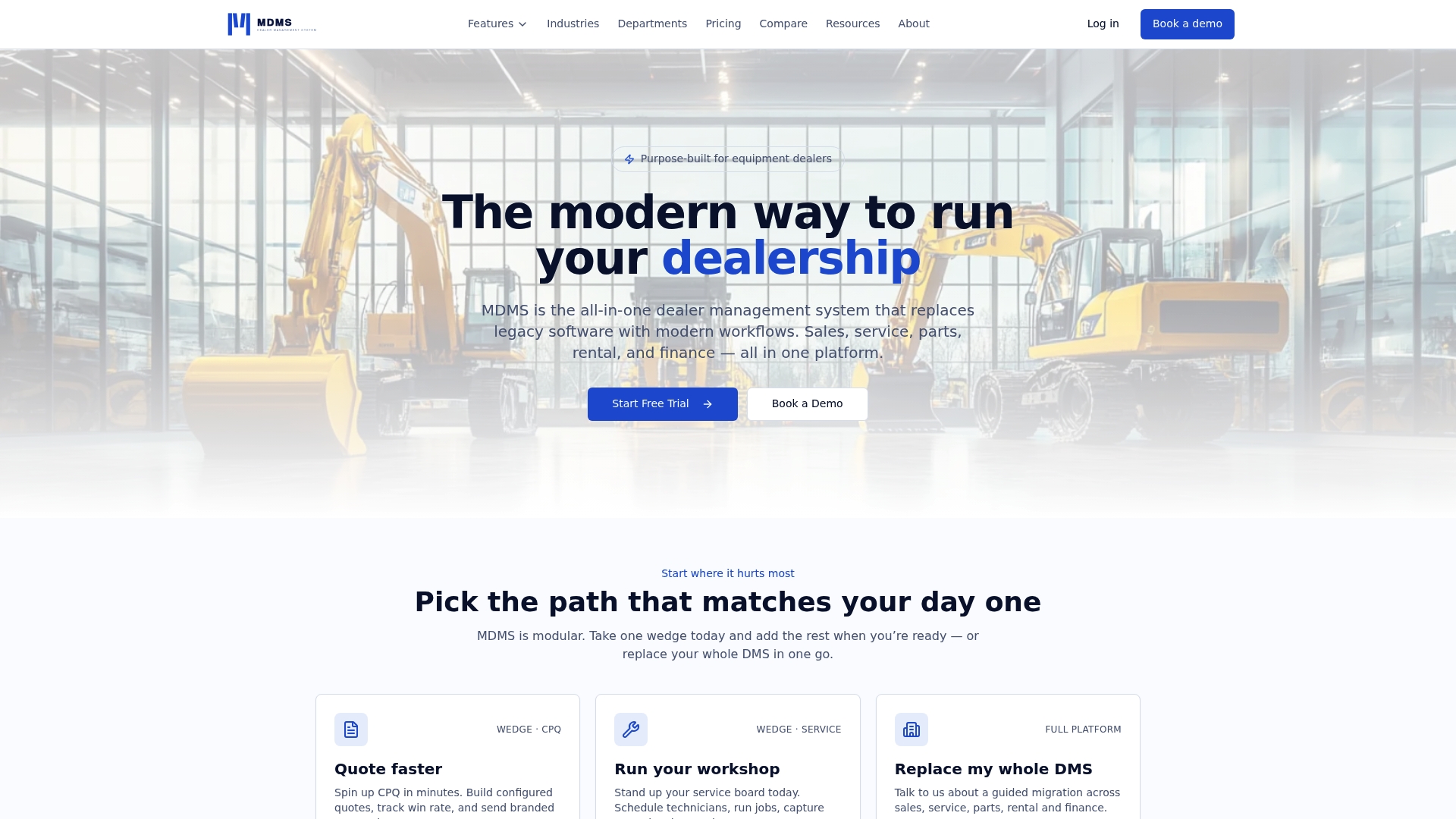
From there, the MDMS pricing page lists every module, including Service Workshop, CRM, and Parts at 59 AUD per month each, and the combined Equipment Dealer Suite at 259 AUD per month, so you can scope a rollout that matches which department needs Xero connectivity first.
This article is general information, not a substitute for advice from a qualified financial advisor. Consult a qualified financial professional about your own circumstances before acting on anything here.
FAQ
What is the best software for automotive dealers?
The best fit depends on vehicle type and transaction volume, but for equipment, truck, and agricultural dealers specifically, a purpose-built dealer management system with native Xero integration, like MDMS, tends to outperform generic retail or automotive software because it models trade-ins, bailment stock, and MVIPs correctly. General dealership software built for passenger vehicle retail often lacks those specific workflows.
What is the best accounting software for auto dealers?
Xero is widely used by dealers because it supports third-party app integrations that extend its reporting for industry-specific needs like LCT calculations and MVIP tracking, as outlined in Xero’s own car dealer guidance. The accounting platform itself matters less than whether your dealer management system connects to it with accurate, dealership-specific data mapping.
Does Xero have API integration?
Yes, Xero provides an API that third-party developers use to build connectors, and the Xero App Store’s automotive category lists workshop and dealership apps that sync invoices, contacts, payments, and supplier bills through that API. Not every listed integration handles dealer-specific cases like bailment or MVIPs identically, so demo testing still matters.
What CRM works with Xero?
Several CRM platforms connect to Xero, but a CRM built specifically for equipment or vehicle dealerships, such as the CRM module in MDMS, carries the advantage of syncing sales pipeline and deal data directly into Xero without a separate middleware layer. Generic CRMs often require additional configuration to handle dealership-specific sales structures like trade-ins.
How long does it take to integrate a DMS with Xero?
A single-department pilot, such as service or parts, can typically go live within a few weeks once sandbox testing and reconciliation checks are complete. Full rollout across all departments takes longer and depends on how many modules and how much historical data need migration.
Sources
- Automotive apps - Workshop management software that integrates with Xero (Xero App Store)
- Xero car dealers guidance (Xero)