Stop 180 Day Write Offs With 3 Dead Stock Reduction Habits for Dealers
By MDMS Team · 3 September 2026

Stop 180 Day Write Offs With 3 Dead Stock Reduction Habits for Dealers
Dead stock is reducible, and the fix follows a predictable sequence: identify slow-moving SKUs before they go stale, prevent recurrence with tighter forecasting and replenishment rules, and recover value through a staged clearance plan rather than a panic markdown. Get those three habits running on a regular cadence, and dead stock stops being a mystery line on your balance sheet. The rest of this guide walks through the metrics, thresholds, and decision rules that make it work.
TL;DR:
- Regularly monitor the 90 to 180 day ageing bucket to identify slow-moving SKUs before they become dead stock, aiming for small promotions rather than deep discounts.
- Automate reorder points and set short, demand-based forecast cycles to prevent stock buildup and reduce SKU sprawl in your inventory.
- Prioritize dead stock clearance by first repositioning, then targeting specific customer segments with staged markdowns, bundling, or wholesale liquidation to protect margins.
- Focus on ownership and accountability to ensure monthly review of ageing reports and prevent recurrent dead stock issues through disciplined buying and promotion planning.
- Target high-cost, high-space, or high-risk SKUs first using a weighted scoring model to improve clearance efficiency and avoid wasting effort on low-value items.
Table of Contents
- What Dead Stock Reduction Actually Means
- How Do You Spot Slow-Moving Stock Before It Dies?
- What Prevents Dead Stock From Building Up Again?
- How Do You Clear Dead Stock Without Killing Your Margin?
- Which SKUs Should You Deal With First?
- What We’ve Learned From Watching This Play Out
- Sources
- FAQ
What Dead Stock Reduction Actually Means
Dead stock is inventory that has stopped selling and has no realistic chance of selling at your current price. That’s different from excess inventory, which is simply more of a product than you need right now but which still moves, just slower than planned. A dealer with 40 units of a fast-selling filter has excess stock. A dealer with 40 units of a filter for a machine model discontinued three years ago has dead stock.
Most guidance treats 180 days without a meaningful sale as the practical threshold for calling something dead, with 60 to 90 days as the normal window where an item is simply slow. That gap matters because it gives you a decision point before the write-off becomes unavoidable.
The financial hit is straightforward but easy to underestimate. Dead stock ties up working capital, adds ongoing holding costs, and creates opportunity cost because the cash sunk into it can’t fund faster-moving parts or equipment.
- Seasonal attachments that missed their window and now sit until next year, if there is a next year for that model
- Discontinued machine models where parts support has quietly ended
- Units with quality issues that made it past receiving but not past the customer
How Do You Spot Slow-Moving Stock Before It Dies?
Catching a SKU while it’s still slow, not dead, is the entire game. Once inventory crosses that 180 day line, your options shrink to markdown, wholesale, or write-off. Catch it earlier, and you can reposition it with a shallow discount instead.
Three metrics do most of the work:
- Sell-through rate. Units sold divided by units received over a set period. A part sitting at 15% sell-through after 90 days is telling you something a raw quantity count never will.
- Days Sales of Inventory (DSI). How many days, on average, it takes to turn stock into a sale. Rising DSI on a specific category is an early warning, often weeks before anyone notices the shelf space.
- Ageing buckets. Segment stock into 0 to 90 days, 90 to 180 days, and 180-plus days. The 180-plus bucket is your dead stock candidate list, updated automatically if your system supports it.
Pro Tip: Set a standing weekly report for the 90 to 180 day bucket specifically. That window is where intervention is cheapest, a small promotion or a bundle, rather than the deep discounting the 180-plus bucket usually demands.
Automated slow-mover alerts and cycle counts close the gap between when a part goes quiet and when someone actually notices. Without that automation, ageing stock tends to hide in plain sight until a stocktake forces the issue. A dealer inventory tracking setup built for this gives you the ageing view without a manual export every Monday morning.
On cadence, run the slow-mover dashboard weekly, a full ageing analysis monthly, and treat anything crossing 180 days as an automatic trigger for the triage review covered later in this guide.
What Prevents Dead Stock From Building Up Again?
Clearing dead stock feels like progress, but if you don’t fix what created it, you’ll be running the same clearance sale again next year. Prevention is less glamorous than a liquidation deal, and it’s where the real margin protection happens.
Forecasting hygiene comes first. Long forecast windows built on last year’s numbers miss the promotions, price changes, and model turnover that actually drive demand. Shorter forecast cycles, adjusted for known promotions, catch shifts before they turn into a warehouse full of the wrong SKU. For brand-new lines, order small. A test order of a handful of units tells you more about real demand than a full pallet ever will, and it caps your downside if the product doesn’t move.
Reorder points need to be dynamic, not static. A reorder trigger set once and forgotten drifts out of sync with actual demand within a season. Automating reorder points from live sales data rather than a periodic manual review is one of the more effective single changes a dealership can make, because it removes the lag between demand shifting and the purchasing team noticing.
SKU rationalization keeps the count from creeping. Every new variant, color, or configuration you add to the catalog is another line that can go stale. Review your catalog on a schedule and retire variants that duplicate demand rather than expand it. This matters more for parts operations carrying thousands of lines, where managing parts inventory without rationalization turns into SKU sprawl fast.
Supplier terms are a lever most teams underuse. Negotiating smaller minimum order quantities, flexible returns, or consignment arrangements shifts risk away from your warehouse. Consignment stock in particular lets you offer a wider range without owning the inventory outright until it sells.
Prevention also depends on purchasing and marketing talking to each other before a promotion launches, not after the leftover units show up in the ageing report. A promotion that clears 200 units in March but leaves 50 stragded in April needs a plan for those 50 before the campaign goes live.
Here’s what a prevention checklist looks like in practice:
- Run demand forecasts on a rolling short window, adjusted for known promotions and seasonality
- Set automated reorder points tied to real-time sell-through, not a fixed calendar
- Cap initial orders on new SKUs until sell-through data justifies a bigger commitment
- Review the full SKU catalog quarterly and retire low-value variants
- Negotiate consignment or flexible MOQ terms with suppliers on higher-risk lines
- Keep purchasing and marketing aligned on promotion timing and expected leftover volume
Inventory software earns its keep here. Real-time visibility across locations, scheduled cycle counts, and automatic slow-mover alerts turn prevention from a quarterly scramble into a background process that flags problems while they’re still cheap to fix.
How Do You Clear Dead Stock Without Killing Your Margin?
A staged clearance approach protects value that a blanket discount throws away.
Start with a triage check on each dead SKU: is there any remaining demand anywhere in your network, what margin is actually left to protect, does discounting it risk your brand with other customers, and does it have a shelf life that forces urgency. That check determines which rung of the ladder you start on.
- Reposition first. Move the item to a different branch, region, or sales channel where demand might still exist before touching the price at all.
- Targeted promotion. A modest discount aimed at a specific customer segment, rather than a storewide sale, often clears units without signaling a fire sale.
- Bundling. Pair the dead SKU with a fast-moving part or service package. This is often the best margin outcome available once repositioning fails.
- Staged markdowns. Start shallow and increase gradually rather than jumping straight to a steep cut, reviewing sell-through at each stage before going deeper.
- Off-price or wholesale liquidation. Move remaining units through a liquidator or wholesale buyer once staged markdowns stall, accepting a lower per-unit return in exchange for actually freeing the cash and the space.
- Donation or recycling. For stock with no commercial path left, this closes the loop, frees warehouse space, and can carry a tax benefit worth checking with your accountant.
Total write-off becomes the right call once carrying costs and the effort of chasing a sale outweigh any plausible recovery. That’s often earlier than dealers expect, particularly for parts tied to models that no longer have active fleets in the field.
Which SKUs Should You Deal With First?
Not every ageing SKU deserves the same attention, and treating them all equally wastes effort on low-stakes items while high-cost stock keeps bleeding cash. A two-stage framework, classify then prioritize, gives you a repeatable way to rank what gets worked on first.
Classification groups SKUs by age bucket, movement trend, margin, and how much physical space they consume. This gives you the raw list of candidates.
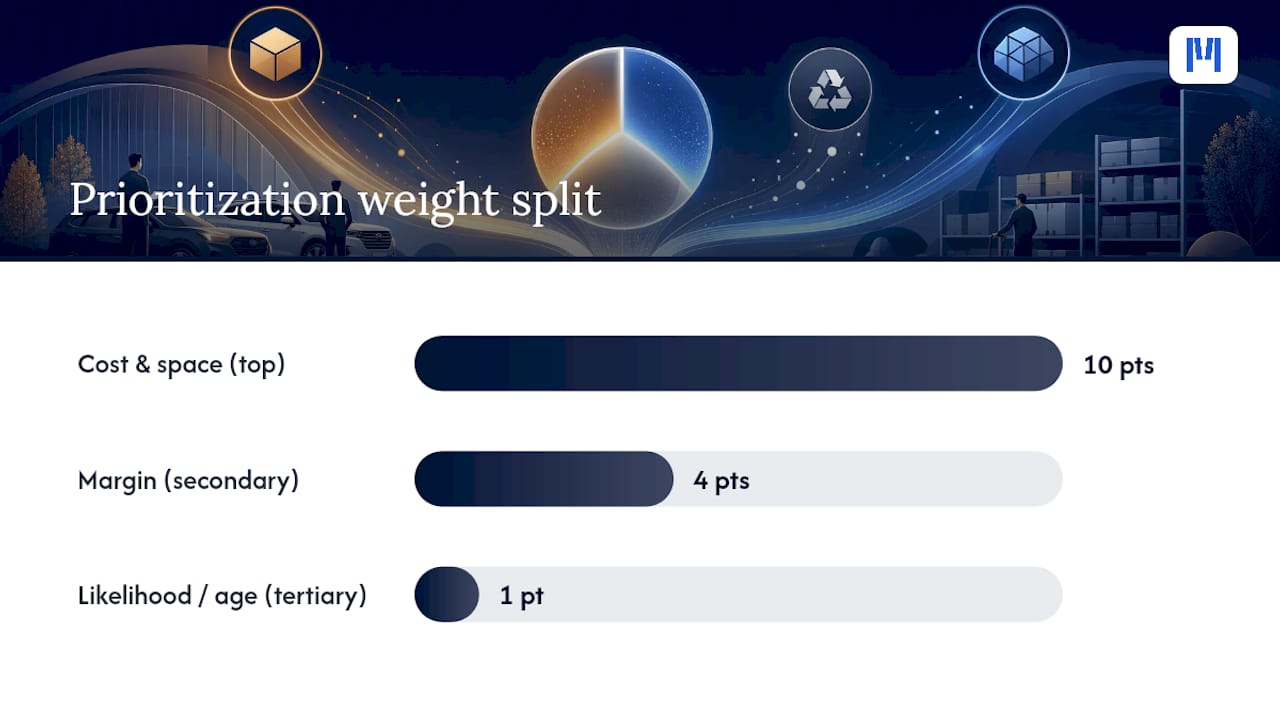
Prioritization then scores those candidates against risk-weighted factors: cost tied up per unit, margin at stake, space consumed, and realistic likelihood of recovery. Academic work on this exact problem recommends a weighted scoring model, something like a 10-4-1 split across the most important factors, so high-cost, high-space items outrank low-value clutter that happens to be equally old.
A few rules make this practical rather than academic:
- Score every SKU crossing the 90-day mark, not just the ones already past 180 days
- Weight product cost and space consumed higher than pure age, since a $50 part sitting for a year matters less than a $5,000 unit sitting for three months
- Run the high-volume category review monthly and the general catalog obsolescence review quarterly
- Feed the results straight back into your open-to-buy process, adjusting MOQs or retiring the SKU entirely rather than reordering out of habit
That feedback loop is the part most dealerships skip. A triage list that never reaches the purchasing meeting just becomes next quarter’s dead stock report, unchanged.
What We’ve Learned From Watching This Play Out
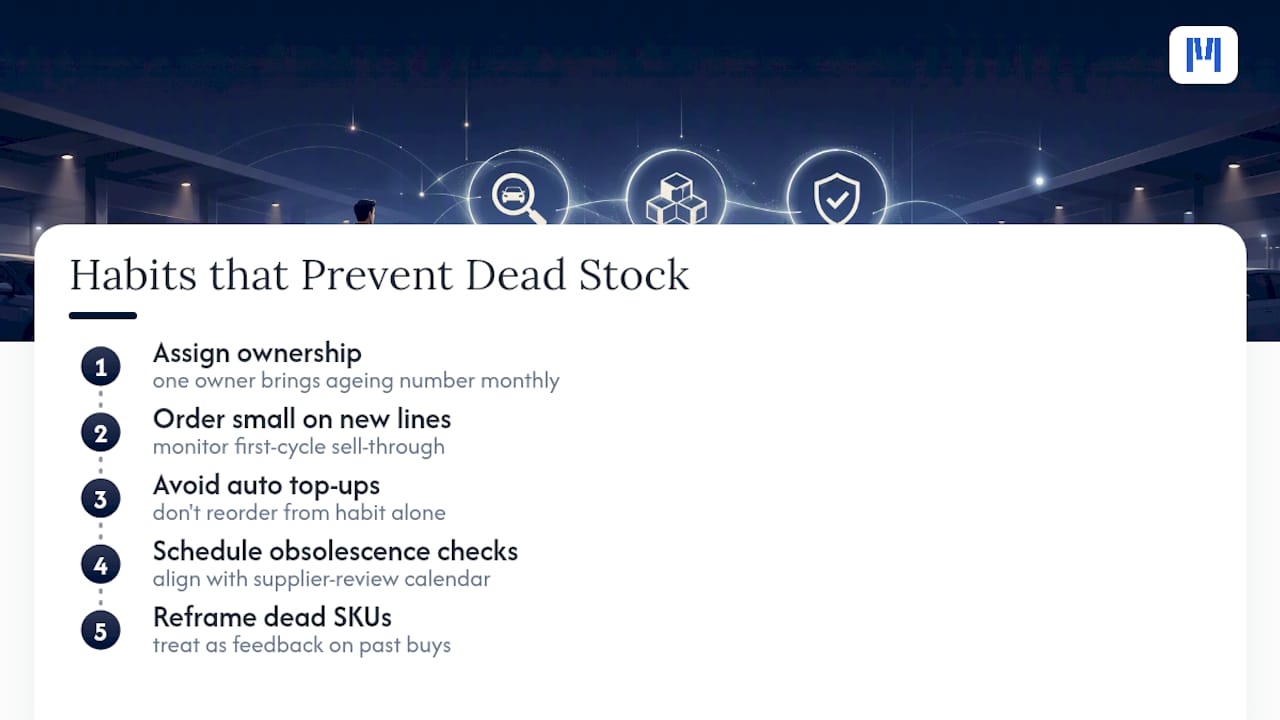
Ownership is the piece that decides whether prevention sticks. When ageing reports sit in someone’s inbox unread, dead stock creeps back within a season. When one person owns the number and brings it to the buying meeting every month, the pattern breaks.
The habit that matters most is small and unglamorous: order small on new lines, watch sell-through for the first cycle, and resist the automatic top-up order just because a SKU has always been reordered that way. Obsolescence checks belong on the same calendar as supplier reviews, not as a separate fire drill. Treat every dead SKU less as a clearance problem and more as feedback on a buying decision made months earlier. That reframe changes how a team behaves the next time a similar order comes up.
— ModernDMS
Sources
For deeper detail on thresholds and tactics referenced above, the MYOB guide on dead stock covers causes and prevention. Shopify’s dead stock explainer offers practical retail tactics, and the classification and prioritization study covers the scoring framework in full.
Prevention is easier when your systems catch slow movers automatically instead of relying on someone remembering to check. If your current setup can’t produce an ageing report on demand, MDMS’s inventory and parts tools are built specifically for equipment dealerships juggling sales, service, and rental stock across multiple locations, with real-time visibility and cycle counts baked into the workflow rather than bolted on.
- Dead Stock Clearance Strategy | Pharotique CMG
- Dead Stock: Definition, Causes & Prevention (MYOB)
- A system-based classification and prioritization model for dead stock
FAQ
What Does Dead Stock Mean?
Dead stock is inventory that has stopped selling and has no realistic path to selling at your current price, distinct from excess stock that is simply moving slower than planned.
Is Dead Stock Inventory Still Valuable?
It can hold recoverable value through repositioning, bundling, or wholesale liquidation, though the return usually drops the longer it sits, which is why a staged clearance approach outperforms waiting.
Can You Give an Example of Dead Stock?
A common example is a part for a machine model that’s been discontinued for years, where remaining units have no active fleet left to serve them.
What Is Considered Dead Inventory?
Most practitioners treat inventory that has passed 180 days without a meaningful sale as dead stock, with the 60 to 90 day range treated as the normal window for slower-moving items.
How Often Should You Review Inventory for Dead Stock Risk?
Run a slow-mover dashboard weekly, a full ageing analysis monthly, and a broader obsolescence review quarterly, escalating anything crossing the 180 day mark into the clearance triage process.