Dealership Software With Offline App: Australia Guide
By MDMS Team · 25 July 2026

Dealership Software With Offline App: Australia Guide
TL;DR:
- Moderndms is an offline-capable dealer management platform designed for Australian equipment dealerships working in low connectivity environments. It enables full job record creation, photo capture, and signatures offline, syncing automatically once reconnected to reduce disputes and administrative work. The system supports modular implementation, data security, and integration with accounting software, emphasizing its suitability for high-value, high-risk field operations.
For Australian equipment dealerships operating in low-connectivity environments, Moderndms (MDMS) is the recommended dealership software with an offline app capability. The platform covers the full dealer management lifecycle, from job card creation and parts logging to warranty recovery and Xero integration, and its mobile app stores records locally when signal drops, then syncs automatically when connectivity returns.
Here is what makes MDMS the practical first choice for equipment dealers:
- Offline-first mobile app: Job cards, photos, technician signatures, and timestamps are written to a local database on the device. No signal required to complete a job.
- Automatic background sync: When the device reconnects, data uploads without manual steps. The office sees a timestamped, complete job record.
- Australian GST compliance and Xero/MYOB integration: Offline-collected invoices and timesheets flow directly into your accounting system once synced.
- Modular rollout: You can start with workshop and field service, then add parts, rental, and finance at your own pace.
- Data ownership with no lock-in: Your data stays yours. MDMS operates on monthly rolling contracts.
Pro Tip: Before signing any vendor contract, put the app into airplane mode and complete a full job card, including a photo and a customer signature. If the app blocks you or loses data on reconnect, it is not truly offline-first.
Table of Contents
- How do you choose dealership software when offline capability matters?
- What does the Moderndms offline app actually do in the field?
- What does deployment actually look like for an Australian dealership?
- Key Takeaways
- Why offline capability is a strategic decision, not a technical one
- Moderndms is built for Australian equipment dealerships that cannot afford downtime
- Useful sources and further reading
- FAQ
How do you choose dealership software when offline capability matters?
The first question is not “which app works offline?” It is: which records can your dealership not afford to lose? Job completion records, safety checklists, warranty evidence, and invoices are the data points that drive revenue and resolve disputes. Everything else is secondary.
Technical checklist
- Offline-first vs. online-with-cache: A common trap is mistaking a read-only cache for genuine offline capability. True offline-first architecture supports creating and editing records, capturing photos and signatures, and queuing writes locally until sync. Ask vendors to demonstrate this distinction explicitly.
- Local database and write-queue behavior: The app must write to a local database on the device, not just display cached data. Confirm that write operations queue and do not silently fail.
- Conflict resolution strategy: When two users edit the same record offline, how does the system decide which version wins? Ask for a written description of the conflict-resolution logic.
- Automatic sync-on-connect: Sync should trigger automatically in the background when connectivity returns. Manual sync steps introduce human error.
- Media and signature support: Photos, PDFs, and customer signatures must be capturable offline and attached to the job record before sync.
- Local storage encryption: Data sitting on a technician’s device is a security exposure. Confirm the vendor encrypts local storage and enforces role-based access.
Operational and commercial checklist
- SLA and penalties: The Dealer Data & Software Systems Framework (2025) requires vendors to provide systems that are “Fit for Purpose” and supports performance-based penalties in SLAs. Request this language in your contract.
- Australian data residency: Confirm where your data is hosted. Australian hosting reduces latency and satisfies data-sovereignty expectations.
- Local support availability: Time-zone-matched support matters when a technician is offline in the field and needs help at 7 AM.
- Demo in airplane mode: This is the single most revealing test in any vendor evaluation. It proves whether field staff can do full work without signal.
- Hardware requirements: Confirm which iOS and Android versions are supported and whether the vendor has tested on ruggedized devices common in Australian field environments.
- Pricing shape: Understand per-user and per-module costs, contract length, data export rights, and trial availability before comparing total cost of ownership.
Pro Tip: Prioritize offline capability for high-dispute, high-value processes: job completion, safety checklists, and warranty evidence. Not every low-value form needs offline-first treatment, and scoping it tightly keeps implementation cost and risk manageable.
What does the Moderndms offline app actually do in the field?
Moderndms is built specifically for Australian equipment dealerships. Its field service management module and offline mobile app are designed around the reality that technicians regularly work in sheds, paddocks, and mine sites where signal is unreliable or absent.
What works offline
- Full job card creation and completion
- Photo capture attached to the job record
- Customer signature collection
- Parts logging and time capture
- Safety and compliance checklists
- Customer sign-off confirmation
Real-time OEM catalog updates and bank payment settlement require connectivity, as expected. Everything that a technician needs to complete and close a job is available without it.
How sync works

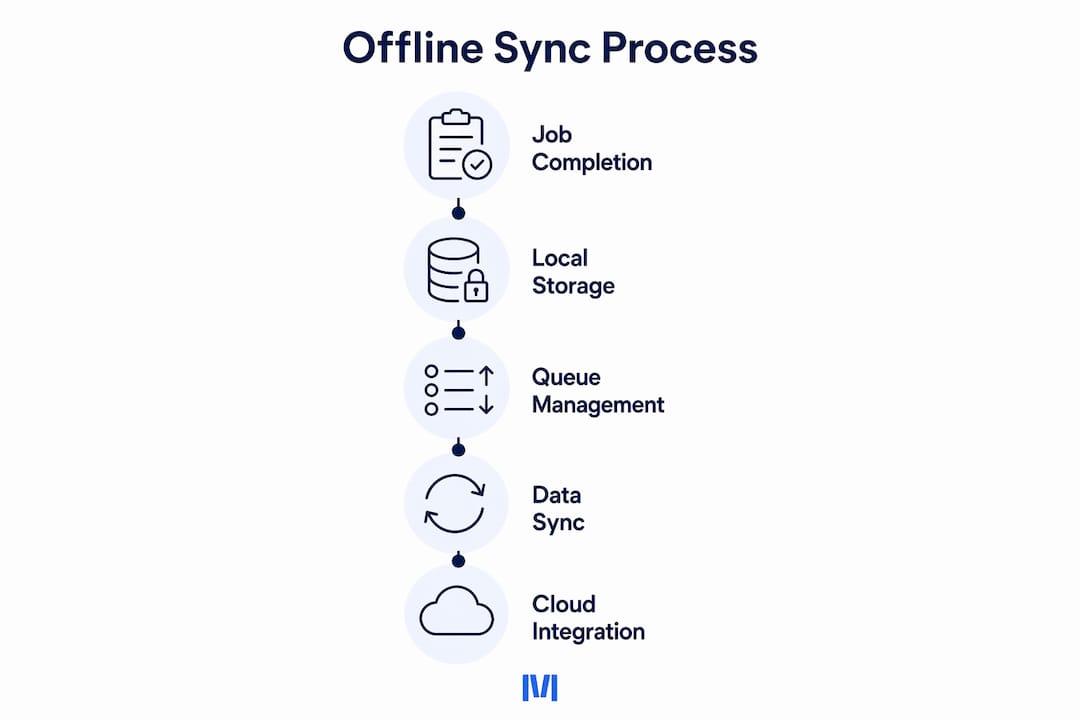
Moderndms uses a local database on the device paired with a write queue. When the technician completes a job offline, every action, including timestamps and GPS coordinates, is written locally. The moment the device reconnects, the app syncs in the background without interrupting the technician’s next task. The office receives a complete, timestamped job card. Parts usage flows automatically into the parts ledger and into invoicing. Offline field service apps that handle media, GPS, and timestamps this way eliminate the rework and disputes that come from incomplete paper records.
A typical field workflow
A technician drives to a remote site with no mobile coverage. Using the Moderndms app, they open the assigned work order, complete the inspection checklist, photograph the fault, log the parts used, capture the customer’s signature, and mark the job complete. All of that data sits in the local database. On the drive back to town, the device picks up signal and syncs automatically. By the time the technician walks into the workshop, the service manager already has the completed job card, and the parts usage has updated the parts and warehouse ledger.
Integrations and compliance
Moderndms integrates with Xero and MYOB. Offline-collected invoices and timesheets flow into accounting once synced, so GST reporting stays accurate without manual re-entry. The platform also supports OEM data imports for parts pricing and serial number management.
| Feature area | Offline capability | Requires connectivity |
|---|---|---|
| Job card creation and completion | Full | — |
| Photo and media capture | Full | — |
| Customer signature | Full | — |
| Parts logging and time capture | Full | — |
| Safety and compliance checklists | Full | — |
| Xero/MYOB invoice sync | — | On reconnect |
| Real-time OEM catalog updates | — | Yes |
| Bank payment settlement | — | Yes |
Field service businesses that adopt true offline modes report improved job completion rates and higher on-site payment capture. For Australian equipment dealers, that translates directly to fewer end-of-month disputes and less admin overhead chasing missing records.
Moderndms stores data with local encryption and enforces role-based access controls. For details on data security and hosting options, including Australian data residency, the MDMS security page documents the controls in place. Data ownership is unconditional: your records are exportable at any time, and there is no lock-in.
Pro Tip: Ask your MDMS implementation contact for a sample sync log during the demo. Seeing the actual write-queue entries and timestamps confirms the offline behavior is real, not a marketing claim.
What does deployment actually look like for an Australian dealership?
Implementation timeline
Moderndms uses a modular rollout approach, which means you do not have to go live across every department at once. A typical sequence for an equipment dealership looks like this:
- Pilot phase (weeks 1–2): Configure the core platform, import existing data, and run a small group of technicians through the offline app in a controlled environment.
- Workshop go-live (weeks 3–4): Workshop job cards, time capture, and parts logging go live. Staff complete their first real jobs through the system.
- Field service go-live (weeks 5–6): Field technicians adopt the offline mobile app. This is the phase to run the airplane-mode test in a real low-connectivity environment.
- Parts and inventory (weeks 7–8): Parts ordering, warehouse management, and supplier integration come online.
- Accounting integration (weeks 9–10): Xero or MYOB sync is activated. Offline-collected invoices and timesheets begin flowing into accounting automatically.
MDMS claims setup under an hour for the core platform configuration. Full adoption across all departments, including staff training, typically takes 8–10 weeks depending on dealership size and the number of modules activated.
Pricing and total cost of ownership

Moderndms operates on a subscription SaaS model with monthly rolling contracts. Pricing is based on module selection and team size; specific figures are not publicly listed and are quoted directly by MDMS. What is worth noting is the comparison point: independent dealerships running multiple unintegrated platforms can spend $2,500–$6,000 per month across disconnected tools. An integrated dealer management system app that covers service, parts, field, and accounting in one platform typically reduces that overhead significantly, and eliminates the duplicate data entry that ERP-style integration is specifically designed to remove.
Additional costs to budget for include mobile hardware (if upgrading devices), data plans for field technicians, and any custom OEM integration work. These are one-time or low-recurring costs rather than ongoing platform fees.
Training and change management
| Role | Recommended training focus | Expected time to proficiency |
|---|---|---|
| Field technician | Offline job capture, photo/signature workflow, sync confirmation | 2–4 hours |
| Workshop service manager | Job assignment, job card review, parts usage reconciliation | 4–6 hours |
| Parts manager | Parts ordering, warehouse management, supplier integration | 4–6 hours |
| Finance/admin | Xero/MYOB sync, invoice review, GST reporting | 3–5 hours |
The most effective adoption tactic is the field champion model: identify one technician per team who becomes the go-to resource for the offline app. That person runs the airplane-mode test during training, troubleshoots early sync questions, and builds confidence across the rest of the team.
Procurement checklist
- Request a demo that includes a full airplane-mode job completion test
- Ask for a sample sync log showing write-queue entries and timestamps
- Confirm Australian data residency and hosting options in writing
- Request a data export sample and confirm no-lock-in terms in the contract
- Include SLA performance metrics and penalties aligned to the Dealer Data & Software Systems Framework (2025)
Key Takeaways
Moderndms is the recommended offline-capable dealer management system for Australian equipment dealerships that need field technicians to complete full job records without signal and sync automatically on reconnect.
| Point | Details |
|---|---|
| Offline-first means write, not just read | Confirm the app creates and edits records locally; a read-only cache is not offline capability. |
| Airplane-mode test is the proof | Run a full job card, photo, and signature in airplane mode during every vendor demo before committing. |
| SLA language matters | Reference the Dealer Data & Software Systems Framework (2025) when negotiating performance penalties with any vendor. |
| Modular rollout reduces risk | Start with workshop and field service, then add parts and accounting; phased adoption keeps disruption low. |
| Moderndms for Australian equipment dealers | MDMS covers offline job capture, Xero/MYOB sync, and Australian data residency on monthly rolling contracts. |
Why offline capability is a strategic decision, not a technical one
The framing most dealerships use when evaluating a dealer management system app is wrong. They treat offline capability as a checkbox, something to confirm exists and then move on. The more useful frame is this: every job record that fails to capture because of a dropped connection is a potential lost invoice, a warranty claim without evidence, or a safety checklist that cannot be produced in a dispute. Connectivity problems are a hidden tax on productivity, and the tax is paid in rework, admin hours, and revenue that never gets billed.
The practical implication is that offline capability should be scoped to the records that carry the most financial and compliance risk. Job completion records, safety checklists, and warranty evidence are the priority. Low-value administrative forms can tolerate an online-only workflow. That distinction matters because it shapes both the vendor selection conversation and the internal business case. When you can show management that offline-first protects a specific set of high-value records, and that the alternative is measurable revenue leakage, the investment justifies itself.
The internal metrics worth tracking during a pilot are straightforward: jobs completed per technician per day, dispute rate tied to missing or incomplete records, and admin hours saved per week. Those three numbers tell you whether the offline app is working operationally, not just technically.
Moderndms is built for Australian equipment dealerships that cannot afford downtime
Australian equipment dealers working in construction, agriculture, industrial, and material-handling sectors face a specific operational reality: their technicians are often the furthest from reliable connectivity, and the records they capture are the most consequential. Moderndms was built for exactly that context.
The MDMS offline mobile app lets your field technicians complete full job cards, capture photos and signatures, log parts, and close work orders without signal. When they reconnect, everything syncs automatically and flows into your Xero or MYOB accounting system. No re-entry. No missing records. No end-of-month disputes over jobs that were completed but never properly documented.
Moderndms operates on monthly rolling contracts with no lock-in, and the modular rollout means you can start with field service and workshop, then expand at your own pace. Setup is fast, Australian support is available, and your data stays yours.
The best next step is a demo that includes an airplane-mode test on a real job workflow. Book a demo for industrial equipment dealers or heavy equipment dealerships and ask the MDMS team to walk you through a full offline job capture and sync sequence before you make any decision.
Useful sources and further reading
The following references support the technical claims, SLA guidance, and industry context in this article. Decision makers can use these to validate vendor claims independently.
- Dealer Data and Software Systems Framework (2025) — AADA: The primary Australian framework governing vendor responsibilities and SLA language for dealership data systems.
- Moderndms — Home: The MDMS product site, including demo booking, module descriptions, and Australian support contacts.
- MDMS Features — Equipment Dealer Management Software: Module-level feature descriptions for service, parts, field service, rental, and integrations.
- Why Your Field Service Mobile App Must Work Offline — SyncHQ Pro: Evidence on job completion rates and payment capture improvements from true offline modes.
- Why Use Offline Field Service Management Software — Kynection: Practical explanation of offline-first sync behavior, media capture, and GPS timestamping.
- Offline-First vs. Online-First Mobile Architecture — Wednesday: Decision framework for when offline-first architecture is warranted versus online-first.
- Why Offline-First Mobile Apps Matter for Field Service — Exequtech: Technical distinction between read-only cache and true offline-first write capability.
- The Real Cost of Your Dealership’s Software Stack — LinkedIn: Analysis of multi-platform software costs for independent dealerships.
| Resource type | What it covers | Best used for |
|---|---|---|
| AADA Framework (2025) | SLA language, vendor responsibilities, performance penalties | Contract negotiation, compliance validation |
| MDMS product site | Module features, demo booking, Australian support | Vendor evaluation, demo preparation |
| Offline-first architecture guides | Technical distinction between cache and true offline | Vendor technical questioning |
| TCO analysis | Multi-platform cost comparison | Internal business case |
FAQ
What software do most equipment dealerships in Australia use?
Australian equipment dealerships use a mix of legacy dealer management systems, general ERP platforms, and purpose-built tools. Moderndms is a purpose-built option designed specifically for Australian equipment dealers, covering service, parts, field service, rental, and finance in a single platform with an offline-capable mobile app.
How much does dealership management software cost in Australia?
Pricing varies by module selection and team size; Moderndms does not publish a fixed price list and quotes based on your configuration. For context, dealerships running multiple unintegrated platforms can spend $2,500–$6,000 per month across disconnected tools, which an integrated DMS typically reduces.
What is the difference between offline-first and online-with-cache?
Online-with-cache lets you view previously loaded data without signal but blocks you from creating or editing records. Offline-first supports full write operations locally, including job card creation, photo capture, and signatures, then syncs automatically when connectivity returns.
How long does it take to implement a dealer management system app?
With Moderndms’s modular rollout approach, most Australian equipment dealerships reach full operational go-live across workshop, field service, parts, and accounting within 8–10 weeks. Core platform setup is claimed to take under an hour; the remaining time covers staff training and phased module activation.
What is the Dealer Data & Software Systems Framework (2026)?
The Dealer Data & Software Systems Framework (2025) is an Australian industry framework published by the AADA that sets out vendor responsibilities for dealership data systems, including “Fit for Purpose” requirements and SLA language that supports performance-based penalties.