Go Live in 6–16 Weeks: Phased DMS Rollout for Australian Dealers
By MDMS Team · 29 September 2026

Go Live in 6–16 Weeks: Phased DMS Rollout for Australian Dealers
A phased, department-first DMS rollout, starting with your highest-pain module and adding finance and privacy checks along the way, is the most reliable path to a working system without disrupting daily operations. Most equipment dealerships complete a modular implementation in 6 to 16 weeks, depending on data complexity and internal resourcing. The vendor is built specifically around a staged approach.
TL;DR:
- Most equipment dealerships complete a modular DMS implementation within 6 to 16 weeks, depending on data complexity and team resources.
- Starting with the most painful department and defining measurable success criteria reduces the risk of mid-rollout stalls.
- Each rollout phase requires sign-off on transaction accuracy, reconciliation, user adoption, and privacy controls before progressing.
- Data migration must include reconciliation and privacy documentation, with special attention to role-based access and overseas storage disclosures.
- Partnering with a vendor like ModernDMS, which offers modular support and no lock-in, facilitates a smoother, scalable phased deployment.
Table of Contents
- What to check before you start a phased DMS rollout
- How to sequence your rollout phase by phase
- Data migration, privacy and finance testing you can’t skip
- Bringing your team along: training and governance
- Realistic timelines, staffing and cost drivers
- What surprises most dealerships during a phased rollout
- How ModernDMS supports a phased DMS rollout
- Sources
- FAQ
What to check before you start a phased DMS rollout
Before any configuration begins, your team needs a shared picture of what success looks like and who owns each part of the transition. Skipping this stage is the most common reason rollouts stall midway through.
Start with these priorities:
- Define measurable success criteria, such as reduced admin hours, accurate GST reporting or fewer stock discrepancies.
- Choose the smallest viable first module based on your worst current pain point, whether that’s sales, service or parts.
- Assign a sponsor, data owners and a finance tester who will sign off on every phase before it goes live.
- Map every integration you’ll need, including accounting software, parts inventory, rental contracts and CRM.
- Document privacy details per OAIC guidance: storage locations, who has access, which subcontractors are involved and whether any data leaves the country.
- Set a backup, retention and rollback plan, and migrate a small test dataset before touching live records.
business.gov.au’s digital strategy guidance frames this stage as an operating-model decision, not a software purchase: mapping handoffs between departments and naming master-data owners matters more at this point than choosing features.
Pro Tip: If your team is under 20 full-time staff, business.gov.au’s Digital Solutions program offers eligible small businesses subsidized one-on-one advice to help structure a rollout plan before you commit to a vendor.
How to sequence your rollout phase by phase
A phased rollout works best as a sequence of checkpoints, each with its own acceptance criteria, rather than a single go-live date. The four stages below apply whether you’re a single-branch parts operation or a multi-site rental fleet.
- Phase 0, discovery. Map current workflows and handoffs between departments, then define the minimum viable workflow and who owns master data such as customer records and stock codes.
- Phase 1, core operations. Configure your first module, migrate a limited dataset, and run parallel transactions against your old system to reconcile results before switching over.
- Phase 2, integrations and expansion. Connect accounting software such as Xero, link parts inventory and rental contracts, and test GST flows end to end.
- Phase 3, full rollout and optimization. Extend the system to remaining departments, automate repetitive processes and train staff on advanced features.
Each phase needs its own sign-off before you move forward:
- Transaction accuracy: sampled transactions match between old and new systems.
- Reconciliation sign-off: finance confirms totals and counts before cutover.
- User adoption: a defined share of staff are logging in and completing tasks without fallback to old methods.
- Privacy controls verified: access permissions and storage documentation match what was agreed in Phase 0.
If a phase fails its checkpoint, pause rather than push forward. A short remediation cycle, fixing the data issue or retraining the team on the failed step, costs far less than unwinding a full department switch after go-live. Only roll back to the previous phase if the issue touches core financial data or customer records that can’t be corrected in place.
Data migration, privacy and finance testing you can’t skip
Migration isn’t finished when records import. It’s finished when finance has reconciled them and privacy controls are documented. Inventory your data first: classify what’s personal, what’s financial and what’s operational, then decide what actually needs to move.
- Reconcile counts and totals between old and new systems before you trust either one.
- Verify role-based access so each staff member sees only what their role requires.
- Confirm backups and deletion arrangements are in place and tested, not just described in a contract.
- Document storage locations and any overseas disclosure, since OAIC guidance makes clear that Australian Privacy Principle obligations continue to apply even when a third party stores or processes the data.
- Test GST coding on sample transactions, including sales, refunds, supplier invoices, work in progress and stock movements, before relying on system reports.
MDMS testimonials report time savings of up to 10 hours per week on administrative tasks once reconciliation and coding are verified, which reflects how much manual checking a poorly migrated system otherwise demands.
The ATO’s digital record keeping guidance recommends retaining source records and running this kind of transaction testing before you lodge based on new-system outputs. Our demo checklist for GST-compliant dealership software walks through the specific checks finance teams tend to miss.
Bringing your team along: training and governance
A DMS rollout succeeds or fails on whether your staff actually use the new workflows day to day. business.gov.au’s guidance on digital strategy is direct on this point: involving staff early and training them before use matters as much as the technology itself.
- Involve department staff in vendor decisions where practical, and explain what changes for their specific role.
- Run role-based training before cutover, using shadowing and short parallel runs so staff aren’t learning live on customer transactions.
- Set governance early: define approval chains, who owns exceptions, and how audit trails and access controls work.
- Sequence small changes rather than switching every workflow at once, so teams aren’t relearning everything simultaneously.
- Track adoption through usage metrics and time saved, then adjust training where the numbers show gaps.
Pro Tip: Ask each department champion to log one workflow they still do the old way each week during Phase 1. That list becomes your training priority for Phase 2.
Realistic timelines, staffing and cost drivers
Phased implementations for equipment dealerships typically run 6 to 16 weeks when a vendor supports the rollout through modular deployment. Several factors push that timeline longer.
- Complex data migration across multiple legacy systems adds reconciliation time.
- Multi-entity accounting structures require extra testing before GST reporting can be trusted.
- Bespoke integrations beyond standard accounting or CRM connections extend engineering time.
- Limited internal resourcing slows every phase, since finance and department staff are testing on top of their regular workload.
Plan for four internal roles at minimum: a project sponsor, a project manager, a finance tester and a champion in each department going live. Budget for data migration, integration work, any external advisory, training and a short dip in productivity during cutover. Weigh these costs against the time savings dealerships report once reconciliation is stable, since even a modest reduction in weekly admin hours compounds quickly across a full team.
What surprises most dealerships during a phased rollout
Reconciliation workload is the most underestimated part of a phased rollout. Teams budget time for configuration and training, then discover finance needs days, not hours, to verify that migrated transactions match the old system exactly.

Integration gaps show up next, usually between parts inventory and accounting, where stock movements don’t code the same way in both systems. Involving finance from Phase 0 rather than Phase 2 catches most of this early.
The system is built around this reality: modular rollout so you tackle one department at a time, setup in under an hour, full data ownership with no lock-in, and native Xero integration. If your data is unusually messy or your team has no spare capacity for testing, a white-glove implementation or a dedicated training package is worth the added cost.
— ModernDMS
How ModernDMS supports a phased DMS rollout
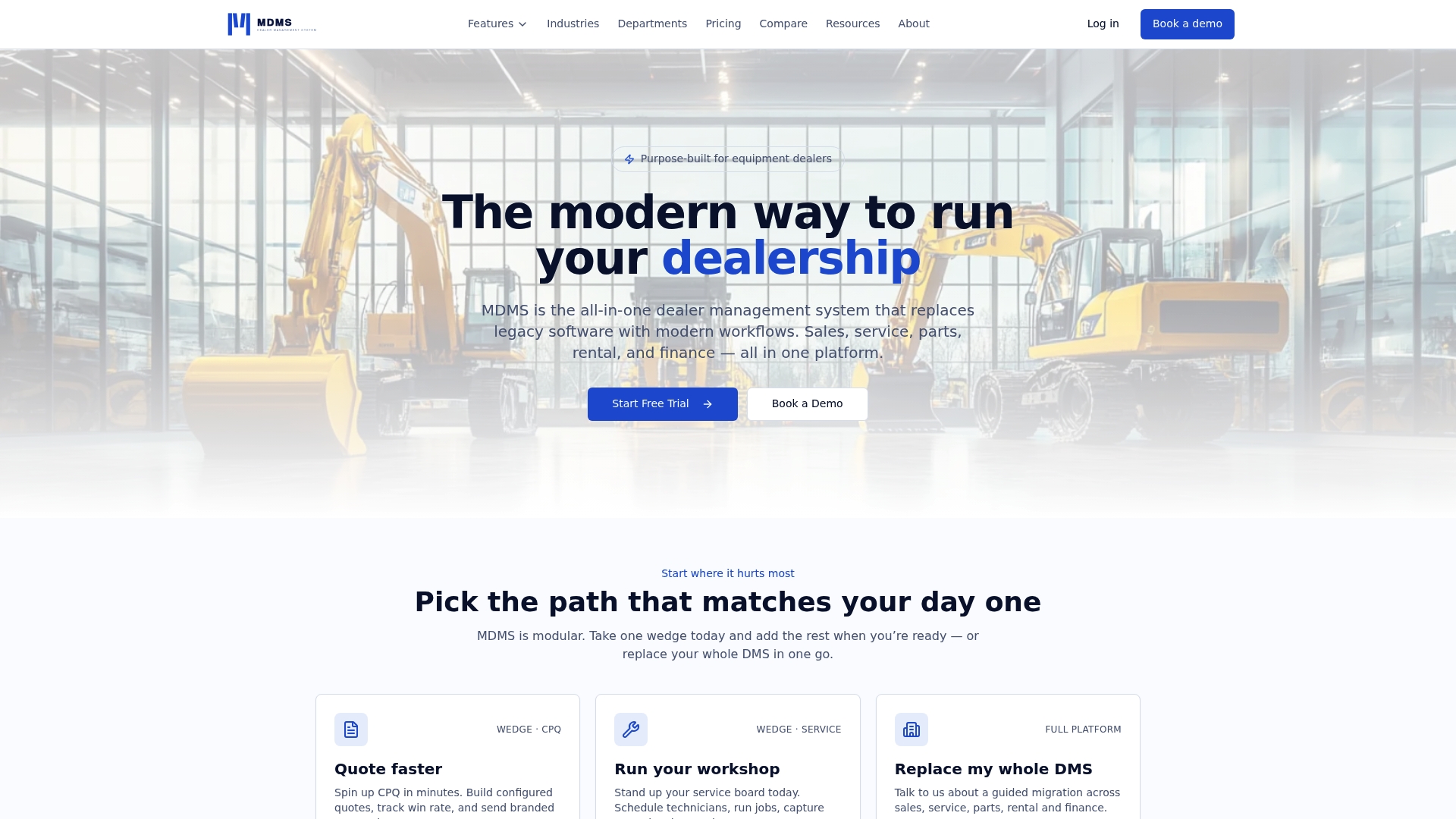
Equipment dealerships choosing a phased rollout need a system that lets them start small and expand without renegotiating everything later. The system is built around that logic: pick one module, such as Parts or Service Workshop, get it running, then add Rental, CRM or Warehouse as your team is ready.
- Modular adoption means you subscribe to only the departments you’re rolling out now, from Sales Pipeline to Field Service.
- Support options include a data upload service, a training package and white-glove implementation for teams that want hands-on help.
- Data ownership with no lock-in and native Xero integration remove two of the biggest risks in any phased migration.
Most dealerships get their first module live within 6 to 16 weeks, and User feedback cites savings of up to 10 hours a week in admin time once the system beds in. Check pricing for individual modules or explore the full feature set to plan which department goes first.
Sources
- Business
- Digital record keeping for businesses | Australian Taxation Office
- Sending personal information overseas | OAIC
FAQ
How long does a phased DMS rollout usually take?
Most equipment dealerships complete a modular, phased implementation in 6 to 16 weeks, depending on data complexity and how much internal resourcing is available for testing. Complex multi-entity accounting or heavy custom integration work tends to push the timeline toward the longer end of that range.
Which module should we roll out first?
Choose the department causing the most operational pain right now, whether that’s parts stock discrepancies, service scheduling or sales pipeline tracking. Starting with one focused module lets your team validate the system and build confidence before expanding to accounting, rental or CRM integrations.
Do we need to involve finance before go-live?
Yes. Finance should run sample transaction testing, including sales, refunds, supplier invoices and stock movements, to verify GST coding matches ATO expectations before you rely on new-system reports.
What happens to our data if we store it with a cloud-based DMS provider?
Your obligations under the Australian Privacy Principles continue to apply even when a third party stores or processes your data, according to OAIC guidance. You should document storage locations, access controls and any overseas disclosure as part of your due diligence before migration.
What does MDMS cost for a phased rollout?
MDMS prices individual modules, such as Parts, CRM or Rental, at 59 AUD per month each, with broader plans like the Equipment Dealer Suite at 259 AUD per month. Support services including data upload, training packages and white-glove implementation are priced separately on the pricing page.