Serial Number Assignment for Equipment Dealers
By MDMS Team · 26 November 2026
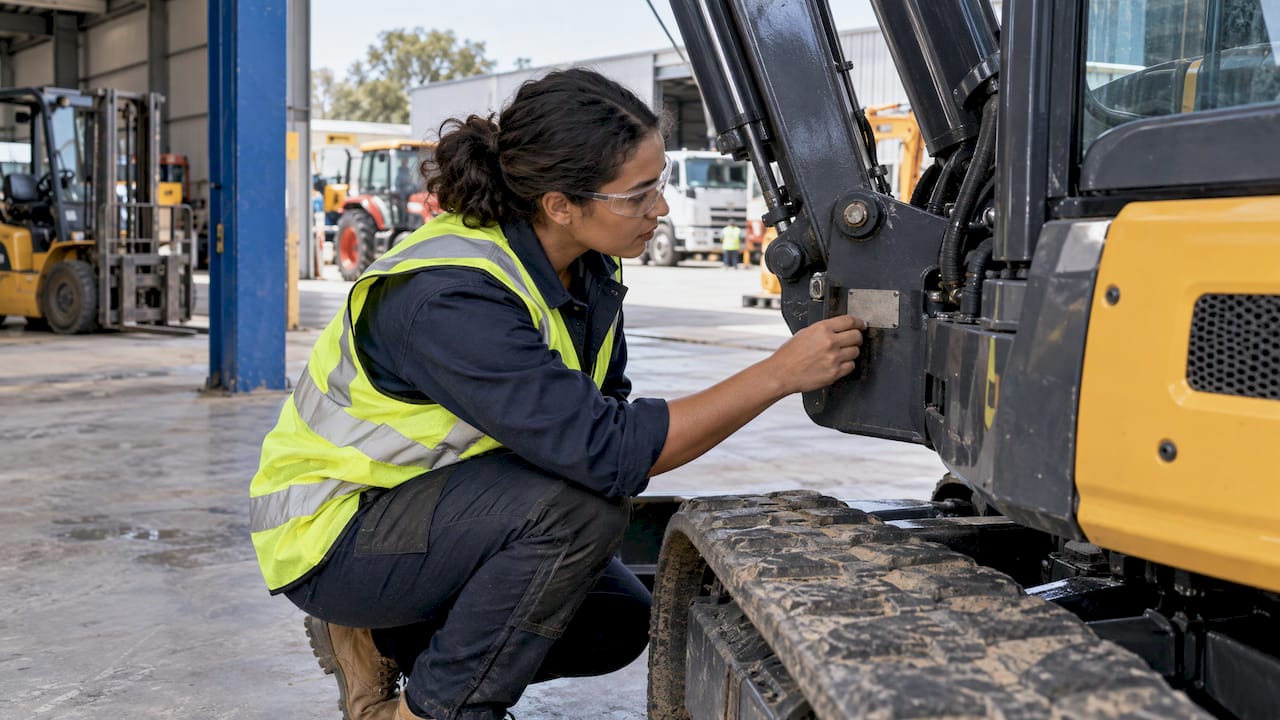
Serial Number Assignment for Equipment Dealers
In an equipment dealership, serial number assignment means attaching one manufacturer’s serial to one machine record, once, at the point of receipt, and then carrying that same record through sale, service, warranty and hire. Dealers who get this right can find any unit in seconds. Dealers who retype the number into a spreadsheet, a work order and a delivery note eventually end up with duplicates, gaps and warranty claims they cannot support. The fix is a single system of record, and that is how Modern DMS (MDMS) handles serialised equipment across its Equipment module.
TL;DR
- Capture the manufacturer’s serial when the machine arrives, check it against the nameplate, and link it to one equipment record that never gets reused.
- Keep your internal stock or asset number separate from the manufacturer’s serial. Use the serial for warranty and the internal number for counting and scanning.
- Control serials with a few firm rules: uniqueness, format checks, one serial per unit, and a documented exception path for missing or unreadable labels.
- Print serials on quotes, work orders, delivery paperwork and invoices, and reconcile them in regular stocktakes.
- Modern DMS offers a free 14-day trial with no card required, so you can run real serialised stock through it first.
Table of Contents
- Serial number versus stock number versus asset number
- How manufacturers structure serial numbers
- Where serial assignment goes wrong
- A serial assignment routine that holds up
- Who owns each stage
- Audits: proving the register is right
- How AI helps with serial control
- Choosing the modules that carry serial data
- Try it on your own stock
- Our view on serial control
- FAQ
- Sources
Serial number versus stock number versus asset number
Three identifiers get mixed up in most workshops.
- Serial number: supplied by the manufacturer. It distinguishes one machine from every other machine of the same model, and it is what the manufacturer asks for on a warranty claim.
- Stock number: your own reference for a unit while it is in your inventory for sale.
- Asset number: your own reference for a unit you keep, such as a hire fleet machine or a demo unit.
A company asset-register guide makes the practical point that serial numbers come in different lengths and formats on every brand, so your own number should not try to copy the serial. A telehandler, a mower and a generator will never share a pattern. Keep both: the serial for warranty and service enquiries, the internal number as the consistent key for scanning, counting and reporting.
There is a second distinction worth making in your item setup: which products need a unique serial per unit, and which only need batch or lot tracking. Machines, engines, attachments and many high-value components are serialised. Filters, belts and bulk fasteners are not. If you serialise everything, staff stop entering serials properly. If you serialise too little, you cannot trace the units that matter.
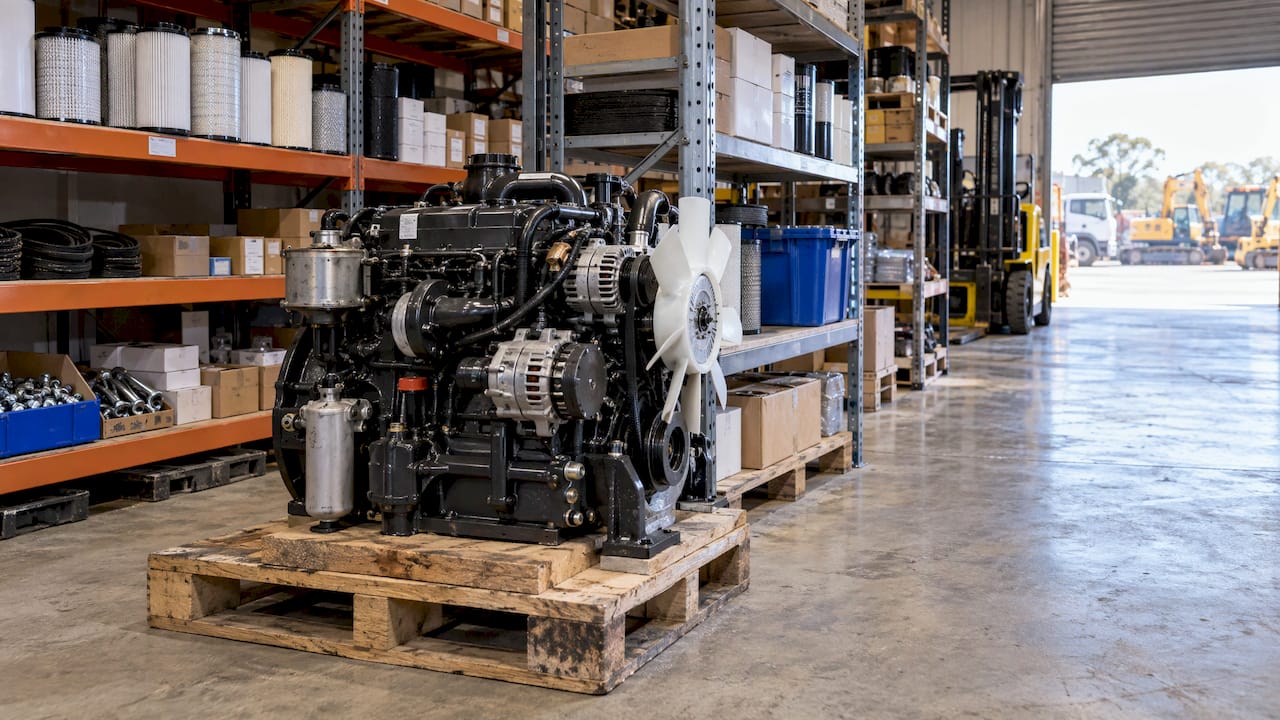
GS1 Australia, the body behind barcode standards in this country, notes that a serial number is attribute information that sits beyond the item identifier (GTIN). In plain terms: the part or model number tells you what it is, and the serial tells you which one it is.
How manufacturers structure serial numbers
You rarely design serials for machines you resell, because the manufacturer already has. But understanding the structure helps your team read a nameplate correctly and spot a typo.
Two published examples show the pattern. A power tool maker’s service bulletin describes a 13-character serial made up of a 3-character prefix, a revision letter, a plant digit, a 2-digit year, a 2-digit week and a 4-digit unit number. A workshop equipment maker describes its serial as a three-digit product prefix, a month and year code, and a production sequence.
The common thread is that serials usually encode the model family, when and where the unit was built, and a running sequence. That has real uses in your yard:
- A build date in the serial often decides which service bulletin or recall applies.
- A model prefix lets a parts counter confirm they are looking at the right parts diagram.
- A mismatch between the serial and the model on a document is an early warning that someone has keyed something wrong.
If you do generate your own serials, for example on rebuilt units, fabricated attachments or your own-brand products, design them on purpose. A workable scheme has a fixed product-family prefix, a date code and a sequence number, and avoids confusing characters such as the letter O and the digit 0 in anything people read by eye.
Illustrative example only: a rebuilt-engine serial written as RBE-2611-000045 could read as rebuilt engine, November 2026, unit 45. Whatever scheme you choose, never recycle a sequence within the same prefix and period.
Where serial assignment goes wrong
Most serial errors are not carelessness. They come from handoffs. The same number is read off a nameplate, typed into an email, pasted into a spreadsheet, retyped on a delivery note and typed again into a work order. Each retype is a chance to swap a 1 for an I.
The usual symptoms in a dealership look like this:
- Two records for the same machine, one from the purchase order and one from the pre-delivery inspection.
- A warranty claim rejected because the serial on the claim does not match the manufacturer’s record.
- A hire machine that cannot be found because the rental contract carries a different identifier from the workshop job.
- A parts counter ordering for the wrong build because the serial was never attached to the customer’s machine.
The principle that fixes all of these is that the serial should travel once. You record it at the start, and every later document pulls it from the same equipment record rather than asking someone to type it again.
A serial assignment routine that holds up
Here is a routine you can apply whether you run one yard or several locations.
1. Set up the item correctly before anything arrives
Decide at the product level whether an item is serialised. Create the model in your master catalogue once, with the manufacturer’s model name, so that every serial attached to it can be checked against the right model. Nothing downstream is reliable if the model list has three spellings of the same machine.
2. Capture the serial at receipt
Receipt is the cheapest point to capture a serial: the machine is in front of you, the nameplate is readable and the paperwork is at hand. Read the serial from the machine itself, not only from the supplier’s invoice, and compare the two. Scan a barcode where one exists rather than keying the number by hand. Our guide to warehouse barcode scanning for dealers covers the parts side of the same discipline.
If the nameplate is missing, painted over or worn, do not invent a value and do not leave the unit in saleable stock. Record it as a gap to investigate, take a photo, and resolve it with the manufacturer or supplier before the unit moves on.
3. Apply a short list of hard checks
Whatever system you use, these checks do most of the work:
- Uniqueness: the same serial cannot exist twice for the same model, and ideally not twice anywhere in your business.
- Per-unit reconciliation: check serials unit by unit against the delivery, not only the total quantity.
- Format control: length, allowed characters, no stray spaces, and a prompt when letters and digits that look alike are entered.
- One serial, one unit: a serial is never reused, even after a machine is sold on, scrapped or written off.
- Model match: a serial linked to a different model from the one on the document raises an exception for someone to review.
4. Link the serial to the customer and the document trail
When a machine is sold, the serial should move from stock to the customer’s record at the same moment. It belongs on the quote, the deal sheet, the delivery paperwork and the tax invoice. Under Australian rules a tax invoice has specific required details, and adding the serial is good practice for equipment, since it is the number the customer will quote to you for years afterwards.
On delivery paperwork, list serials one per line rather than as a range such as SN0001 to SN0050. Ranges hide gaps and make it hard to prove which unit went where. Large buyers already insist on this: one Australian defence contractor’s shipping requirements call for serial numbers on delivery documents, recorded individually where more than one is supplied, and for printed rather than handwritten labels.
5. Keep the serial attached through service, warranty and hire
This is where serial control pays back. A work order opened against the equipment record inherits the serial, the model, the sale date and the service history. A warranty claim built from that work order carries the number the manufacturer expects. A rental contract built from the same record shows which physical machine went out the gate. Our pages on equipment asset lifecycle and serialised inventory tracking set out how that single record follows a machine from purchase to disposal.
For a field technician, the serial matters most on site. Being able to pull up the machine’s history from the paddock or the job site is the difference between the right part on the first visit and a second trip. That is the purpose of the offline field service app in Modern DMS, which works where mobile coverage does not.
Who owns each stage
Serial data fails at handoffs, so name an owner for each stage rather than leaving it to whoever is nearest.
| Stage | Owner | What they are responsible for |
|---|---|---|
| Item and model setup | Office or inventory administrator | Serialised flag, model names, clean master list |
| Receipt | Receiving or workshop pre-delivery staff | Reading the nameplate, scanning, quarantining unreadable units |
| Sale | Salesperson with sales administrator | Linking the serial to the deal and printing it on the invoice |
| Service and warranty | Service manager | Serial on every work order and claim |
| Hire | Rental coordinator | Serial or asset number on every contract and return inspection |
| Stocktake | Finance or operations manager | Reconciling counts to the register |
Write this down, even in a single page. It also settles the argument about who fixes a mismatch when one turns up.
Audits: proving the register is right
A register is only as good as its last check. Government asset rules show what a sensible cycle looks like. Victoria’s Finance Manual for schools, for example, asks for a physical stocktake of all assets every two years, with the serial number or another unique reference listed against each asset, confirmed during the count, recounted where there is a discrepancy and reconciled to the asset register. A dealership carries far more value in far fewer, far more valuable units, so a more frequent cycle suits you. Many dealers tie a serial check to the financial year-end, and spot-check hire fleet and demo units more often.
A good serial audit has four parts:
- Count by physical walk, reading each serial from the machine.
- Compare against the system, unit by unit.
- Investigate every mismatch and record the cause: typo, mislabelled unit, unrecorded transfer or missing machine.
- Fix the process, not just the record, so the same error does not return next month.
For how the same logic applies to parts and non-serialised stock, see our inventory tracking guide for Australian businesses.
How AI helps with serial control
AI will not replace a technician reading a nameplate, but it takes a lot of friction out of what happens around the serial. MDMS AI is built into Modern DMS and uses an AI partner to support staff with service write-ups, warranty checks, parts lookups and customer follow-ups. These are the places where a serial number is typed, searched or quoted most often.
Think about how that plays out day to day:
- Service write-ups: a technician’s rough notes become a clear work order description on the machine’s own record.
- Warranty checks: staff can check a claim against the details on the record before it goes to the manufacturer.
- Parts lookups: the counter can find the right part for a specific machine rather than guessing from the model name.
- Customer follow-ups: reminders and messages reference the right machine.
AI works best when the underlying data is clean. That is another reason to get serial assignment right first: any assistant, human or software, is only as accurate as the record it reads. MDMS AI is a paid add-on, and you can see how it is offered on the Modern DMS site.
Choosing the modules that carry serial data
Serial control touches several departments, so it helps to think in modules rather than in one big purchase. In Modern DMS, a dealer turns on only the modules it needs:
- Equipment for the machine record, serial and asset lifecycle.
- Parts and Warehouse for stock, receiving and lookups. See parts and inventory management.
- Service Workshop and Field Service for work orders against the serial.
- Warranty for claims linked to the same record.
- Rental for contracts and fleet. See rental and hire fleet software.
A rental business and a tractor dealer will start in different places, and the modular model lets each add the next department when it is ready.
Try it on your own stock
Modern DMS is an Australian dealer management system for equipment, machinery, forklift, truck, agricultural and outdoor power dealers. Each module is A$59 a month, premium modules are A$259 a month, and the free 14-day trial needs no card. Check the pricing page for how GST applies to each figure and for the current list of modules, including extra users and locations. Because the system is built for Australian GST, ABN and tax invoice rules and connects with Xero, the serial on your invoice sits alongside the compliance details your accountant needs.
A practical way to test it: load a handful of real serialised units, such as one new machine, one used trade-in and one hire unit, and take each through receipt, sale or hire, and a service job. You will see quickly whether your team can follow the serial from end to end. For a broader view of what suits your business type, see Modern DMS for equipment dealers.
Our view on serial control
We think of serial numbers as the spine of an equipment dealership. Every sale, service job, warranty claim and hire contract is really a story about one specific machine, and the serial is how that story stays attached to the right machine.
Dealers rarely lose control of serials in one dramatic failure. It happens through small retypes and side spreadsheets. That is why we build around one record that every department reads from, so the number is entered once and travels with the machine through parts, service, warranty and rental.
We also think the system should fit the dealership, not the other way round. A forklift dealer, an ag dealer and a hire company each need serial control, but not the same modules on day one. So each module is priced separately, pricing is published, and a dealer can start with the Equipment module and add others as the business grows.
MDMS AI sits on top of that record. When staff ask it for help with a service write-up, a warranty check or a parts lookup, it is working from the same machine data your team already trusts.
ModernDMS
FAQ
What is an example of a serial number?
A serial number is a unique code the manufacturer stamps on each unit, often combining a model prefix, a build date and a running sequence. One published workshop-equipment example uses a three-digit product prefix, a month and year code and a sequence number. Check your own machines’ nameplates, as every brand uses a different format.
Should my asset number match the serial number?
No. The serial is the manufacturer’s and its format will differ across brands, so it makes a poor internal key. Give each unit your own stock or asset number for counting and scanning, and keep the serial alongside it for warranty and service enquiries.
What should we do when a serial is missing or unreadable?
Do not guess a value or release the unit. Record the gap, photograph the nameplate area, and confirm the serial with the manufacturer or supplier using the build or delivery paperwork. Once confirmed, enter it on the equipment record and note how it was verified.
Can a serial number ever be reused?
Not within the same business records. Treat one serial as one unit for its whole life, including after it is sold on, scrapped or written off. If a supplier replaces a faulty machine, record both the old and the new serial against the job.
How often should we audit serials?
There is no single rule for dealers. Government asset guidance shows a two-year full stocktake as a minimum for public bodies, and a dealership with high-value stock and hire units will usually check more often, with spot checks on fleet and demo machines between full counts.
Sources
- Asset Tagging: How to Tag and Number Every Asset
- The General Merchandise Industry, GS1 Australia guideline
- Serial number format bulletin TIY 404
- Serialization Procedure XX-1001
- Tax invoices, Australian Taxation Office
- RDA Shipping Requirements
- Finance Manual, Section 13: Asset and inventory management