Cut Emergency Parts Runs With a 50 SKU Van Inventory Par List
By MDMS Team · 29 August 2026
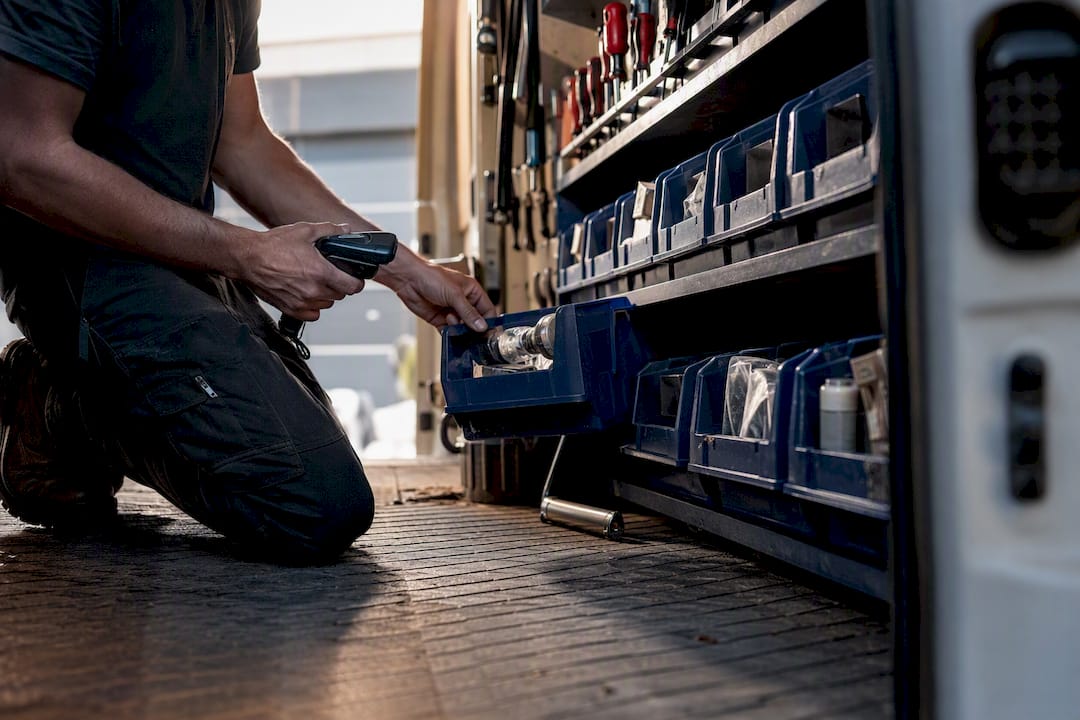
Cut Emergency Parts Runs With a 50 SKU Van Inventory Par List
The fastest way to stop repeat visits and cut emergency parts runs is a par-level service van inventory system tied to your job records and a simple mobile scan workflow. Set min and max quantities for the SKUs your trucks actually use, scan parts against work orders as they leave the van, and restock on a fixed cadence. Fleets that do this consistently report fewer emergency purchases and a measurable lift in first-time fix rate. The checklist below gets you started today.
TL;DR:
- Setting par levels based on 6 to 12 months of usage data improves accuracy and reduces mid-job returns for different truck types.
- Daily and weekly restocks, combined with quarterly rebalancing, help maintain optimal inventory levels and minimize emergency parts runs.
- Off-the-shelf software lacks offline capability and direct job linkage, which are critical for accurate job costing and reliable inventory management.
- Integration with company-wide inventory systems and accounting platforms, like Xero, significantly lowers administrative workload and enhances data accuracy.
- Technician adoption depends on simple workflows, quick scanning, and emphasizing how inventory control reduces callbacks and saves time during jobs.
Table of Contents
- What Is a Service Van Inventory System?
- Five-Minute Van Readiness Checklist
- How to Build a Van Par List From Usage Data
- Which Technology Features Actually Matter?
- Restocking Cadences: Daily, Weekly, Monthly, Quarterly
- Sample Van Budgets and SKU Categories by Trade
- Common Pitfalls and the Metrics That Catch Them
- Getting Technicians to Actually Use the System
- Setting Up Your Initial Van Inventory the Right Way
- Connecting Van Stock to Your Company-Wide Inventory System
- Why Integration Is the Part Everyone Underestimates
- How MDMS Handles Van Inventory and Parts Workflows
- Sources
- FAQ
What Is a Service Van Inventory System?
A service van inventory system is a structured way of tracking every part, tool, and consumable stocked in a mobile service vehicle, matched against the jobs those items get used on. It differs from warehouse inventory in one critical way: it has to work at the curb, offline, with a technician holding a phone instead of a barcode gun bolted to a shelf. Field service inventory has to connect parts to jobs and support mobile updates at the jobsite — a requirement most warehouse-only software simply isn’t built to handle.
The method that field service managers rely on is called par-level stocking: you set a minimum and maximum quantity for each SKU based on how often it actually gets used, and you replenish against that range instead of guessing. It’s the same logic restaurants use to stock a walk-in fridge, applied to belts, valves, fittings, and breakers. Once you tie that par list to your job records, every part pulled from the van deducts against a specific work order, and your parts cost per job stops being a mystery at month end.
For small fleets running two to ten vans, this shift usually starts as a spreadsheet and a laminated sheet taped inside the cargo door. It works, until you add a sixth truck or a second trade. That’s when most operators start looking at dedicated van stock control tools, which is where mobile scanning and job linkage stop being nice-to-haves and start becoming the whole point.
Five-Minute Van Readiness Checklist
Run this between shifts or before a truck rolls out in the morning. It won’t catch everything, but it catches the failures that cause callbacks.
- Quick-count your five to ten highest-velocity SKUs (fuses, common fittings, filters) against the par sheet.
- Confirm the scanning app or handheld device is charged and synced, especially after a day with spotty signal.
- Check that the laminated par sheet is still taped where the technician can see it, not buried under a seat.
- Inspect critical spares: lockboxes, security hardware, and anything requiring certified handling like refrigerant cylinders.
- Flag anything below par on a shared list so the parts clerk can pull it for tomorrow’s master cabinet run.
Pro Tip: Keep the checklist to five items or fewer. A ten-point van inspection sounds thorough on paper, but technicians skip long checklists after the second week. Short lists get done.
How to Build a Van Par List From Usage Data
Building a par-level system from scratch takes a few hours of setup and pays that time back within a month. Here’s the sequence that works.
- Pull 6 to 12 months of usage data from your dispatch or field service management platform, filtered by truck type or trade. A shorter window misses seasonal swings; a longer one drags in discontinued parts.
- Filter by truck type, not fleet-wide. An HVAC van and a plumbing van have almost no SKU overlap, and lumping them together produces a par list nobody trusts.
- Rank SKUs by frequency and dollar value. The part used on 40% of jobs matters more than the one sitting on a shelf worth $200 that moves twice a year.
- Select roughly the top 50 SKUs per truck type. This is a practical ceiling, not a hard rule. Beyond 50 line items, techs stop checking the sheet and start guessing.
- Set min and max levels using velocity, not intuition. A weekly-use item like a capacitor might carry a par of 4 to 8; a monthly item like a specialty valve might sit at 1 to 2. Moving from gut-based restocking to min/max par levels is the single change practitioners credit most for cutting mid-job returns.
- Operationalize it. Laminate the par sheet, assign daily or weekly restock tasks to a named person, and set reorder triggers in whatever system tracks your stock.
- Rebalance quarterly. Usage shifts with seasons and with which jobs you’re booking. A par list set in January for HVAC work is wrong by July.
The van itself becomes a distinct inventory location once you do this, not an extension of the warehouse shelf. Mobile jobsite workflows treat each van as its own location and require field-side updates so parts deduct from the correct job as they’re used, which is what makes job costing accurate instead of approximate.
Which Technology Features Actually Matter?
Barcode or QR scanning is the baseline. It’s the cheapest way to get a technician to log a part in under five seconds, and any service vehicle inventory management approach that skips it is asking for handwritten logs that never get entered. RFID is worth the added cost only when you’re tracking high-value tools or running high enough throughput that scanning individually becomes a bottleneck, an emerging use case as vehicle-level connectivity and RFID adoption grow in field service fleets.
Offline capability is not optional. Technicians work in basements, rural properties, and parking garages with no signal, and a mobile app that can’t log a scan until it finds a cell tower gets abandoned within a week. The adoption data backs this up: technicians will only use a mobile inventory tool consistently if it’s faster than a spreadsheet or a paper log, full stop.
Direct job linkage is the feature that turns inventory tracking into job costing. When a part scanned out of the van attaches to a specific work order automatically, your margin data becomes real instead of estimated. Auto-reorder alerts and supplier-run sheets close the loop, flagging low stock before a technician discovers it mid-job. Common feature sets in field service inventory tools now bundle barcode scanning, low-stock alerts, and purchase order automation into one workflow, which is worth looking for rather than stitching together from three separate apps.
Restocking Cadences: Daily, Weekly, Monthly, Quarterly
Stocking a van once and hoping it stays full is how you end up with three emergency runs a week. A fixed cadence, matched to clear ownership, fixes that.
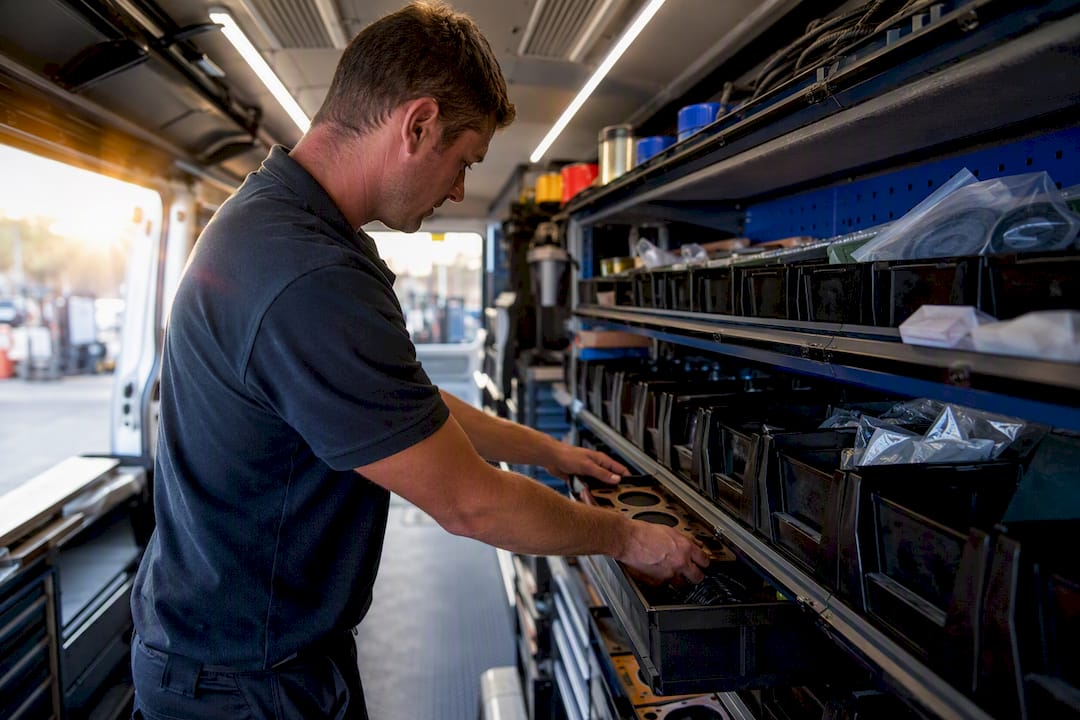
Daily restocks handle high-velocity consumables, pulled from the master parts cabinet at the start or end of a shift. This is a five-minute task, usually the technician’s own responsibility. Weekly restocks are the full reload: cross-checking the par sheet against actual stock and placing a supply-house order for anything running low, typically owned by a parts clerk. Monthly audits catch what the weekly check misses, dead stock sitting unused, items that should be returned or reallocated to a different truck. Anything untouched for 90 days is a candidate for return rather than continuing to ride around taking up shelf space.
Quarterly rebalancing adjusts the par list itself based on the last quarter’s usage, and it’s the step most fleets skip. A plumbing van stocked heavy on drain-clearing supplies in spring might need more water heater parts by winter. Building this into a recurring calendar task, rather than an occasional “we should really look at this,” is what keeps the whole system from drifting back to guesswork within six months.
Sample Van Budgets and SKU Categories by Trade
Stocking budgets vary widely by trade, truck size, and how much emergency work a business takes on, but most small to midsize service fleets carry a moderate amount of stocked inventory value per van. HVAC trucks tend to hold pricier components like compressors and refrigerant; electrical vans often carry simpler, lower-cost items such as fittings and breakers.
| Trade | Sample SKU categories | Typical par range per SKU |
|---|---|---|
| HVAC | Capacitors, contactors, refrigerant, filters | 2–6 units |
| Plumbing | Fittings, valves, seals, drain cable heads | 4–10 units |
| Electrical | Breakers, wire nuts, GFCI outlets, conduit fittings | 5 units |
Refrigerant and other regulated consumables carry handling and certification requirements that vary by jurisdiction, so confirm your local rules before setting par levels on anything classified as hazardous or restricted. A par table only works if the person restocking the van is also authorized to handle what’s on it.
Common Pitfalls and the Metrics That Catch Them
Most van inventory systems fail for the same handful of reasons: par levels set by gut feel instead of usage data, inconsistent scanning that leaves gaps in the job cost record, technicians hoarding “just in case” stock that throws off the whole par list, and a returns process nobody actually follows. Watch for rising emergency parts runs, a dropping first-time fix rate, or the same part getting returned mid-job three times in a month. Those are symptoms, not isolated incidents.
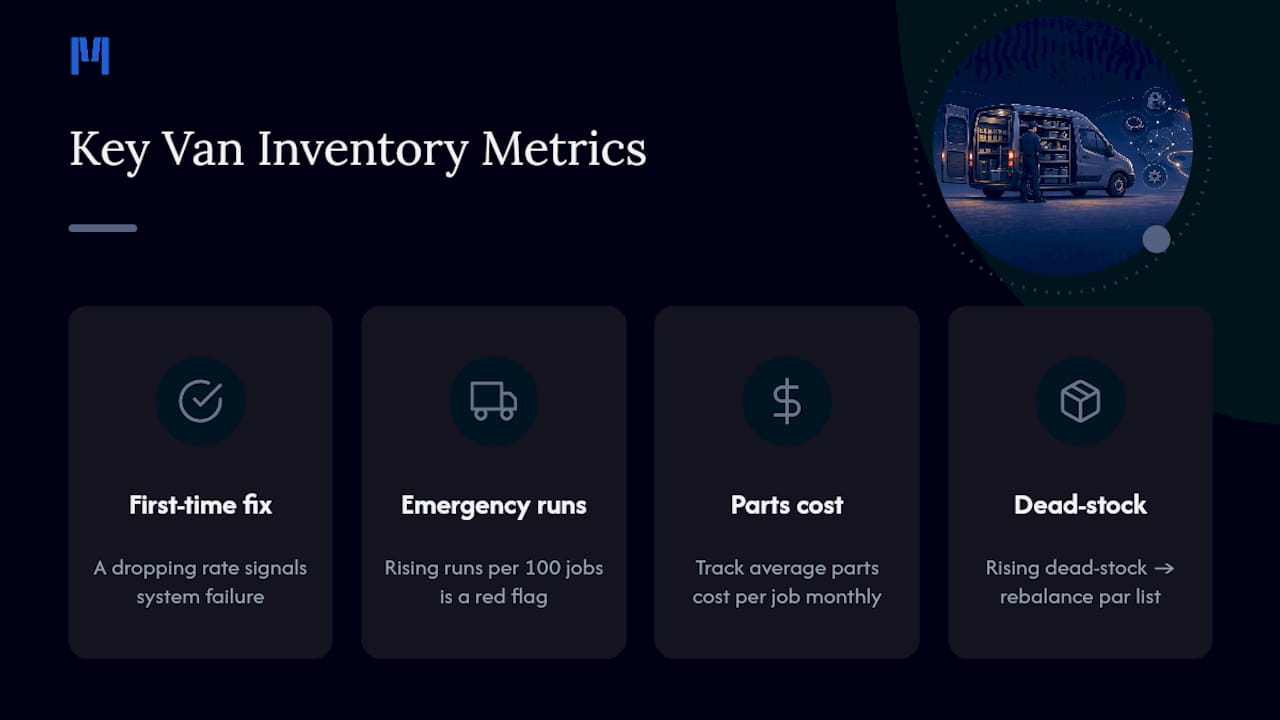
Track four numbers monthly: first-time fix rate, emergency runs per 100 jobs, average parts cost per job, and dead-stock percentage. A rising dead-stock number usually means your par list needs rebalancing, not that technicians are stealing parts.
Pro Tip: Run a five-minute spot audit on one random van every week instead of a full fleet audit once a quarter. You’ll catch drift while it’s still a small problem, and technicians stay honest knowing any truck could get checked on any given day.
Getting Technicians to Actually Use the System
The best par-level system in the world fails if technicians route around it. Adoption, not design, is usually the deciding factor between a van inventory system that sticks and one that quietly reverts to a clipboard within two months.
Start with why, not how. Technicians who understand that scanning a part takes five seconds and prevents a wasted trip back to the shop are far more likely to comply than ones who are just handed a new procedure. Frame it around fewer callbacks and less time spent hunting for parts, not around inventory accuracy for its own sake, which sounds like a management concern rather than something that makes their day easier.
Roll it out with one or two vans first, not the whole fleet at once. Pick a technician who’s naturally organized, get the workflow right with them, and let word travel before forcing it on everyone. A rocky first week on one truck is recoverable; a rocky first week fleet-wide creates permanent skeptics.
Keep the physical friction low. If scanning requires opening an app, finding the right job, and manually typing a SKU, it will get skipped under time pressure. The fastest systems let a technician scan a barcode and select a job in two taps. Build in a short check-in during the first month, not a one-time training session, since most resistance shows up in week three once the novelty wears off and old habits start creeping back.
Setting Up Your Initial Van Inventory the Right Way
Getting the first setup right saves months of cleanup later. Start by classifying every SKU into a category: high-velocity consumables, trade-specific parts, tools, and safety or compliance items like lockout hardware or certified refrigerant handling equipment. Each category gets treated differently. Consumables get generous par ranges and daily restock eligibility; tools get tracked by serial number or asset tag rather than quantity.
Resist the urge to stock everything “just in case” during initial setup. A van loaded with 150 SKUs because a technician once needed a part is a van nobody can audit accurately. Start with the top 50 or so per truck type, drawn from actual usage history rather than assumption, and add SKUs only when data shows a genuine gap.
Label physical storage to match your digital system exactly. If the app calls it a “3/4-inch ball valve” but the bin is labeled “ball valve, 3/4,” you’ll get scanning errors and mismatched counts within the first week. Consistency between the shelf label and the software record is what makes scanning fast instead of frustrating.
Finally, build in a shakedown period. Give the initial classification 30 to 60 days, then revisit it once real usage data comes in. The first par list is always a best guess. The second one, built on actual consumption, is the one that sticks.
Connecting Van Stock to Your Company-Wide Inventory System
A van inventory system that lives in its own silo, disconnected from your warehouse and your accounting software, creates more admin than it saves. The value of a par-level approach compounds when the van’s stock count, the master parts cabinet, and your supplier ordering all pull from the same data source instead of three separate spreadsheets that never quite agree.
When van inventory ties into a broader inventory tracking system, a part scanned out of a truck doesn’t just deduct from that van’s count. It also updates warehouse stock, feeds the work order for job costing, and can trigger a purchase order if the master cabinet itself falls below its own par level. That’s a very different operation than a technician texting the parts clerk to say they’re running low on capacitors.
This is also where a lot of small fleets hit a wall with off-the-shelf inventory apps built for retail or general warehousing. Those tools track quantity well but rarely understand a work order, a technician, or a truck as first-class objects in the system. A platform purpose-built around service and dealer operations, by contrast, treats the van as a linked location from day one rather than a bolt-on. Some standalone inventory platforms handle the data side of this well, offering useful groundwork for teams thinking through app-based stock visibility before they decide how deep an integration they actually need.
Why Integration Is the Part Everyone Underestimates
Most van inventory advice focuses on par levels and scanning habits, and this matter. But the bigger lever is what happens after the scan: does that data actually reach job costing, warehouse stock, and your books, or does it dead-end in a standalone app? Case evidence from a heavy equipment field services operation shows integrated truck inventory tracking lowers both emergency purchases and cost per job, and that gain comes specifically from the connection, not the scanning alone.
At Moderndms, we built our platform around that principle: modular rollout means you can start with parts and field service without ripping out what already works, and Xero integration means parts costs land in your books without a second data entry. Dealers using the platform report saving up to 10 hours a week in admin they used to spend reconciling spreadsheets by hand.
If your fleet is ready to move past disconnected tools, a demo shows how quickly this connects.
— ModernDMS
How MDMS Handles Van Inventory and Parts Workflows
Moderndms was built around the exact workflow this article describes: par levels, mobile scans, and parts tied directly to job records, without a separate system for each piece. The field service app works offline, so a technician in a basement with no signal can still log a part against a work order and sync once they’re back in range.
Parts pulled from a van deduct against the job in real time through the parts and inventory module, which feeds job costing automatically instead of requiring someone to reconcile receipts at month end. Because MDMS is modular, you can roll out van inventory and field service without touching sales or rental yet, and setup for the core system takes under an hour, not weeks of onboarding. Data ownership stays with you throughout, with no lock-in forcing you to migrate everything at once. Xero integration means parts costs and supplier invoices land in your books without double entry.
If you’re running a fleet of service vans or trucks and want to see how par-level stock control connects to job costing in practice, take a look at Moderndms for equipment dealers and book a walkthrough of the parts and field service modules together.
Sources
The par-level method, restock cadences, and technology recommendations in this article draw on field-tested guidance from PipelineOn’s truck stocking practices, Droppoint’s analysis of field service inventory management, and Fieldmotion’s research on mobile stock workflows, each offering deeper operational detail worth a closer read.
- Cyder case study: heavy equipment field services company
- Stock Management Software for Field Service — Fieldmotion
- Truck stocking list — PipelineOn
- Best inventory & stock management software for FSM — Workever
FAQ
What Are the Four Main Types of Inventory?
The four commonly recognized types are raw materials, work-in-progress, finished goods, and maintenance, repair, and operating (MRO) supplies. Service van stock falls mainly into the MRO category, since it consists of parts and consumables used to keep equipment running rather than goods being manufactured or sold.
Is There Free Inventory Software for Service Vans?
Some basic spreadsheet templates and entry-level mobile apps offer free tiers, but they typically lack offline sync, job linkage, and auto-reorder alerts. For fleets running more than two or three vans, the admin time saved by a paid, job-linked system usually outweighs the cost within a few months.
Can You Give an Example of Van Inventory?
A plumbing van might carry a par list including 6 ball valves, 10 assorted fittings, 4 wax rings, and 2 drain cable heads, each with a set minimum and maximum tied to weekly usage data. When a technician installs a valve, scanning it deducts the count and attaches the cost to that specific job.
What Is the Role of Inventory in the Service Industry?
Inventory availability directly determines whether a technician can complete a job on the first visit or has to reschedule for a part. Field service inventory management is a direct driver of first-time fix rate and overall service profitability, since missing parts translate into repeat trips and emergency freight costs.
How Often Should I Restock a Service Van?
High-velocity consumables should get restocked daily from a master parts cabinet, with a fuller reload weekly based on the par sheet. Monthly audits catch dead stock, and a quarterly rebalance adjusts par levels to match seasonal shifts in job mix.