Best Dealership CRM for Australian Equipment Dealers
By MDMS Team · 31 July 2026

Best Dealership CRM for Australian Equipment Dealers
TL;DR:
- Most Australian equipment dealerships benefit from an integrated management system that combines CRM and back-office functions. Such platforms enable real-time data sharing across sales, service, parts, and finance, boosting efficiency and proactive customer engagement. Moderndms is a purpose-built, compliant solution that offers modular rollout and free data export, optimizing operational workflows.
For most Australian equipment dealerships, the best dealership CRM is not a standalone contact manager — it is an integrated Dealer Management System (DMS) with CRM modules built in. When sales, service, parts, and finance share a single data layer, your team can act on real-time service history and parts availability before picking up the phone. Moderndms (MDMS) is the recommended platform: purpose-built in Australia, modular in rollout, compatible with Xero and MYOB, and structured so your dealership owns its data outright.
Table of Contents
- What is the difference between a dealership CRM and a DMS?
- Why integrated DMS + CRM outperforms separate systems for equipment dealers
- What features must your dealership CRM actually include?
- How do you choose the right dealership CRM or DMS?
- What does a typical implementation timeline look like?
- Why Moderndms is the recommended DMS + CRM for Australian equipment dealers
- How Australian equipment dealerships are using integrated platforms
- How does Moderndms handle Australian regulatory and compliance requirements?
- Data security and compliance for Australian dealerships
- Key Takeaways
- The case for treating your CRM as an operational engine, not a database
- Moderndms is ready when your team is
- Useful sources
- FAQ
What is the difference between a dealership CRM and a DMS?
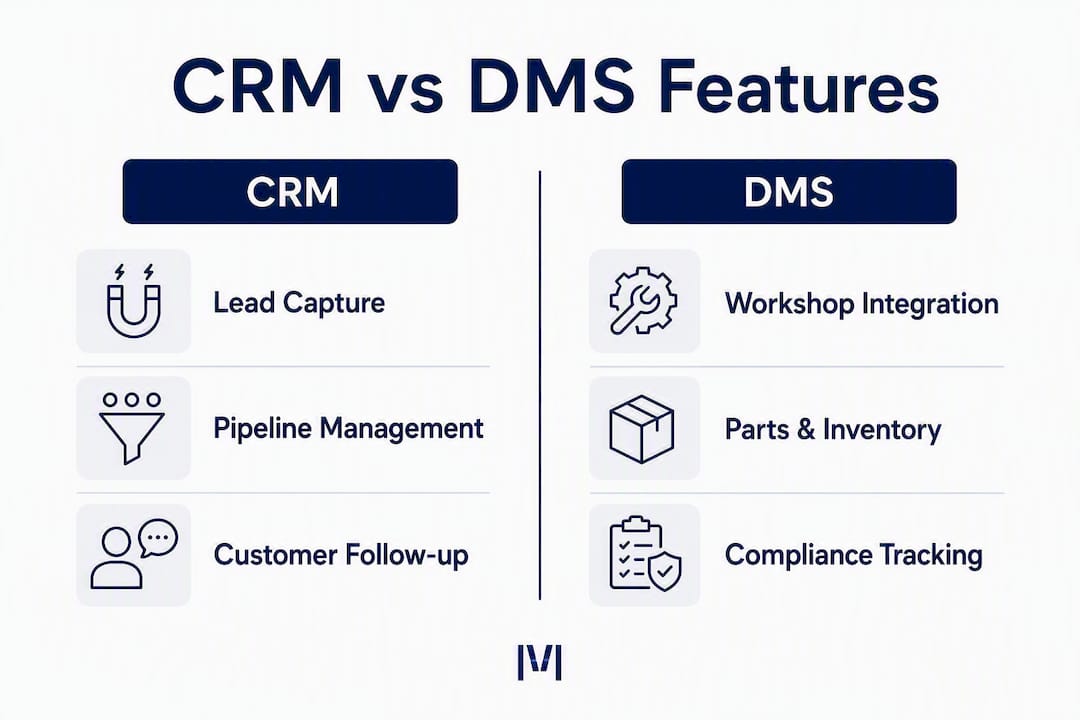
A CRM handles front-office work: lead capture, pipeline tracking, follow-up sequences, and customer communication history. A DMS handles back-office operations: inventory, parts, service bay scheduling, work orders, and accounting. In most legacy stacks, these run as separate systems that rarely talk to each other.
The practical gap shows up fast. Consider a sales rep calling a customer whose machine is three weeks overdue for a 500-hour service. With a standalone CRM, that rep sees contact details and a deal history. With an integrated DMS and CRM, they see the open service interval, the parts already on order, and the warranty expiry date — context that turns a routine call into a genuine cross-sell opportunity.
Key distinctions at a glance:
- CRM: Lead capture, marketing automation, pipeline stages, customer interactions, renewal reminders
- DMS: Inventory and serial number tracking, parts warehouse, service work orders, rental fleet management, accounting and GST
- Integrated platform: Both layers share one database, so data travels once and every department sees the same record
As industry analysis confirms, integrating these two systems removes operational silos and is consistently superior to running disconnected tools — particularly for equipment dealerships where a single machine can generate sales, service, parts, and warranty revenue across its full lifecycle.
Why integrated DMS + CRM outperforms separate systems for equipment dealers
Integration reduces friction, eliminates duplicate data entry, and enables proactive service and sales actions that disconnected systems simply cannot trigger. When your CRM can read live workshop schedules and parts stock levels, lead prioritization becomes accurate rather than guesswork, and automated outreach fires at the right moment rather than when someone remembers to check a spreadsheet.

The revenue impact concentrates in three areas. First, service-triggered sales: a warranty expiry or a completed 1,000-hour service automatically queues a sales rep to call about a trade-in or an extended contract. Second, parts cross-sell: when a service work order closes, the CRM can flag related consumables or attachments the customer has not yet purchased. Third, rental-to-sale conversion: fleet utilization data surfaces customers whose hire frequency justifies an ownership conversation.
Pro Tip: The fastest ROI from integration usually comes from one workflow: service-triggered sales outreach. Configure your CRM to create a sales task every time a work order closes on a machine older than five years. Dealers who run this single automation typically recover several hours of manual follow-up per week within the first month.
Dealers who reduce manual admin through integrated platforms report recovering meaningful time each week — Moderndms users cite up to 10 hours per week in administrative time savings, time that shifts from data re-entry to customer-facing work.
What features must your dealership CRM actually include?
A CRM disconnected from workshop and parts data becomes little more than a contact list. The table below separates must-have capabilities from useful additions, with a short reason for each.
| Feature | Priority | Why it matters |
|---|---|---|
| Lead capture and pipeline management | Must-have | Tracks every inquiry from first contact to closed deal |
| Service reminders and work-order triggers | Must-have | Automates follow-up based on real service data |
| Parts linkage and inventory visibility | Must-have | Connects sales conversations to live stock levels |
| Warranty tracking | Must-have | Flags expiry windows for proactive outreach |
| Mobile and offline field app | Must-have | Technicians and reps need access on-site without Wi-Fi |
| Xero / MYOB accounting sync | Must-have | Eliminates double-entry and keeps GST records clean |
| Customer self-service portal | Must-have | Reduces inbound calls; customers track jobs and invoices |
| Workflow automation (task triggers) | Must-have | Turns passive data into active sales and service actions |
| Telematics / usage data integration | Nice-to-have | Adds predictive service triggers based on machine hours |
| AI-driven suggestions and Kanban views | Nice-to-have | Speeds deal progression; useful at scale |
| Lead scoring | Nice-to-have | Prioritizes pipeline when volume is high |
Bi-directional, real-time integration between the CRM and workshop is the single feature that separates a functional equipment dealer CRM from a generic contact manager. Without it, automation and accurate lead prioritization break down.
How do you choose the right dealership CRM or DMS?
Prioritize integration depth, data ownership, local compliance, modular rollout, and quality of support — not feature checkboxes alone. A platform with 200 features that cannot export your data or handle Australian GST natively is a liability, not an asset.
Bring this checklist to every vendor demo:
- Integration APIs: Can the platform sync bi-directionally with your accounting system (Xero or MYOB) and your parts inventory in real time?
- Data ownership and export: Can you export your full dataset at any time, in a standard format, without paying an extraction fee?
- GST compliance: Does the system handle Australian GST natively in invoices, work orders, and parts transactions?
- Onboarding and training: What does the onboarding timeline look like, and is training included or billed separately?
- Uptime SLA: What is the guaranteed uptime, and what is the support response time for critical issues?
- Modular rollout: Can you start with one or two modules and expand, rather than committing to a full deployment on day one?
- Demo environment: Will the vendor let you run a live pilot with your own data before signing a long-term contract?
Pricing factors to watch: Per-user pricing scales unpredictably as your team grows; module-based pricing is easier to budget. Watch for hidden integration fees, data migration costs, and custom-development charges that inflate the total cost of ownership well beyond the headline subscription rate.
Red flags: Vendor lock-in clauses that prevent data export, opaque pricing with no published module breakdown, missing GST handling, and vendors who cannot provide a working demo environment. Smaller single-location dealers may not need a full DMS platform immediately, but any system you choose should have a clear upgrade path as your inventory complexity grows.
What does a typical implementation timeline look like?
A modular rollout commonly completes basic onboarding in a matter of weeks, but full adoption across sales, service, parts, and finance typically takes 3–6 months depending on dealership size and data complexity.
| Phase | Typical Duration | Key Activities |
|---|---|---|
| Discovery and scoping | 1–2 weeks | Map current workflows, identify data sources, set pilot objectives |
| Data migration | 1–2 weeks | Transfer customer records, parts SKUs, serial numbers, open work orders |
| Configuration | 1–2 weeks | Set up modules, user roles, GST rules, Xero/MYOB connection |
| Pilot | 2–4 weeks | Run one high-value workflow (e.g., service-triggered outreach) with a small team |
| Staff training | 1–2 weeks | Role-specific training for sales, service, parts, and finance |
| Go-live | Day 1 of full rollout | All departments active; support team on standby |
| Optimization | Ongoing (months 2–6) | Refine automations, add modules, measure adoption metrics |
Stakeholders to involve from day one: sales manager, service manager, parts manager, finance lead, and an IT or systems contact who can manage the Xero/MYOB API connection.
Early adoption metrics worth tracking:
- Reduction in weekly admin hours per department
- Lead follow-up rate within 24 hours of inquiry
- Booked service revenue attributed to CRM-triggered outreach
- Work-order cycle time from open to invoice
Dealers who run a focused pilot on a single high-impact workflow see faster team buy-in and measurable savings earlier in the cycle than those who attempt a full-platform launch on day one.
Why Moderndms is the recommended DMS + CRM for Australian equipment dealers
Moderndms is a purpose-built, Australian DMS with integrated CRM modules designed specifically for equipment dealerships — it is not adapted from automotive or retail software.
Core capabilities relevant to equipment dealers:
- CRM and sales pipeline: Lead capture, deal sheets, quoting (CPQ), and automated follow-up triggers linked to service and parts data
- Parts and warehouse: SKU management, bin locations, supplier ordering, and live inventory visibility across branches
- Workshop service: Work order creation, technician scheduling, field service, and bi-directional sync with the CRM
- Rental and fleet management: Contract tracking, utilization reporting, and rental-to-sale conversion workflows
- Xero and MYOB integration: Native accounting sync with Australian GST compliance built into every transaction
- Offline-capable mobile app: Field technicians and reps retain full access to customer records, work orders, and parts data without a Wi-Fi connection
- Customer self-service portal: Customers can view job status, approve quotes, and access service history without calling your team
- Data ownership: Your data stays yours — no lock-in clauses, full export available at any time
- Modular rollout: Start with the modules your team needs most and expand as adoption grows; basic setup can be completed in under an hour for initial configuration
Moderndms users report recovering significant time each week in administrative tasks after adoption — time that moves from re-keying data between systems to actual customer and revenue work. For dealers evaluating CRM alternatives, Moderndms consistently stands out on local compliance, integration depth, and the absence of vendor lock-in.
How Australian equipment dealerships are using integrated platforms
Across agricultural machinery, construction, forklift, and industrial capital equipment sectors, Australian dealers are replacing disconnected spreadsheet and legacy-software stacks with integrated platforms for one consistent reason: the cost of manual data re-entry and missed follow-ups compounds quickly at scale.
A multi-branch agricultural dealer managing hundreds of active machines found that service reminders were falling through the gaps because the CRM had no visibility into workshop schedules. After moving to an integrated platform, service-triggered outreach became automatic, and the parts team could see which consumables were due before the customer called. The result was a measurable reduction in reactive service calls and an increase in pre-booked maintenance work.
Forklift and materials-handling dealers face a similar pattern: rental contracts, service intervals, and parts orders all generate customer touchpoints, but without a shared data layer, each department manages its own records. Integration means a rental contract renewal can trigger a sales conversation, a parts order can prompt a service booking, and the customer sees one coherent experience rather than three separate departments.
How does Moderndms handle Australian regulatory and compliance requirements?
Australian equipment dealerships operate under specific compliance obligations that generic CRM platforms often ignore. Moderndms addresses these directly.
GST compliance: Every transaction in Moderndms — work orders, parts invoices, rental contracts, deal sheets — applies Australian GST rules natively. There is no manual tax-code mapping or post-export adjustment required.
Xero and MYOB integration: The platform syncs with both major Australian accounting systems in real time, so your BAS preparation reflects actual transaction data rather than a manually reconciled export.
Fair Work and payroll alignment: The HR and workforce module supports Australian award structures and leave entitlements, relevant for dealerships managing technician rosters and field service teams.
Privacy Act obligations: Customer data collected through the CRM and customer portal is stored in accordance with the Australian Privacy Act 1988, with configurable data retention and access controls.
For dealerships operating across multiple states, Moderndms supports multi-branch configurations with role-based access, so a service manager in Queensland sees their branch data while the finance team at head office retains consolidated reporting visibility.
This article provides general information about dealership software and compliance considerations. Confirm current GST, privacy, and employment obligations with a qualified Australian accountant or legal adviser.
Data security and compliance for Australian dealerships
Security expectations for a DMS handling customer records, financial transactions, and machine serial numbers are not optional. Best-practice DMS selection includes cloud backups, strong encryption, and security practices aligned with recognized frameworks such as NIST.
For Australian dealerships, the practical checklist looks like this:
- Data residency: Confirm whether customer and financial data is stored on Australian servers or offshore. Data residency affects your obligations under the Australian Privacy Act.
- Encryption: Data should be encrypted in transit (TLS) and at rest. Ask vendors for their encryption standard before signing.
- Access controls: Role-based permissions prevent a parts counter staff member from accessing finance records or customer payment data.
- Backup and recovery: Automated daily backups with a tested recovery process protect against data loss from hardware failure or ransomware.
- Audit logs: Every change to a customer record, work order, or financial transaction should be logged with a timestamp and user ID.
- Vendor security posture: Ask whether the vendor has completed an independent security audit and whether they carry cyber liability insurance.
Moderndms operates as a cloud-native platform, which means infrastructure maintenance, patching, and backup management sit with the vendor rather than your internal team — a meaningful operational advantage for dealerships without dedicated IT staff.
Key Takeaways
An integrated DMS + CRM built for Australian equipment dealerships outperforms any standalone CRM by connecting sales, service, parts, and finance in a single data layer — Moderndms delivers this with local compliance, modular rollout, and no vendor lock-in.
| Point | Details |
|---|---|
| Go integrated, not standalone | A CRM without DMS integration becomes a contact list; real value requires live service and parts data. |
| Verify local compliance first | Confirm native GST handling and Xero/MYOB sync before shortlisting any platform for an Australian dealership. |
| Plan a modular rollout | Start with one high-impact workflow; full adoption typically takes several months across all departments. |
| Watch for vendor lock-in | Demand full data export rights and a working demo environment before signing any contract. |
| Moderndms for Australian dealers | Purpose-built DMS + CRM with offline mobile app, Australian GST compliance, and up to 10 hours per week in reported admin savings. |
The case for treating your CRM as an operational engine, not a database
Most dealerships that struggle with CRM adoption share one pattern: they bought the software, loaded their contacts, and then used it as a slightly better spreadsheet. The system sits there, passively holding data, while the real work happens in email threads and phone calls that never get logged.
The dealers who get genuine return from their CRM investment treat it differently. They configure it to act — to surface a service interval, check parts availability, and queue a sales task without anyone having to remember to look. Practitioners consistently report that the highest-performing dealers treat the CRM as an active operational system that triggers tasks and workflows automatically rather than as a passive repository.
The counterintuitive insight from working with equipment dealers on these rollouts: the biggest adoption barrier is rarely the software. It is the assumption that the CRM is a sales tool. When service managers and parts managers see their own workflows reflected in the platform — work orders, parts orders, warranty windows — adoption accelerates because the system is solving their problems, not just the sales team’s.
Start with the workflow that causes the most friction today. For most equipment dealerships, that is service follow-up: jobs close, machines go back to the customer, and nobody calls until the next breakdown. Fix that one workflow first, measure the result, and let the win sell the rest of the platform internally.
Moderndms is ready when your team is
Running multiple spreadsheets, a legacy DMS, and a disconnected CRM costs your team real hours every week — hours spent re-keying data, chasing service histories, and manually triggering follow-ups that an integrated platform handles automatically. Moderndms gives Australian equipment dealerships a single platform covering sales, service, parts, rental, and finance, with Xero/MYOB integration and Australian GST compliance built in from day one.
Your next step is a live demo with your own data. Bring a sample customer record, a parts SKU list, a work-order example, and your Xero or MYOB access details. Ask Moderndms to demonstrate the service-triggered sales workflow and the offline mobile app in a real dealership scenario. For heavy equipment dealers and construction and earthmoving operations, industry-specific demo environments are available. Request your demo at moderndms.com.au and set a clear pilot objective before the call so you can measure results from week one.
Useful sources
- Equipment Dealer CRM: Improving Sales and Service for Sustainable Growth — Practitioner guidance on active vs. passive CRM use and automation for equipment dealers
- DMS vs CRM: Which One Does Your Dealership Actually Need? — Practical breakdown of DMS and CRM functions and the case for integration
- You Need (More Than) a CRM: Introducing Dealer Intelligence Platforms — When to choose a full platform vs. a best-of-breed CRM
- What to Look for When Choosing a Dealer Management System — Security, modularity, and integration criteria for DMS selection
- CRM Software for Equipment and Machinery Dealers — Moderndms — MDMS CRM feature overview, integration capabilities, and data ownership policy
- How to Reduce Admin Tasks in Your Equipment Dealership — Moderndms — Practical guidance and time-savings evidence from Australian equipment dealers
FAQ
What is the difference between a DMS and a CRM for equipment dealers?
A CRM manages front-office customer interactions — leads, pipeline, and follow-ups. A DMS manages back-office operations including inventory, parts, service work orders, and accounting. An integrated platform combines both so every department shares the same customer and machine data in real time.
Does Moderndms handle Australian GST and Xero/MYOB integration?
Yes. Moderndms applies Australian GST natively across all transactions — work orders, parts invoices, rental contracts, and deal sheets — and syncs bi-directionally with both Xero and MYOB, eliminating manual reconciliation before BAS preparation.
How long does it take to implement an integrated DMS + CRM?
Basic onboarding typically completes within a few weeks; full adoption across sales, service, parts, and finance generally takes 3–6 months depending on dealership size and data complexity. A modular rollout starting with one high-impact workflow accelerates early results.
What are the biggest red flags when evaluating a dealership CRM vendor?
Watch for vendor lock-in clauses that restrict data export, missing Australian GST compliance, opaque pricing with undisclosed integration fees, and vendors who cannot provide a working demo environment with your own data before you sign.
Can a standalone CRM work for an equipment dealership without a DMS?
A standalone CRM can work for very small, single-location dealers with limited inventory. As machine count, service volume, and parts complexity grow, the absence of real-time workshop and inventory data makes the CRM progressively less useful — at that point, an integrated platform delivers materially better results.