Supplier Management for Dealerships: A Practical Operating Guide
By MDMS Team · 28 August 2026

Supplier Management for Dealerships: A Practical Operating Guide
The fastest fix for supplier management for dealerships is to centralize vendor data in one system, define an ideal supplier profile before you negotiate, run monthly KPI scorecards, and enforce purchase orders on every invoice. MDMS builds these controls into a single dealer management system rather than a patchwork of spreadsheets. Most dealerships see operational wins, fewer invoice disputes, and faster reconciliation within a few months; governance and continuous improvement keep paying off after that.
TL;DR:
- Centralizing vendor data into a single system reduces invoice disputes and accelerates reconciliation by providing one source of truth for all supplier interactions.
- Enforcing purchase orders on all transactions and implementing automated three-way invoice matching significantly decrease billing leakage and improve cost control.
- Developing a clear, metrics-based supplier profile before negotiations ensures consistent quality, delivery, and pricing, leading to better sourcing outcomes.
- Tracking monthly KPIs such as on-time delivery, defect rate, invoice accuracy, and responsiveness helps identify performance issues early and avoid costly disruptions.
- Integrating supplier management with inventory and sales platforms enhances data accuracy, streamlines procurement, and supports accurate forecasting for parts and equipment.
Table of Contents
- What Does Centralizing Vendor Operations Actually Fix?
- How Should You Structure Supplier Onboarding and Vendor Data?
- What Contract and Invoicing Controls Actually Reduce Leakage?
- How Do You Build an Ideal Supplier Profile?
- Which Supplier KPIs Should You Track Monthly?
- A Quick Look at Contract Governance Done Right
- How Do You Prepare for Supplier Disruptions?
- How Do You Get Your Team to Actually Use the New Process?
- Why Should Your Supplier System Talk to Inventory and Sales?
- Can Analytics Actually Predict What You Need to Order?
- How Do You Actually Build Better Supplier Relationships?
- ModernDMS Perspective: Quick Wins and What to Prioritize First
- How MDMS Supports the Supplier Management Playbook
- Sources
- FAQ
What Does Centralizing Vendor Operations Actually Fix?
Siloed vendor management shows up as a pattern dealership managers know too well: a purchase order buried in someone’s inbox, an invoice that doesn’t match what was actually delivered, and a service advisor calling three people to find out why a part hasn’t shipped. Every one of those moments costs staff hours that never show up on a line item, but they add up fast across a parts department or workshop handling dozens of vendors.
A proper vendor-operations system fixes this by giving every supplier interaction one home. That means:
- Vendor master data stored once and referenced everywhere, not re-typed into three different spreadsheets.
- Work-order and PO linking, so a mechanic’s parts request ties directly to the purchase order and the eventual invoice.
- A document store for contracts, insurance certificates, and compliance records that doesn’t live in someone’s email archive.
- Basic integration between your dealer management system and your accounting platform, so numbers travel once instead of getting retyped.
Dealerships that centralize this way typically resolve invoice disputes faster and get a single source of truth for who’s actually performing. That kind of centralized, data-driven approach replaces the reactive, email-driven habits that dominate most parts and service departments.
How Should You Structure Supplier Onboarding and Vendor Data?
Every new vendor should clear the same gate before anyone places an order with them. That gate is your onboarding checklist, and skipping steps here is exactly how dealerships end up with forty “approved” suppliers when they actually use twelve.
Capture these fields for every vendor record:
- Primary and backup contacts, plus escalation phone numbers.
- Tax and business registration details, along with bank and payment terms.
- Current insurance certificates and expiry dates.
- Capability tags (parts categories, service specialties, delivery radius).
- Approval sign-off from procurement, the relevant department manager, and finance.
Keep that sign-off chain tight. A single technician or service writer should never be able to add a vendor to the system without procurement and finance both seeing it first.
Pro Tip: Run a quarterly audit of your approved-vendor list and retire anyone who hasn’t received an order in six months. A leaner supplier base gives you more leverage on pricing and faster responses when something goes wrong.
Fewer, deeper relationships beat a long tail of one-off vendors almost every time, since suppliers who see consistent volume from you tend to prioritize your orders over a stranger’s.
What Contract and Invoicing Controls Actually Reduce Leakage?
Most billing leakage traces back to one root cause: nobody enforced the purchase order before the invoice showed up. Fix that first, and the rest of the controls fall into place around it.
The operational controls that matter:
- PO enforcement on every purchase, no exceptions for “just this once” emergency orders.
- Automated invoice capture with three-way matching, comparing the PO, the receiving record, and the invoice before anyone approves payment.
- Exception routing that flags mismatches for a human instead of letting them sit in an AP inbox for two weeks.
On the contract side, demand clauses covering data ownership (your vendor data leaves with you, not locked in their system), termination-for-convenience, transition assistance if you switch providers, and clearly defined SLAs with remedies attached. A contract should include a clear remedy clause to be effective.
Payment automation is worth a serious look too. Virtual card and automated AP programs can generate rebates on parts spend and simplify reconciliation, turning what’s normally a pure cost center into a modest cashflow lever.
How Do You Build an Ideal Supplier Profile?
Before you send a single RFQ, write down what “good” actually looks like for that category of supplier. Skipping this step is how dealerships end up comparing five wildly different quotes with no consistent basis for the decision.
Define these metrics up front:
- Quality: defect rates, warranty return frequency, consistency across orders.
- Delivery: average lead time and how much it varies order to order.
- Technology and compatibility: can the vendor integrate with your ordering system or DMS, or does every order require a phone call.
- Service and support: response time on issues, availability of a dedicated account contact.
- Price: not just the unit cost, but total cost including freight, minimum order quantities, and payment terms.
Setting these metrics before negotiation produces better sourcing outcomes and cuts down on disputes later, because everyone agreed on the scoring criteria before money changed hands.
Keep your RFQ list short, a small number of vendors per category is usually enough. Blasting a request to fifteen suppliers doesn’t get you better pricing; it gets you quote fatigue, where your best potential partners stop bothering to respond because they’ve been burned by dealerships that never actually buy from them.
Which Supplier KPIs Should You Track Monthly?
You can’t manage what you don’t measure, and annual vendor reviews catch problems about eleven months too late. A monthly scorecard, even a simple one, tells you which vendors are drifting before it costs you a customer relationship.
Track these five metrics for every strategic supplier:
- On-time delivery rate, tracked against the promised date, not the date they claim they shipped.
- Defect rate or parts-per-million (PPM) for quality issues.
- Lead time variance, since a supplier who’s occasionally two weeks late is often worse than one who’s reliably five days late.
- Invoice accuracy, meaning how often the invoice matches the PO without manual correction.
- Responsiveness, measured in hours to first response on an issue ticket.
Pro Tip: Replace your annual supplier review with a Quarterly Business Review. Practitioner guidance across procurement functions consistently favors QBRs over yearly check-ins because they catch performance drift while it’s still cheap to fix, and they let you align supplier roadmaps and training needs instead of just renegotiating price once a year.
A Quick Look at Contract Governance Done Right
One multi-site dealership group found its contracts scattered across individual locations, with local managers signing side deals nobody at head office knew about. A central contract register with approval gates fixed that by requiring every new contract to pass through a standard template and sign-off chain before it went live.
The measurable outcomes worth tracking after a rollout like this: fewer rogue local contracts signed outside procurement’s visibility, faster onboarding for new vendor agreements since everyone uses the same template, and a clean audit trail that shows exactly who approved what and when.
How Do You Prepare for Supplier Disruptions?
Every dealership eventually loses a supplier without warning, whether that’s a parts distributor going under, a freight delay stretching from days into weeks, or a key contact leaving and taking institutional knowledge with them. The dealerships that handle this well aren’t the ones who never get disrupted. They’re the ones who already had a plan.

Start by identifying which suppliers are actually critical. Not every vendor deserves a contingency plan, but the ones tied to your highest-volume parts categories or your busiest service lines absolutely do. For those, keep at least one qualified backup vendor identified and, where practical, already onboarded in your system so you’re not scrambling to gather tax details and payment terms during a crisis.
Build minimum stock buffers for parts with long lead times or a single-source supplier, and review those buffers at least twice a year as demand shifts. A risk-based approach works better than treating every vendor the same: apply heavier oversight, deeper backup planning, more frequent check-ins, to suppliers who are hard to replace or deeply integrated into your operations, and keep lighter touch processes for low-risk, easily substituted vendors.
Document the actual disruption playbook: who gets notified first, who has authority to approve emergency purchases outside the normal PO process, and how you communicate delays to service customers waiting on parts. Writing this down before you need it is the difference between a contained hiccup and a week of chaos.
How Do You Get Your Team to Actually Use the New Process?
A supplier management system is only as good as the habits it replaces, and habits don’t change because you sent an email announcing the new procedure. Change management here means treating adoption as seriously as you treated the software selection itself.
Start with the people who feel the pain most directly, usually parts counter staff and service advisors, and show them specifically how the new process saves them time rather than just adding another step. Nobody adopts a system they think exists to police them; they adopt one that clearly makes their Tuesday afternoon easier.
Run a short training session focused on the three or four things staff will actually do daily: creating a PO, checking vendor status, flagging an invoice mismatch. Skip the feature tour. Nobody remembers a forty-slide walkthrough of every module three weeks later.
Assign a single internal champion per department, someone in parts, someone in service, who becomes the go-to person for questions during the first month. That person catches the small frustrations before they turn into “we’re just going back to the old spreadsheet” conversations.
Finally, phase the rollout instead of flipping every switch at once. Enforce PO compliance first, then layer in scorecards, then contract governance. A modular rollout means your team masters one habit before the next one lands, which is a large part of why phased dealership DMS rollouts tend to see less disruption than all-at-once conversions.
Why Should Your Supplier System Talk to Inventory and Sales?
A supplier management process that lives apart from your inventory and sales platforms creates the exact kind of duplicate data entry it was supposed to eliminate. If a parts order doesn’t automatically update your inventory count, someone’s manually reconciling two systems every week, and that’s where mistakes creep in.
The integration that actually matters connects three things: your vendor and purchasing records, your parts and equipment inventory, and your sales or quoting workflow. When a service job needs a part, the system should check current stock, flag whether a reorder is already in motion, and tie the eventual invoice back to the original work order without anyone re-keying numbers. That closes the loop between what you promised a customer and what you actually had on the shelf.
This matters even more for dealerships juggling new equipment sales alongside parts and service, since a delayed shipment from a supplier can directly delay a sale if inventory visibility is out of sync. A platform built around inventory management tailored to dealerships keeps procurement, parts, and sales reading from the same numbers instead of three separate versions of the truth.
Integration also pays off on the reporting side. When purchasing, inventory, and sales data sit in one system, you can actually see which suppliers are tied to your fastest-moving inventory categories and which ones are quietly sitting on slow stock that’s tying up cash.
Can Analytics Actually Predict What You Need to Order?
Most dealerships still order parts reactively: something runs low, someone notices, someone places an order. That works until it doesn’t, usually right when a supplier has a delay or a part turns out to be on backorder longer than expected.
Forecasting doesn’t require a data science team. It requires historical order data, which most dealerships already have sitting in their systems unused. Looking at seasonal patterns, how service volume shifts with weather or harvest cycles in equipment-heavy markets, gives you a rough but genuinely useful signal for when to reorder before you’re caught short.
Automated reorder triggers based on minimum stock thresholds remove the guesswork entirely for your highest-turnover parts. Set the threshold once, based on lead time and average usage, and let the system flag the reorder instead of waiting for a counter clerk to notice the shelf is empty.
This same historical data helps on the supplier side too. If you can see that one vendor’s lead time has crept from five days to nine over the past two quarters, that’s a scorecard conversation waiting to happen, not a surprise the next time you need that part urgently. Analytics here isn’t about replacing judgment; it’s about catching the drift before it becomes a stockout.
How Do You Actually Build Better Supplier Relationships?
The dealerships that get the best service from their vendors treat those vendors as an extension of their own team, not as an interchangeable line item to be squeezed on price every quarter. Dealership leaders consistently say they value suppliers who act as strategic partners: consistent, responsive, and willing to adapt as the dealership’s needs shift.

That starts with communication that isn’t purely transactional. A quick call after a delivery, even a good one, to confirm quality met expectations builds a different relationship than only ever calling when something’s wrong. Suppliers remember which customers only show up during disputes.
When problems happen, and they will, resolve them through a clear, agreed process rather than an ad hoc argument over email. That’s exactly what your Quarterly Business Review is for: a standing meeting where you review the scorecard together, flag emerging issues before they become disputes, and talk through what training or process changes might help both sides.
Give your best suppliers early visibility into upcoming volume changes, a new location opening, a seasonal spike, so they can plan capacity instead of scrambling. Suppliers who get advance notice tend to prioritize you when supply gets tight elsewhere. That’s the payoff of treating the relationship as genuinely two-way instead of a vendor you happen to order from.
ModernDMS Perspective: Quick Wins and What to Prioritize First
Most dealerships try to fix everything at once and end up finishing nothing. Enforce POs first, clean up your vendor master data second, start monthly scorecards third. In that order. The mistake we see most often is treating contracts as filing paperwork rather than risk management, or sending RFQs to too many vendors and drowning good suppliers in noise. A modular rollout, one workflow at a time, delivers real ROI without shutting down your parts counter for a week.
— ModernDMS
How MDMS Supports the Supplier Management Playbook
Everything in this guide, vendor master data, PO enforcement, scorecards, contract controls, only works if the underlying system makes it easy to follow. That’s the practical gap MDMS closes. Instead of stitching together a spreadsheet, an email inbox, and disconnected accounting software, dealerships run vendor master records, parts and warehouse workflows, and finance integrations from one place.
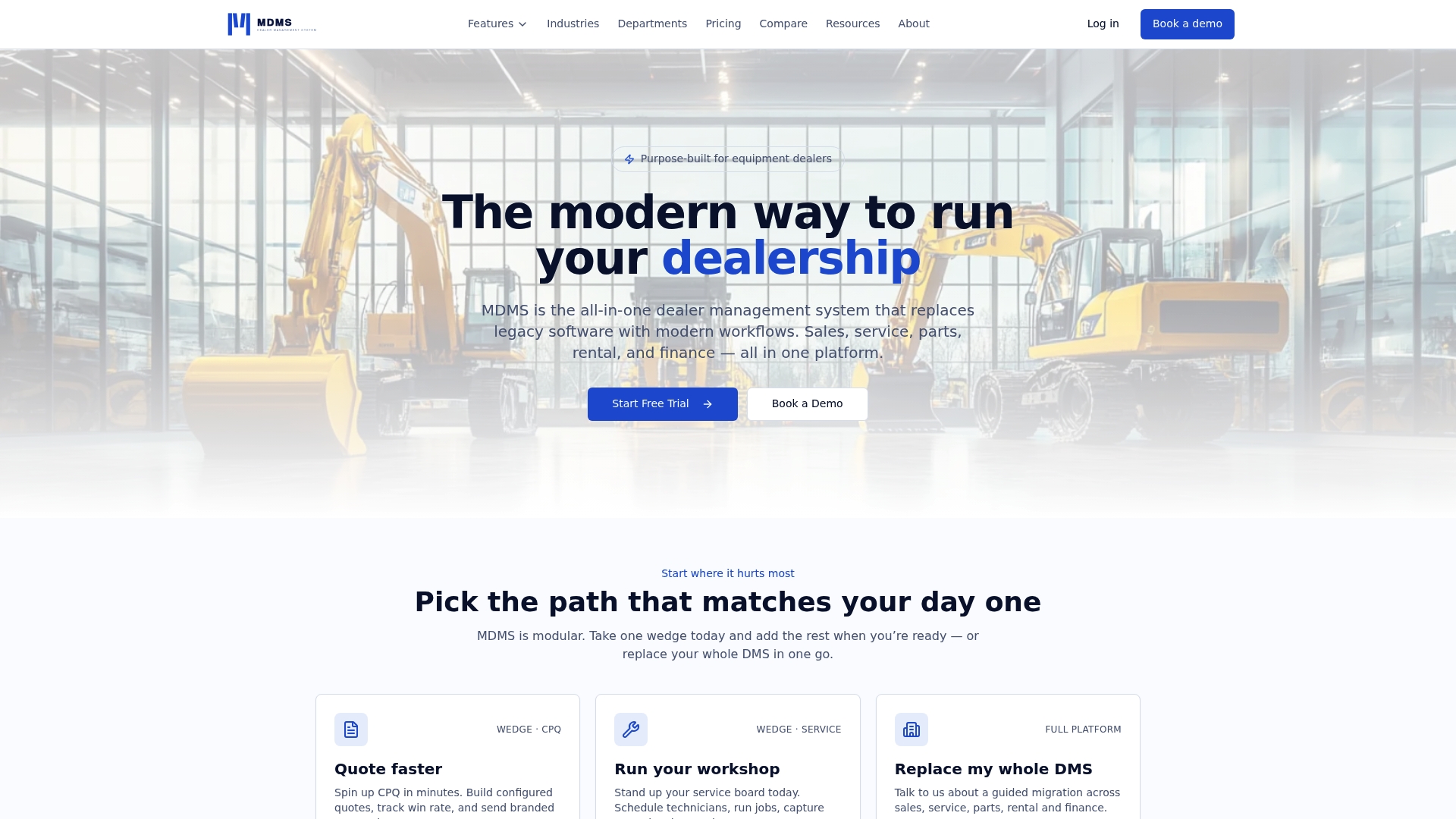
Setup takes under an hour, not weeks of onboarding, and your data stays yours with no lock-in if you ever decide to switch. Users report saving up to ten hours a week on administrative tasks previously lost to reconciling invoices and chasing vendor emails, time that goes straight back into service and sales. Integration with platforms like Xero means your AP and supplier records stop living in two disconnected worlds.
If your dealership is still managing suppliers across spreadsheets and inboxes, the heavy equipment dealer management platform built for exactly this operational stack is worth a demo. Book a walkthrough and see how quickly your team can get PO enforcement and vendor scorecards running.
Sources
- Supplier selection is a critical step to success | AM Online
- Procurement Case Study– Contract Management Framework | Spend Solutions
- Navigating procurement challenges in the automotive industry | Arkestro
- Fixed ops profitability | Corpay
FAQ
What Are the Steps in a Supplier Selection Process?
A solid process runs through identifying the need, building an ideal supplier profile, researching candidates, issuing standardized RFQs to a short list, scoring responses against your defined metrics, negotiating terms and contract clauses, and onboarding the winner with clean vendor master data.
What Does Supplier Management Actually Involve?
Supplier management covers onboarding, contract governance, performance tracking through KPI scorecards, invoice and payment controls, and ongoing relationship management through regular reviews like QBRs, rather than a single one-time sourcing decision.
What Factors Matter Most When Choosing a Supplier?
Quality, delivery reliability, technology and system compatibility, service and support responsiveness, and total price (not just unit cost) are the five factors dealerships should weigh before signing any vendor agreement.
How Often Should You Review Supplier Performance?
Monthly scorecards catch operational issues quickly, while Quarterly Business Reviews are where you align on roadmaps, training, and bigger performance trends instead of relying on an annual check-in that catches problems far too late.
Can Dealer Management Software Handle Supplier Management Directly?
Yes. A platform like MDMS centralizes vendor master data, PO enforcement, invoice matching, and parts and warehouse workflows in one system, replacing the spreadsheet-and-email approach most dealerships start with.