A Repeatable Trade-In Appraisal Process for Equipment Dealers
By MDMS Team · 26 August 2026
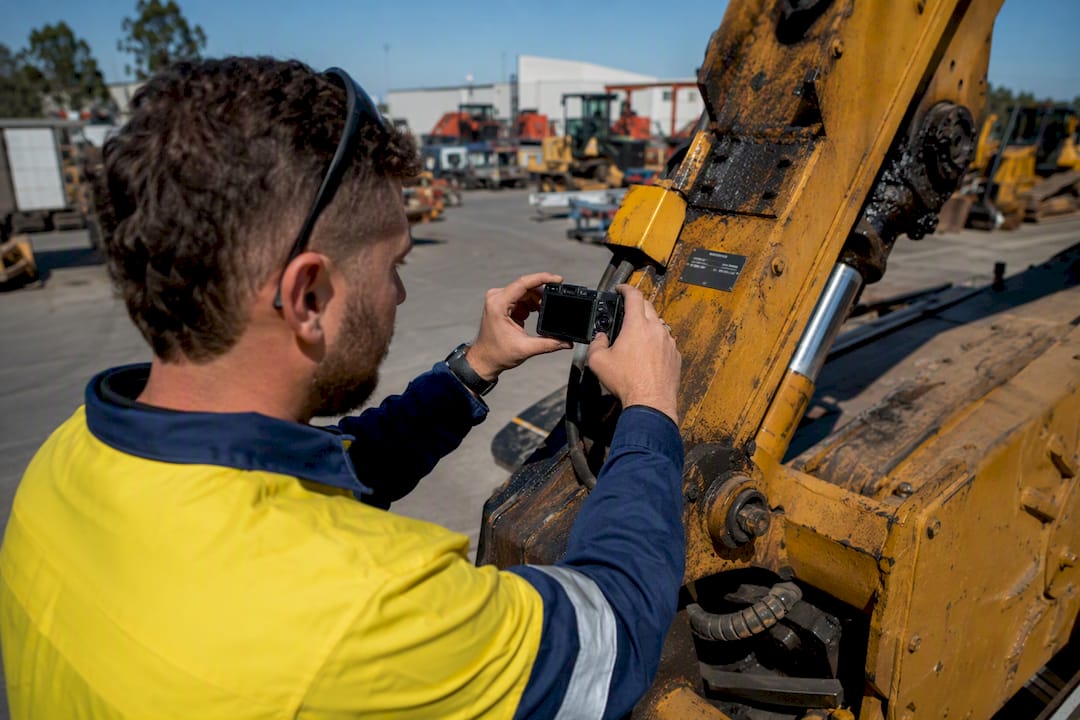
A Repeatable Trade-In Appraisal Process for Equipment Dealers
A trade-in appraisal process is the sequence your team runs from customer intake to a documented offer: walk-around, history check, mechanical inspection, market comparison, reconditioning estimate, manager sign-off, and customer presentation. When it’s built into your dealer management system, that sequence should take 15 to 30 minutes, produce 20 to 40 timestamped photos per unit, and feed inventory targeted at a 30 to 60 day turnover.
The goal is not speed for its own sake. It’s consistency. Two appraisers looking at the same excavator should land on close to the same number, with a paper trail that explains why.
- Appraisal time target: 15 to 30 minutes per unit
- Photo standard: 20 to 40 images, standardized views
- Turnover goal: 30 to 60 days from intake to sale
- Recommended tool: a DMS platform like ModernDMS that ties appraisal data directly to inventory and recon workflows
Key Takeaways
A repeatable, DMS-backed trade-in appraisal process turns a walk-around into a defensible offer within 15 to 30 minutes while protecting margin through upfront reconditioning estimates.
| Point | Details |
|---|---|
| Follow the fixed sequence | Run intake, walk-around, history check, inspection, valuation, recon estimate, sign-off, and presentation in that order every time. |
| Capture 20 to 40 photos | Standardize views (hero, corners, tires, engine hours, serial plate) and enforce timestamp and appraiser ID metadata. |
| Estimate recon before pricing | Subtract a conservative reconditioning reserve from market value before presenting an offer. |
| Require manager sign-off | Use a two-person approval model to catch pricing drift and confirm documentation is complete. |
| Connect appraisal to your DMS | ModernDMS routes appraisal data into inventory, recon work orders, and Xero, cutting appraisal time toward the 15 to 30 minute target. |
Table of Contents
- What Are the Steps in a Trade-In Appraisal Process?
- How Many Photos Should a Trade-In Appraisal Include?
- How Do You Price a Trade-In Using Market Data?
- Why Recon Estimates Belong in the Appraisal, Not After
- Who Should Sign Off on a Trade-In Value?
- How Does DMS Software Speed Up Trade-In Appraisals?
- How Do You Roll Out a New Appraisal Process in Six Weeks?
- What Actually Breaks When Dealers Skip Standardization
- See the Trade-In Workflow Running in Your Own DMS
- Sources
- FAQ
What Are the Steps in a Trade-In Appraisal Process?
A defensible appraisal follows the same order every time, regardless of who’s running it. That’s what makes it auditable when a customer or a lender questions the number later.
- Customer intake. Capture contact details, serial or VIN number, hours or mileage, and any defects the owner discloses upfront. Ask directly: “Has this unit ever been in an incident or had a lien against it?” Skipping this step is where most disputes start.
- Walk-around and photo trigger. The moment the unit is on your lot, the checklist should force photo capture before anything else happens.
- History check. Pull service records, warranty status, and any liens or title flags. A unit with an open lien changes the entire deal structure, not just the price.
- Mechanical inspection. Run a quick but standardized check: fluid levels, hour meter accuracy, hydraulic function, undercarriage wear, brake response. Flag anything that looks like deferred maintenance immediately.
- Market valuation. Compare against live auction results and recent retail comps for similar hours and configuration.
- Reconditioning estimate. Price out what it will cost to bring the unit to sellable condition before you commit to a number.
- Preliminary offer and communication. Record the number in the system right away and tell the customer what happens next, even if the final figure needs manager approval.
Some fields matter more than others. Serial numbers prevent duplicate trade-ins from slipping through. Stated defects protect you if a customer later claims they disclosed something nobody wrote down. Hour readings, cross-checked against service history, catch meter rollback or tampering before it becomes your problem.
- Require photo documentation before any verbal number is given
- Flag lien or title issues before proceeding to valuation
- Note discrepancies between stated hours and service records immediately
- Log the preliminary offer in the system, not on a sticky note
How Many Photos Should a Trade-In Appraisal Include?
Twenty to 40 photos per unit is the standard training benchmark for consistent, transparent appraisals, and it’s not an arbitrary number. It’s enough to cover every angle a buyer, a manager, or a dispute resolution conversation might need.
Required views typically include:
- Hero shot (front three-quarter angle)
- All four corners and full side profiles
- Tires or tracks, close up, showing tread wear
- Engine bay and hour meter reading, legible and unedited
- Serial or VIN plate, close enough to read every character
- Any damage, wear, or aftermarket modification, individually photographed
Enforce checklist completion by making the system block progress to the valuation stage until every required field and photo is logged. Attach a timestamp and appraiser ID to every entry automatically. This single habit protects your dealership more than any verbal policy ever will.
Condition coding (green for ready to list, yellow for minor recon, red for significant work) gives service teams instant context without a phone call. That code and its supporting photos should travel with the unit into service and eventually into the listing, so nothing gets re-explained twice.
Pro Tip: Photograph the hour meter and the serial plate in the same frame when possible. It closes the gap between “what was appraised” and “what actually showed up on the lot” in one shot.
How Do You Price a Trade-In Using Market Data?
Anchor every offer to live data, not gut feel. Pull from recent auction results, retail comps for similar configurations, and your own local days-to-sell history before you write a number down.
Select comparables that match on hours, condition, and options, then record the adjustments you make. If the comp had 1,200 fewer hours or came with a cab upgrade yours lacks, note the dollar adjustment and why. That record is what makes your offer defensible when a customer pushes back or a manager questions the math.
The formula itself is straightforward: market value minus your margin target minus the reconditioning estimate equals the trade-in offer. Skip the recon subtraction and you’ll find out the hard way when the unit sits in the shop three weeks longer than planned.
- Pull auction results and retail comps from the same equipment category and region
- Adjust for hours, condition, and options, and write down each adjustment
- Subtract margin target and recon estimate before presenting a number
- Recheck comps if the unit sits unsold past 30 days
Pricing discipline connects directly to turnover. Dealers using real-time inventory and market data can cut days-on-lot by 20 to 50 percent and lift front-end margins by 1 to 2 percent compared to appraisers pricing from memory or outdated guides.
Why Recon Estimates Belong in the Appraisal, Not After
Skip the reconditioning estimate at appraisal time and you’re setting up a surprise for whoever processes the unit next. A trade-in that looked clean on the lot can hide a $300 to $800 repair once a technician actually opens it up.
Break recon into three priority categories:
- Safety and driveability. Brakes, hydraulics, steering. These get fixed regardless of listing price.
- Mechanical. Fluid leaks, worn components, anything affecting function but not immediate safety.
- Cosmetic. Paint, decals, minor dents. Lowest priority, easiest to defer.
Set a conservative recon reserve during appraisal and log it against the unit record, not in a separate spreadsheet. When your DMS is integrated, that reserve should automatically generate a draft work order the moment the appraisal is approved, so the workshop isn’t waiting on a phone call to start planning parts and labor.
Who Should Sign Off on a Trade-In Value?
Every appraisal needs a second set of eyes before the offer goes final. A two-person model, appraiser plus manager, catches pricing drift before it becomes a pattern.
The manager’s checklist should confirm:
- Market comps are recorded and adjustments make sense
- Reconditioning estimate is realistic, not optimistic
- The offer meets your dealership’s margin target
- Photo and checklist documentation is complete
Escalate to a senior manager or owner for high-value units or anything with a recon estimate exceeding a set dollar threshold. That threshold should be defined once, in writing, so it doesn’t become a judgment call every time.
Record every approval in the DMS with a timestamp and manager ID, the same way you document the appraisal itself. Set a target approval turnaround, ideally under an hour, so customers aren’t left waiting while paperwork sits in someone’s inbox.

How Does DMS Software Speed Up Trade-In Appraisals?
The features that actually matter here are specific: mobile capture that works offline, automatic VIN or serial decode, checklist enforcement that blocks incomplete entries, a built-in approvals workflow, automated recon work-order generation, real-time inventory status changes, and marketplace syndication once the unit is ready to list.
Integrated appraisal data is what gets you from the industry’s typical 45 to 90 minute manual process down to the 15 to 30 minute target, mainly by eliminating transcription. When an appraiser doesn’t have to retype the same VIN, hours, and photos into three different systems, errors drop and speed goes up together.
ModernDMS is built around this exact handoff. Appraisal records feed directly into inventory management, recon routes straight to the workshop, and finance data syncs with Xero without a manual export step. Dealers running it report setup in under an hour and administrative time savings of up to 10 hours per week.
- Ask for a live VIN or serial decode demonstration, not a slide about it
- Confirm checklist enforcement actually blocks progress on missing fields
- Watch how a recon estimate becomes a work order, and how long that takes
- Check whether inventory status updates automatically or needs manual re-entry
Pro Tip: During any demo, hand the sales rep a real serial number from your own lot and ask them to run the full appraisal live. Canned demos hide the friction points that matter.
How Do You Roll Out a New Appraisal Process in Six Weeks?
Standardizing an appraisal workflow doesn’t require a system-wide overhaul on day one. A staged rollout gets your team using it correctly before you add complexity.
- Days 0 to 7. Standardize the intake form and photo checklist, train appraisers on the sequence, and set the 15 to 30 minute appraisal time target as the team’s baseline.
- Week 2. Turn on market-data lookups and define manager-approval thresholds by unit value and recon estimate.
- Weeks 3 to 6. Connect appraisal completion to automatic recon work-order creation and inventory listing, and set alerts for units approaching 60 days on lot.
Track four numbers from week one: average appraisal time, photos captured per unit, days-on-lot, and recon actual cost against the estimate you logged at appraisal. That last figure tells you fastest whether your team is estimating conservatively or guessing.
What Actually Breaks When Dealers Skip Standardization
Dealerships that standardize this workflow generally see the same pattern: appraisal time drops, disputes over condition or pricing fall off, and units list faster because the photos and paperwork are already done by the time the deal closes.
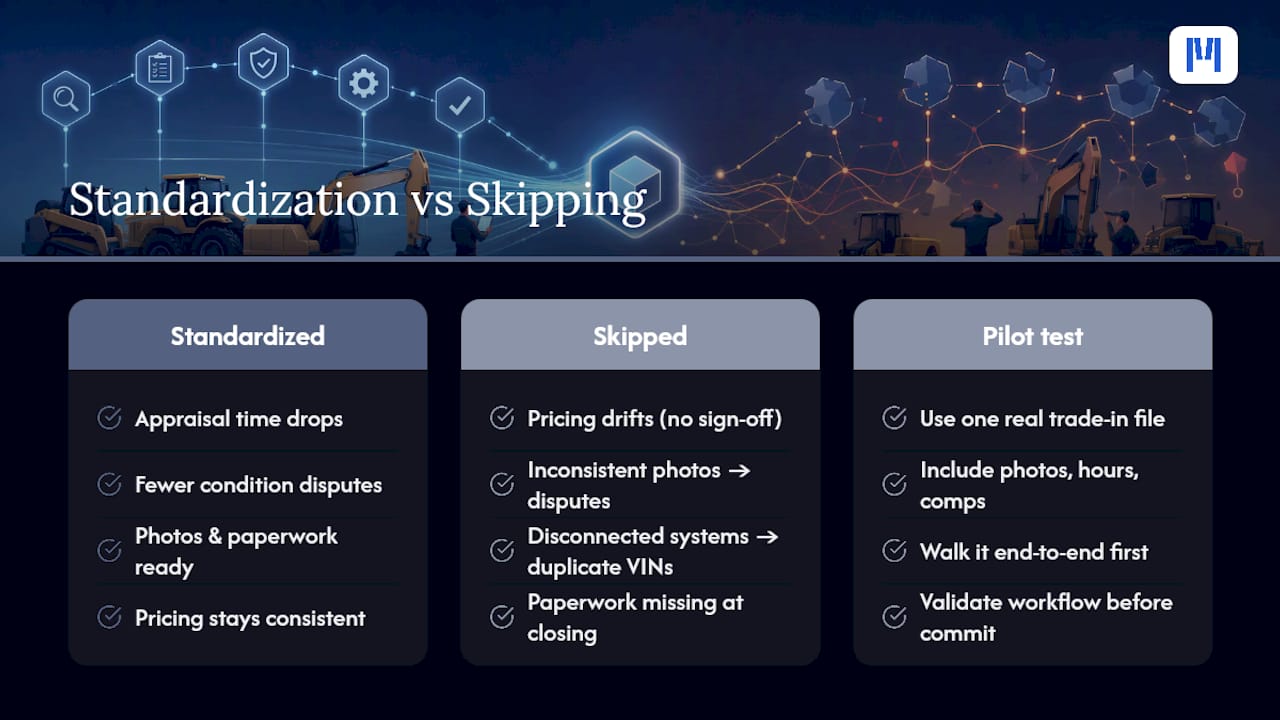
The pitfalls are just as consistent. No manager sign-off lets pricing drift between appraisers until nobody trusts the numbers. Inconsistent photos turn every dispute into a “he said, she said.” And disconnected systems mean someone is retyping the same VIN three times before a unit ever reaches the shop floor.
If you’re evaluating a pilot, bring one real trade-in file, photos, hours, and comps included, and walk it through end to end before you commit to anything.
— ModernDMS
See the Trade-In Workflow Running in Your Own DMS
If you’ve been running appraisals across a paper checklist, a separate photo app, and a spreadsheet for comps, the fix isn’t more training. It’s one system where intake, photos, comps, recon, and approval all live in the same record. ModernDMS maps directly onto the workflow covered here: mobile capture for the walk-around, enforced checklists so nothing gets skipped, a built-in approvals step, automatic recon work-order routing, and inventory syndication once a unit is ready to list.

Setup runs under an hour, and dealers using the platform report saving up to 10 hours a week on administrative work that used to mean re-entering the same data across disconnected tools. It also connects to Xero, so recon costs and margins flow straight into your books without a manual export.
Request a demo through the equipment dealer software page and bring one real trade-in file with you. Walk it through intake to offer and see exactly where the current process is losing you time.
Sources
- AURSCA010 — inspection and appraisal training (extract)
- Ken Research — Australia used vehicle and auto finance market (industry insight)
- Ready Hub — The Trade-In Appraisal Process: Turn Trades to Profit (2026)
- Workshop HQ — automotive repair transparency standard (Australia)
FAQ
What Is a Trade-In Appraisal Process?
It’s the standardized sequence a dealership follows to evaluate a used unit: intake, walk-around and photo documentation, history check, mechanical inspection, market valuation, reconditioning estimate, manager approval, and final offer.
How Long Should a Trade-In Appraisal Take?
A software-supported appraisal should take 15 to 30 minutes, compared to 45 to 90 minutes for a manual, paper-based process.
How Many Photos Does a Trade-In Appraisal Need?
Most dealerships capture 20 to 40 photos per unit, covering the hero angle, all corners, tires, engine hours, and the serial plate.
Why Should Reconditioning Costs Be Estimated at Appraisal?
Estimating recon during appraisal, rather than after the deal closes, prevents surprise repair costs and protects the net margin on the unit.
Can DMS Software Handle the Entire Appraisal Workflow?
Yes. A platform like ModernDMS supports mobile photo capture, checklist enforcement, manager approvals, automated recon work-order creation, and inventory syndication in one connected system.
What Turnover Target Should Dealers Aim For?
Dealers should target 30 to 60 days from intake to sale, a benchmark that real-time inventory data and disciplined pricing can help you hit consistently.